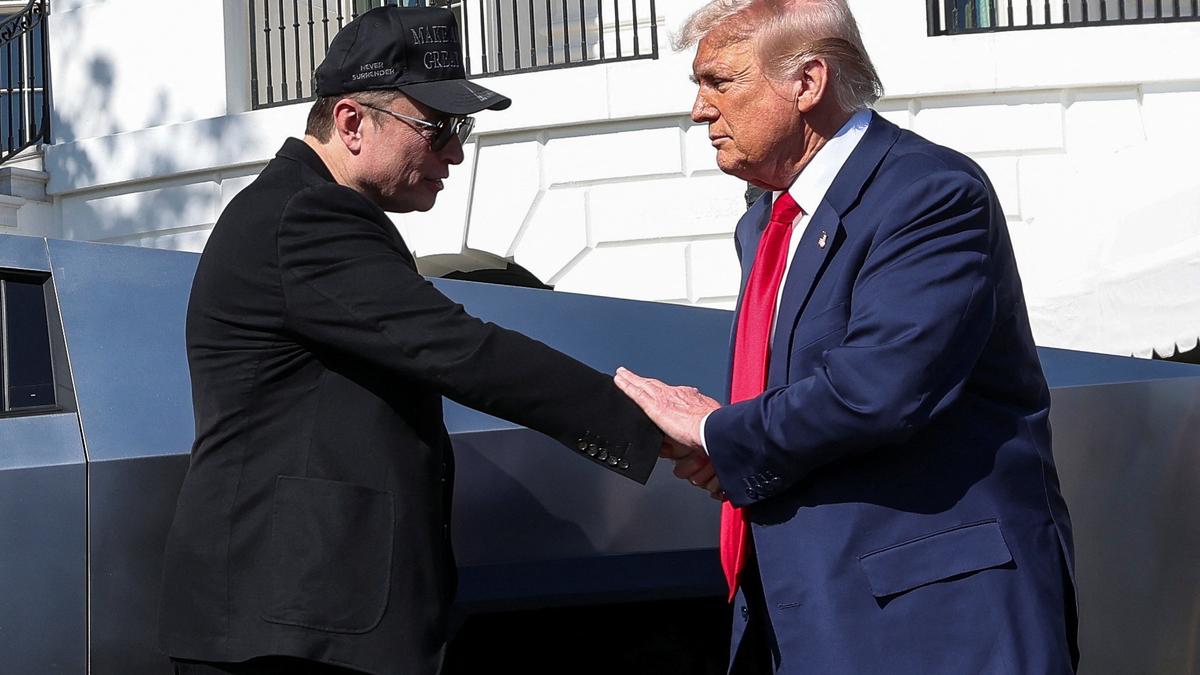
Will Musk be expelled from the Royal Society? | Explained
The Hindu
Royal Society faces crisis over Elon Musk's conduct, sparking debate among members and wider scientific community.
The story so far: The 365-year-old Royal Society in Britain, one of the most reputed scientific institutions in the world, is experiencing a crisis that raises fundamental concerns about the role of a top scientific institution. The Royal Society’s former members include notable figures like Isaac Newton, Charles Darwin, Albert Einstein, and Stephen Hawking, among others. Becoming a member of the Royal Society is frequently regarded as the culmination of an extensive research career, and fellows are chosen after a rigorous process. The Royal Society also imposes a code of conduct on its fellows once they are elected. Of late, there has been a growing demand to rescind Elon Musk’s fellowship for violating the code.
In 1775, the German scientist and writer Rudolf Erich Raspe was expelled from the Royal Society after being accused of “divers frauds and gross breaches of trust”. Today, the actions of the world’s richest man has been deemed a “threat to science” by numerous scientists.
The first fellow of the Royal Society to resign over this matter was Dorothy Bishop, emeritus professor of developmental neuropsychology at the University of Oxford. In 2024, she lodged two complaints with the Royal Society. “On both occasions they consulted lawyers, and it may well be the case that the lawyers are concerned about the prospect of legal action,” she told the BBC. Another fellow, Andrew Millar of the University of Edinburgh, did the same in February this year.
An open letter to the president of the Royal Society, currently British statistician Adrian Smith, has been signed by almost 3,500 members of the wider scientific community. Stephen Curry, an emeritus professor of structural biology at Imperial College London, penned it and expressed similar dismay. Fellow of the Royal Society, AI pioneer, and 2024 physics Nobel Prize winner Geoffrey Hinton also wrote on X that he was in favour of Mr. Musk’s removal. “I think Elon Musk should be expelled from the British Royal Society. Not because he peddles conspiracy theories and makes Nazi salutes, but because of the huge damage he is doing to scientific institutions in the US,” Mr. Hinton wrote. Mr. Musk replied: “Only craven, insecure fools care about awards and memberships”.
Many fellows believe the billionaire’s inflammatory remarks on British politicians have breached the Royal Society’s code of conduct. Scientists have also expressed concerns regarding Mr. Musk’s conduct within the current Donald Trump administration. In his leading position at the U.S. Department of Government Efficiency (or DOGE), Mr. Musk has overseen unprecedented cuts to funding meant for scientific research. He has also been spreading false material and engaging in political propaganda on his social media platform, X. His company Neuralink recently reported developing a novel brain-computer interface. Although this is a worthwhile objective, the research methodology is distinguished by Mr. Musk’s resistance to allowing others to influence his methods. This has resulted in allegations of non-compliance with ‘Good Laboratory Practice’ regulations. Additionally, Mr. Musk’s slanderous charges against public scientists like Anthony Fauci and other public personae have also drawn criticism from a number of scientists. Mr. Musk is also accused of encouraging vaccine hesitancy and baselessly doubting the foundations of climate change science.
The Royal Society counts more than 1,700 fellows, and at least 60 of them have signed Mr. Curry’s letter to have Mr. Musk expelled. But not everyone in the scientific community agrees with it. For instance, Nobel laureate Andre Geim of Manchester University stated, “Musk is certainly an eccentric, but his achievements beat those of any of his critics in the Royal Society. Very few can say that they achieved similar [feats] in their lives.” According to the Society, Mr. Musk was elected in 2018 ostensibly in appreciation of his contributions. He was the lead designer at SpaceX, where he oversaw the development of reusable rockets and spacecraft for missions to earth orbit. He oversaw the design, engineering, and manufacturing of products for the electric car company Tesla, which first popularised EVs. He also developed ultra-high bandwidth brain-machine interfaces to connect the brain to computers at Neuralink.
It might be politically challenging to revoke Mr. Musk’s fellowship at a time of increasing tensions between the U.S. and the U.K. Some have claimed that removing Mr. Musk could undermine public confidence in science as it would erode the integrity of science by obfuscating its separation from politics.


Explore 2026's wallpaper trends in India, highlighting botanicals and handmade designs that enhance modern homes with nature-inspired aesthetics.

Mercedes-Benz CLA 250+ with EQ Technology review: design, performance, range and features explained. Discover how the new electric CLA combines advanced AI, long range, fast charging and futuristic styling for the next generation of luxury EVs.

AI tool for sparrow conservation

BTS’s comeback with ‘Arirang’ marks a major global music event. When does the album release, and where can you watch their concert live stream? We have all the details

The 2026 U.S. cholesterol guidelines urge starting screening and treatment at 30 to prevent cardiovascular disease effectively.

Olam Festival 2026 in Thiruvananthapuram returns March 27-29 with 120+ vendors, music, art, and cultural zones.

A few storytellers in Thiruvananthapuram share their journeys, challenges, and evolving methods on World Storytelling Day, inspiring young minds.

76-year-old Kurian Jacob from Kerala triumphs with seven medals, including five golds, at the Open Masters Games in Abu Dhabi.

Explore the nature of the human mind as an emergent property of brain activity and complex neural interactions.

CERN's Large Hadron Collider discovers the Xi-cc-plus particle, enhancing understanding of quantum mechanics and baryon behavior.

Vibha Batra’s latest book, Spotless (Hachette India) is a novel in verse for young adults

In its first edition, the Madras Art Salon spotlights the works of journalist and artist Narayan Lakshman at The Botanical Club, a social space in the British Deputy High Commission, Chennai

Cholesterol enhances melanoma cell invasion by making nuclei squishier, revealing a potential treatment target in cancer progression.