Will China’s new ethnic unity law hasten the erosion of minority cultures?
The Straits Times
The law gives legal basis to President Xi's agenda to assimilate minorities into a national identity. Read more at straitstimes.com.
BEIJING – China’s passage of a landmark national law on ethnic minority relations puts a legal stamp on President Xi Jinping’s agenda to assimilate minorities into a national identity that has accelerated in recent years.
It gives legal backing to existing practices, such as a requirement for pre-schoolers to learn Mandarin, and for students to be proficient in the language at the end of nine years of compulsory education, at age 15.
The law stresses “interaction, exchange and integration” between ethnic groups, such as through employment, tourism and study tours.
Since coming to power in 2012, Mr Xi has emphasised that ethnic identities must be subordinate to a national Chinese identity, and to the leadership of the Communist Party of China (CPC).
But the law is unlikely to lead to a faster pace of erosion of minority cultures, insofar as it means existing policies will continue.
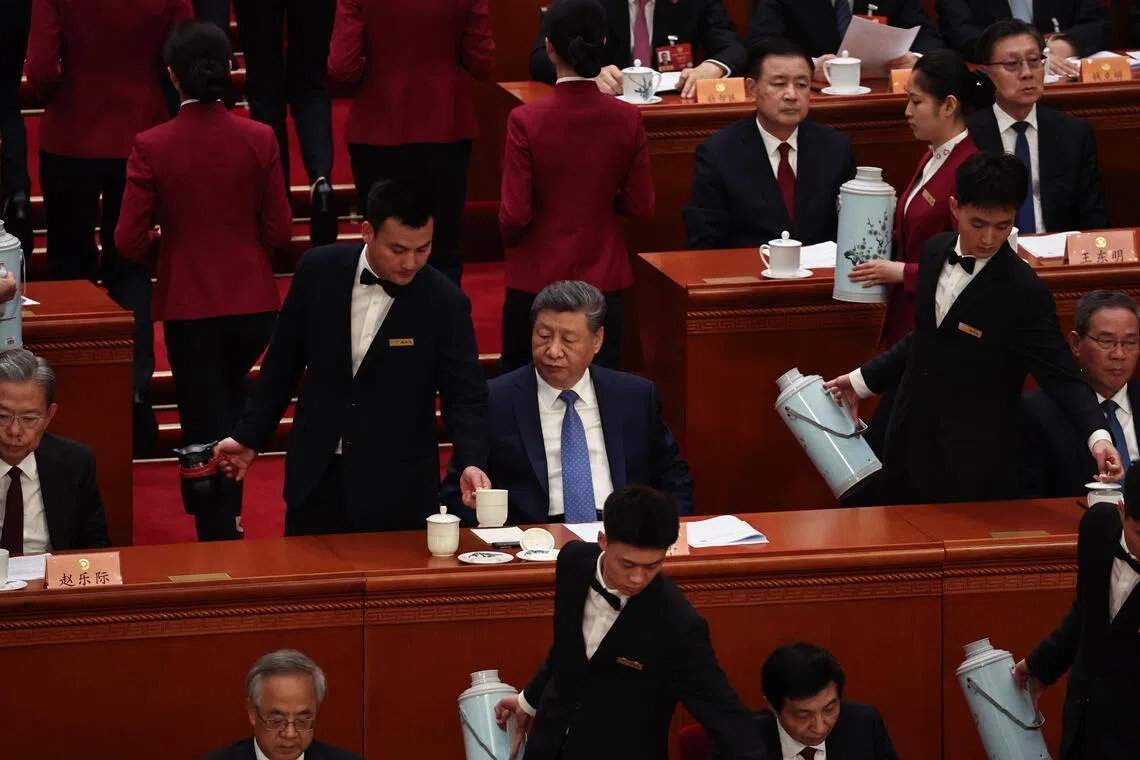
The Law on Promoting Ethnic Unity and Progress was passed on March 12 at the annual meetings of the National People’s Congress, China’s national Parliament, in Beijing.


The EU recently struck trade accords with India and a bloc of South American countries. Read more at straitstimes.com.

Mr Dan Caldwell was a former top adviser to US Defense Secretary Pete Hegseth. Read more at straitstimes.com.

They allegedly shared images and videos of school shootings in other countries with one another. Read more at straitstimes.com.

CHISINAU, March 16 - A Russian attack on a hydroelectric plant in southern Ukraine triggered an oil spill and polluted water systems in neighbouring Moldova, with supplies cut completely in the country's second-largest city, officials said on Monday. Read more at straitstimes.com.
MOSCOW, March 16 - Russian air defence units downed at least 67 Ukrainian drones headed for Moscow on Monday, according to data published by the city's mayor, Sergei Sobyanin. Read more at straitstimes.com.

MOSCOW, March 16 - Russia has taken control of 12 settlements in Ukraine in the first two weeks of March as part of advances along the front line in eastern and southern Ukraine, Russian state-run news agencies quoted top general Valery Gerasimov as saying on Monday. Read more at straitstimes.com.

The eastern half of the US, including New York, Chicago and Atlanta, has been hit with widespread air travel delays and cancellations. Read more at straitstimes.com.

It could lead to a protracted conflict with devastating humanitarian consequences, the leaders said in a joint statement. Read more at straitstimes.com.

Bhumika Shrestha on March 16 became Nepal’s first transgender woman lawmaker. Read more at straitstimes.com.

It would serve as a way to formalise the kinds of things the US should be importing from and exporting to China. Read more at straitstimes.com.

BBC argued that Donald Trump's subsequent re-election showed it did not harm his reputation. Read more at straitstimes.com.

Upgrades include better active noise cancellation and an improved microphone system. Read more at straitstimes.com.

Some 350 oil tankers, some loaded and some empty, are currently stranded in the area. Read more at straitstimes.com.