Indonesia weighs response to price pressures from Middle East war
The Straits Times
It could cut fuel subsidies or slash spending on the President's signature school meals programme. Read more at straitstimes.com.
JAKARTA – Price pressures fuelled by the Middle East war may push Indonesia’s government to reconsider its dogged defence of energy subsidies and a costly meals scheme close to the heart of President Prabowo Subianto, analysts say.
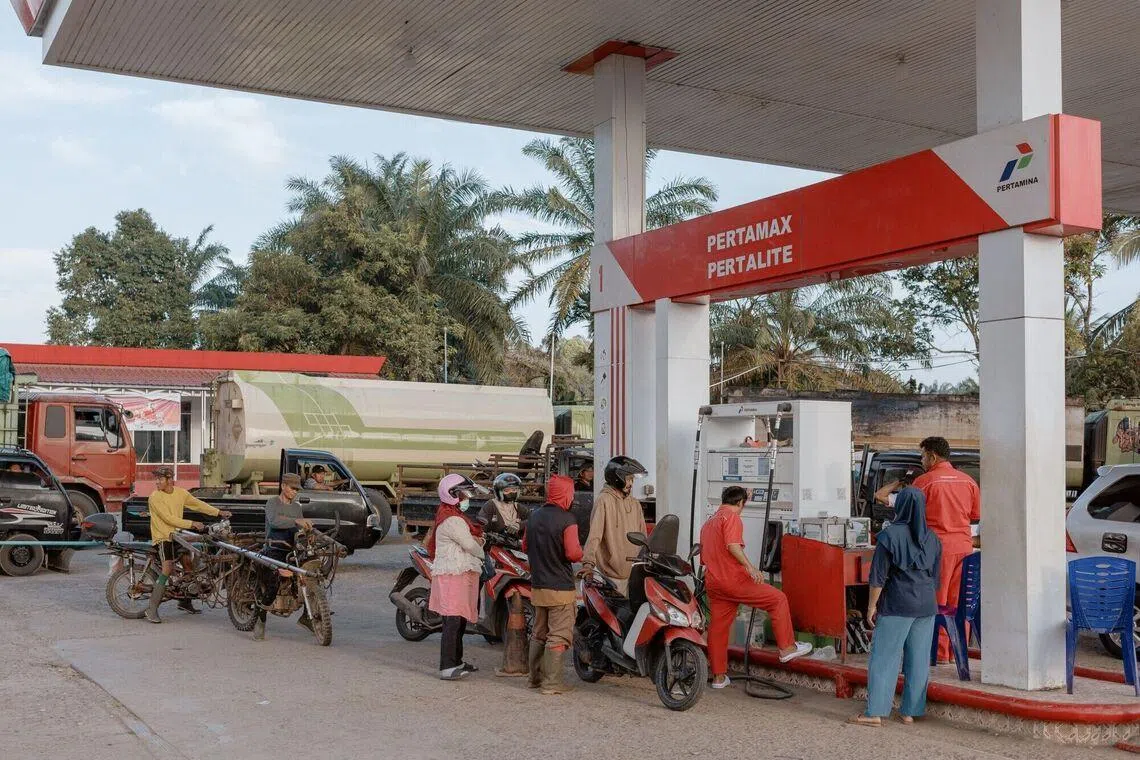
Unlike many of its neighbours, South-east Asia’s biggest economy has not seen long fuel queues as global oil prices have soared, nor have its citizens been subjected to pandemic-style work-from-home measures.
But that may change.
As Mr Prabowo seeks to raise the economic growth rate from 5.1 per cent in 2025 to 8 per cent by 2029, powered by high public spending, Jakarta has limited options for offsetting the impact of rising oil prices, according to experts.
It can either cut fuel subsidies and risk political upheaval, slash spending on Mr Prabowo’s signature school meals programme, or overshoot the fiscal deficit that is capped by law at 3 per cent of GDP.
“We are already in a critical situation”, with fuel and natural gas supplies at about three weeks’ worth – the maximum storage capacity – and a dearth of new suppliers to offset the Middle East blockage, said Dr Yose Rizal Damuri, executive director of Indonesia’s Centre for Strategic and International Studies.


It will also deliberate on the implementation of a five-year national policy plan. Read more at straitstimes.com.

Financial commitments, such as repayment of credit cards, eat into the bulk of their monthly budget. Read more at straitstimes.com.

The conflict exposes the city to many risks, but some are seeing opportunities too. Read more at straitstimes.com.

The 'unprecedented' freeze on trillions of dollars in financial assistance was instituted in early 2025. Read more at straitstimes.com.

The EU recently struck trade accords with India and a bloc of South American countries. Read more at straitstimes.com.

Mr Dan Caldwell was a former top adviser to US Defense Secretary Pete Hegseth. Read more at straitstimes.com.

They allegedly shared images and videos of school shootings in other countries with one another. Read more at straitstimes.com.

CHISINAU, March 16 - A Russian attack on a hydroelectric plant in southern Ukraine triggered an oil spill and polluted water systems in neighbouring Moldova, with supplies cut completely in the country's second-largest city, officials said on Monday. Read more at straitstimes.com.
MOSCOW, March 16 - Russian air defence units downed at least 67 Ukrainian drones headed for Moscow on Monday, according to data published by the city's mayor, Sergei Sobyanin. Read more at straitstimes.com.

MOSCOW, March 16 - Russia has taken control of 12 settlements in Ukraine in the first two weeks of March as part of advances along the front line in eastern and southern Ukraine, Russian state-run news agencies quoted top general Valery Gerasimov as saying on Monday. Read more at straitstimes.com.

The eastern half of the US, including New York, Chicago and Atlanta, has been hit with widespread air travel delays and cancellations. Read more at straitstimes.com.

It could lead to a protracted conflict with devastating humanitarian consequences, the leaders said in a joint statement. Read more at straitstimes.com.

Bhumika Shrestha on March 16 became Nepal’s first transgender woman lawmaker. Read more at straitstimes.com.