Primary Country (Mandatory)

Other Country (Optional)

Set News Language for United States

Primary Language (Mandatory)
Other Language[s] (Optional)
No other language available

Set News Language for World

Primary Language (Mandatory)
Other Language(s) (Optional)

Set News Source for United States

Primary Source (Mandatory)
Other Source[s] (Optional)

Set News Source for World

Primary Source (Mandatory)
Other Source(s) (Optional)
  • Countries
    • India
    • United States
    • Qatar
    • Germany
    • China
    • Canada
    • World
  • Categories
    • National
    • International
    • Business
    • Entertainment
    • Sports
    • Special
    • All Categories
  • Available Languages for United States
    • English
  • All Languages
    • English
    • Hindi
    • Arabic
    • German
    • Chinese
    • French
  • Sources
    • India
      • AajTak
      • NDTV India
      • The Hindu
      • India Today
      • Zee News
      • NDTV
      • BBC
      • The Wire
      • News18
      • News 24
      • The Quint
      • ABP News
      • Zee News
      • News 24
    • United States
      • CNN
      • Fox News
      • Al Jazeera
      • CBSN
      • NY Post
      • Voice of America
      • The New York Times
      • HuffPost
      • ABC News
      • Newsy
    • Qatar
      • Al Jazeera
      • Al Arab
      • The Peninsula
      • Gulf Times
      • Al Sharq
      • Qatar Tribune
      • Al Raya
      • Lusail
    • Germany
      • DW
      • ZDF
      • ProSieben
      • RTL
      • n-tv
      • Die Welt
      • Süddeutsche Zeitung
      • Frankfurter Rundschau
    • China
      • China Daily
      • BBC
      • The New York Times
      • Voice of America
      • Beijing Daily
      • The Epoch Times
      • Ta Kung Pao
      • Xinmin Evening News
    • Canada
      • CBC
      • Radio-Canada
      • CTV
      • TVA Nouvelles
      • Le Journal de Montréal
      • Global News
      • BNN Bloomberg
      • Métro
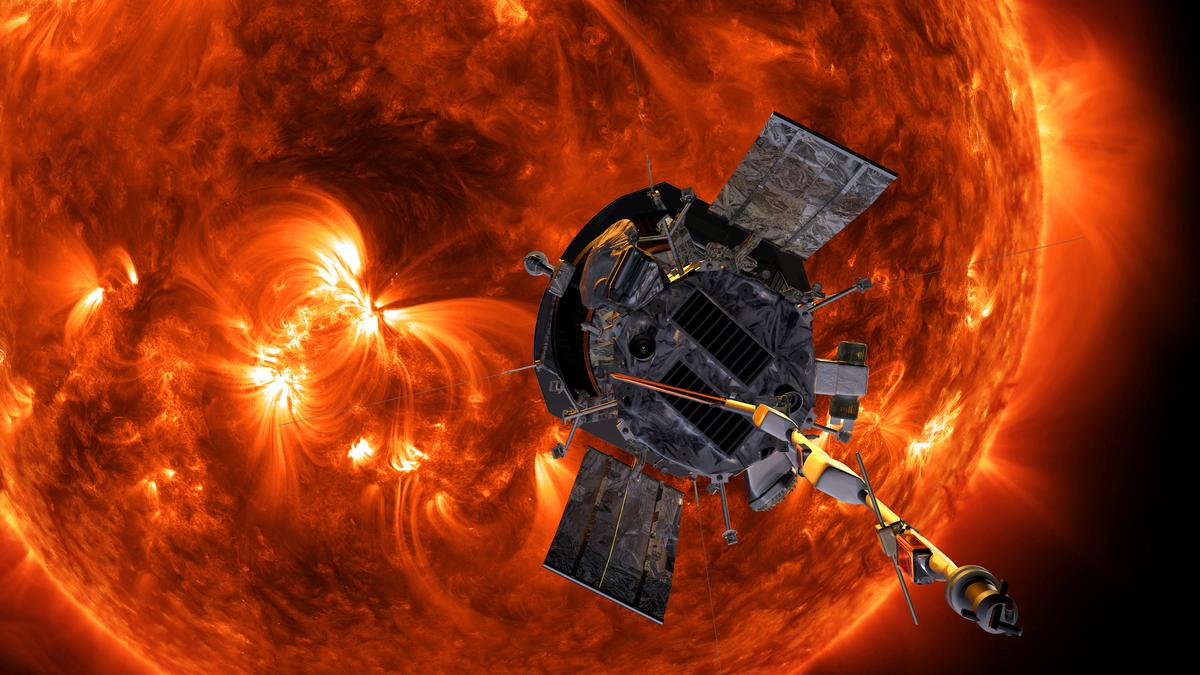
Why is the Parker Solar Probe trying to ‘touch’ the sun?
Premium

Why is the Parker Solar Probe trying to ‘touch’ the sun? Premium

The Hindu
Tuesday, March 25, 2025 04:20:54 AM UTC

NASA's Parker Solar Probe explores the sun's mysteries, revealing new insights into solar phenomena and the solar wind.

Among the various places humans have aspired to visit in the solar system, the sun remains the most foreboding. On December 24, 2024, NASA’s Parker Solar Probe arrived within 6.1 million km from the star’s surface. This is a short distance to be from the sun: no spacecraft has ever made such a close approach. Even the Parker Solar Probe took seven years to get here.

The probe made another approach to the sun on March 22 and will do so again on June 19 this year.

Sunlight is the main source of energy for earthlife. The sun’s core produces this energy using nuclear fusion. The star also has strong, dynamic magnetic fields crisscrossing its surface, and sudden changes in the way they’re arranged give rise to intense explosions called solar flares. Numerous electrons, protons, and heavy nuclei are spit out of the solar corona — the uppermost layer of the sun’s atmosphere — at about 900 km/s.

These particles carry an enormous amount of energy and sometimes rush towards the earth at tremendous speed in an event called a coronal mass ejection. Their effects on the earth constitute a solar storm, including electric grid failures, loss of telecommunication channels, and damage to the ozone layer. They can also damage instruments onboard satellites.

To understand the dynamics of the corona over time and their effects on the solar system at large, scientists need to observe the sun closely. This is also why the Indian Space Research Organisation launched and is currently operating the Aditya-L1 probe, stationed at about 150 million km from the star.

Around six decades ago, a scientist named Eugene Parker predicted the existence of the solar wind: a stream of charged particles flowing out from the sun in all directions. NASA named the Parker Solar Probe in his honour.

The probe was launched on board a Delta IV rocket from Cape Canaveral in Florida in August 2018. Once in space, the probe’s maximum speed was an astounding 692,000 km/hr.

Read full story on The Hindu
Share this story on:-
More Related News
Africa study catches ‘high-flying’ mosquitoes spreading pathogens Premium

Researchers discovered high-flying mosquitoes carry pathogens, revealing new transmission routes for diseases like malaria and dengue in Africa.

Science quiz: Giants on whose shoulders Newton stood Premium

Test your knowledge of the influential figures in physics who paved the way for Newton's groundbreaking discoveries.

Discover Chennai’s unique Christmas celebrations: Traditions and festivities

Forget what Christmas is supposed to look like. In Chennai, it smells of the sea, plum cake and hot chocolate. Here are 12 ways the city keeps the season merry

Why do we get goosebumps? Premium

Discover the science behind goosebumps, their causes, and their vestigial role in human biology.

Why does yawning cause watery eyes? Premium

Discover why yawning leads to watery eyes, exploring the role of facial muscles and lacrimal glands in tear production.

Countdown for launch of ISRO’s Bluebird Block-2 Mission begins in Sriharikota

Countdown begins for ISRO's Bluebird Block-2 mission, launching a record-breaking communication satellite from Sriharikota on December 24, 2025.

How are we protecting astronauts from deadly space debris?

Learn how astronauts are safeguarded from hazardous space debris through innovative engineering and international collaboration.

National Mathematics Day and the double life of Jantar Mantar Premium

Explore the dual significance of Jantar Mantar as both a mathematical observatory and a designated protest site in Delhi.

Why do students fear math? | National Mathematics Day

Explore the roots of math anxiety in students and discover strategies to foster confidence and understanding in mathematics.

NASA loses contact with MAVEN, which reached Mars with Mangalyaan Premium

NASA loses contact with MAVEN, its Mars orbiter studying the planet's atmosphere, after a decade of successful operations.

ISRO’s LVM3 to launch next-generation communication satellite on Dec. 24

ISRO's LVM3 will launch the BlueBird Block-2 satellite on December 24, providing global high-speed cellular broadband directly to smartphones.

Will new Act aid India’s nuclear development? | Explained Premium

Explore the SHANTI Act's implications for India's nuclear development, replacing outdated laws and targeting significant capacity growth.

Drogue parachute deployment tests for Gaganyaan mission successful: ISRO

ISRO successfully completed drogue parachute deployment tests for the Gaganyaan mission, advancing safety for human spaceflight.

Microbe might spark first stages of ulcerative colitis: new study Premium

A new study reveals how gut bacteria may initiate ulcerative colitis by weakening immune defenses before inflammation occurs.

A twist in the tale: are scientists wrong about dark energy? Premium

A new study questions dark energy's role in the universe's acceleration, suggesting it may be weakening instead.

DRDO successfully tests 120-km strike range Pinaka rockets

DRDO successfully tests the 120-km range Pinaka rocket, enhancing India's indigenous rocket artillery capabilities and operational readiness.

What is Theremin?

Discover the fascinating world of the theremin, an enchanting electronic instrument played without touch, invented by Leon Theremin.

Aravalli question faces the brunt of India’s fondness for ‘strategic exemptions’ Premium

Explore India's strategic exemptions impacting the Aravalli Hills, balancing mineral mining needs against environmental protections and public scrutiny.

What is a frequency comb? Premium

Discover how frequency combs, specialized lasers with evenly spaced frequencies, enable precise light frequency comparison and scientific measurements.

‘I don’t believe in erasing history’, says Meneesha Kellay, youngest trustee at the British Museum

Meneesha Kellay, the youngest British Museum trustee, aims to transform cultural spaces through collaboration and inclusivity.

Even low alcohol intake raises oral cancer risk in Indian men: study

A study reveals even low alcohol intake significantly raises oral cancer risk in Indian men, challenging safe consumption perceptions.

Batik workshops to the world’s first arrack-speciality bar — a lowdown on lesser-known destinations of Sri Lanka

Skip the touristy spots, explore Sri Lanka’s local and cultural scene — take notes from a fashion designer, wildlife photographer and luxury travel specialist

The anti-trend shift transforming India’s New Year party dressing

The anti-trend shift transforming India’s New Year’s party dressing

What is jet lag?

Discover the causes, effects, and solutions to jet lag when traveling across multiple time zones.

What are rare-earth elements and why is everyone looking for them? | Explained Premium

Discover the significance of rare-earth elements, their applications in technology, and the global race for their resources.

© 2008 - 2025 Webjosh  |  News Archive  |  Privacy Policy  |  Contact Us