Why India should address its propulsion gap
The Hindu
India's struggle with indigenous aircraft engines highlights the need for comprehensive reforms to achieve aerospace autonomy.
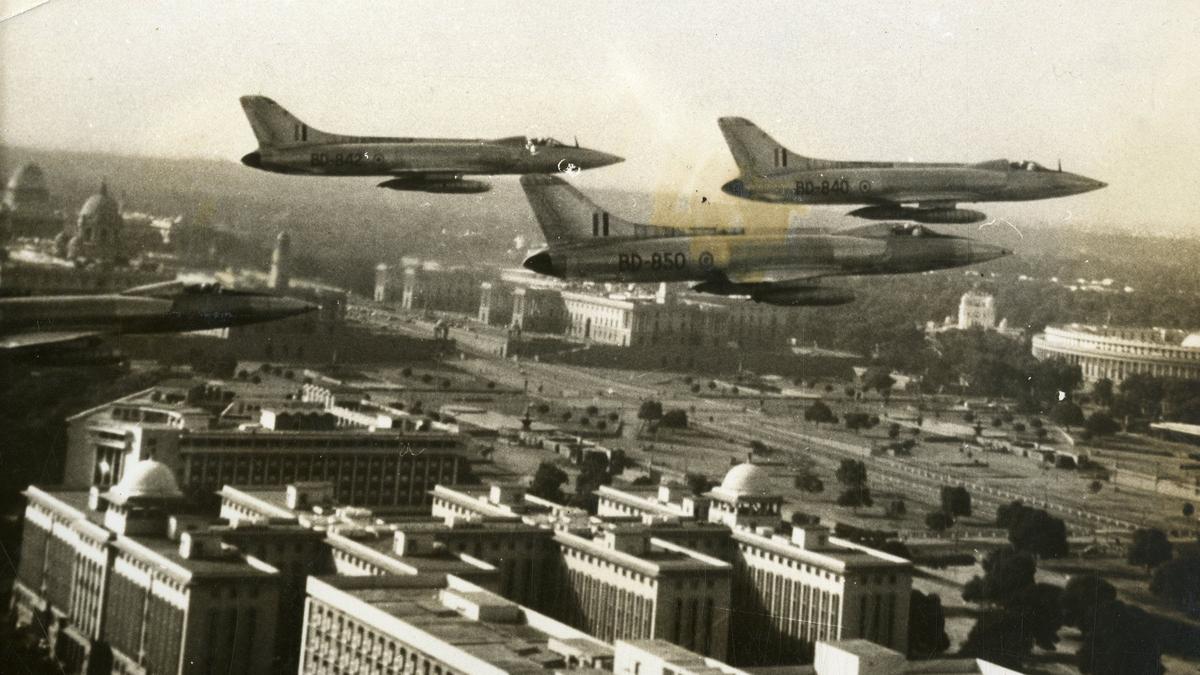
The story so far: There has been growing excitement in military and industrial circles over the fast-tracked indigenous fifth generation stealth Advanced Medium Combat Aircraft (AMCA). Touted as a multi-role fighter with super-cruise capability, internal weapons bays, advanced avionics, and diverter-less supersonic intakes enhancing stealth and reliability, the AMCA is being hailed as a milestone in Indian aerospace history. However, a dose of historical realism is warranted particularly since India has a persistent propulsion gap, and is overly reliant on imported engines. Nearly seven decades of fighter development reveal cautionary lessons, starting with India’s first indigenously designed fighter jet, the HF-24 Marut (Spirit of the Tempest).
Launched in the 1950s by Hindustan Aeronautics Limited (HAL) under famed German engineer Kurt Tank — designer of several WWII Luftwaffe fighters — the twin-engine, swept-wing Marut was, like the AMCA, an ambitious project of its time. Sleek and capable of transonic speeds, it embodied post-colonial India’s drive for self-reliance and entered service amid high hopes in the late 1960s.
However, the Marut never reached its full potential, not because of design flaws, but entirely due to its underpowered British Bristol Siddeley Orpheus 703 turbojets. Although Tank had envisioned a more powerful engine, it never materialised, leaving the Marut’s performance underwhelming. And, while it performed reasonably well in ground-attack roles during the 1971 war on the western front, its propulsion limitations ultimately proved crippling. HAL produced only 147 of these high-maintenance, low-output fighters, which were eventually ‘number-plated’ or retired by 1990.
Indian Air Force (IAF) veterans who flew the Marut consistently cited the lack of a powerful engine as its Achilles’ heel — highlighting the enduring reality that high-end fighters live or die by propulsion technology. Engines, after all, are not mere technical parts but the core of sovereign aerospace capability, shaping a combat aircraft’s power, range, and mission effectiveness.
Following the Marut’s disappointing engine performance, the Defence Research and Development Organisation (DRDO) assigned its Gas Turbine Research Establishment (GTRE) laboratory in 1989 to develop the Kaveri GTX-35VS afterburning turbofan for the Light Combat Aircraft (LCA), which had been under design development since 1981-82.
Over the next 35 years, GTRE spent around ₹2032 crore, as of 2020, on the project, but without success. Despite producing nine full-scale prototypes and four core engines — logging over 3,000 hours of ground testing and 73 hours of flight trials on an Ilyushin IL-76 flying test bed in Russia — the Kaveri failed to meet the LCA’s performance benchmarks. It struggled with thrust-to-weight ratio, reliability, and thermal management under sustained high-performance conditions. Though spinoff versions were proposed for tanks, ships, and locomotives, none have so far entered operational use.
A revival attempt in 2016, in collaboration with French engine-maker Snecma (linked to offset obligations from the IAF’s Rafale deal) also collapsed. A parallel proposal by its partner Safran to co-develop a new engine for the Tejas MkII and AMCA met a similar fate, reportedly rejected by the DRDO due to institutional pride.


The actor, along with director Shashant Shah, speak about their upcoming series ‘Chiraiya’, Divya’s process of working on the dialect, Sushant’s approach to telling a story about women, and more

Sri Lanka's Minister Bimal Rathnayake announces support for Indian refugees, urging political sensitivity from Tamil Nadu and India.

51 couples take thebig plunge at Udaipur mass wedding event

India shows significant progress in reducing child mortality, despite global slowdowns, highlights a new UN report on child health.

Puducherry's upcoming elections test the NDA's governance model amid opposition rifts and promises of stability and welfare delivery.

A Russian oil tanker diverts to India, boosting local refineries despite sanctions and geopolitical tensions.

Supreme Court questions if temple activities like book publishing and prasadam manufacturing qualify as industrial activities under current laws.

Ten of Kozhikode's 13 incumbent MLAs are seeking re-election, with no women candidates from CPI(M) in the upcoming polls.

Height restrictions near airports are stifling Bengaluru's growth, prompting calls for a review to boost development potential.

Explore the Gandhi Bunakar Mela in Vijayawada, showcasing traditional textiles and supporting handloom weavers until March 31.

MDMK leader Vaiko announces a movement to remove Prosopis juliflora trees in Tamil Nadu following a landmark High Court directive.

Lok Sabha Speaker Om Birla emphasizes the importance of Question Hour over meetings and urges decorum during obituary references.

Karnataka approves 300-bed Puttur Government Medical College Hospital project, enhancing healthcare in the coastal region.