Why are farmers protesting in Europe? | Explained
The Hindu
The Hindu explains why farmers across the European Union are protesting against shared concerns of cheap imports, high costs and green policies that embroil them in red tape.
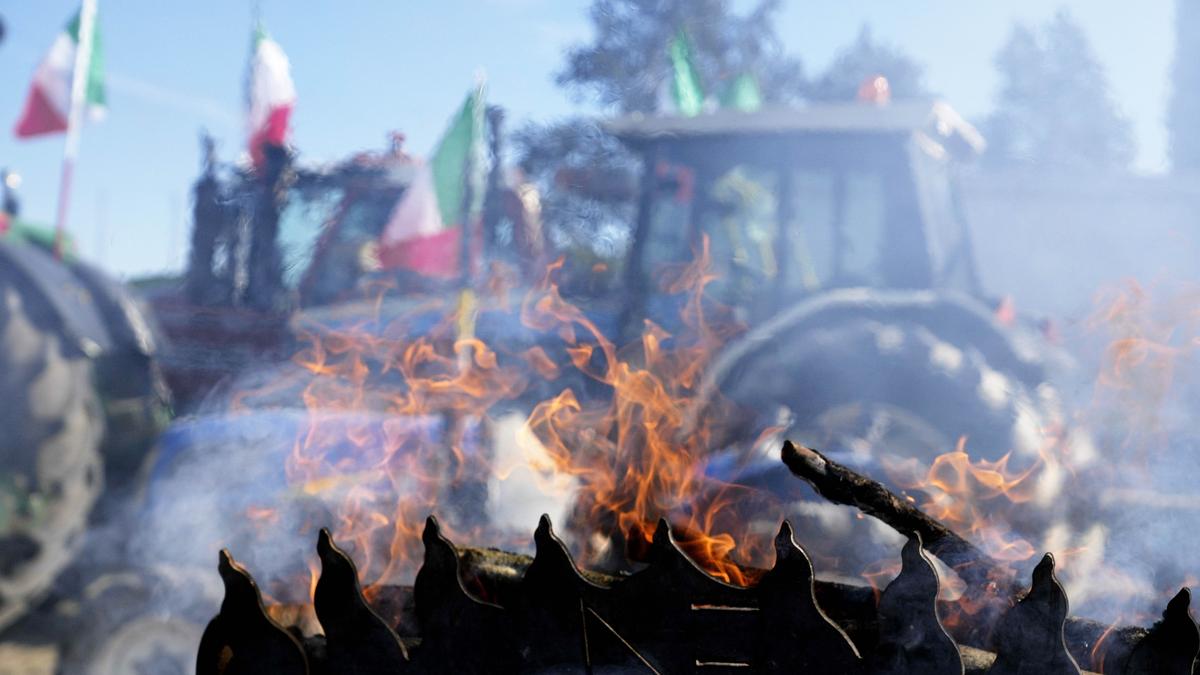
The story so far: Agriculture has become a site of revolt in Europe over the last month. Farmers have taken out hour-long tractor protests and held a multi-day ‘siege’ of Parisian streets. Manure was sprayed on French buildings, eggs hurled at the European Parliament, a statue of a 19th-century British industrialist in Brussels was toppled in anger. Resentment against governments has spread from Spain to Poland, Germany to Greece, as farmers struggle to keep pace with weather changes and war-related supply-chain disruptions. European Union’s green policies have further stoked their anger, as governments face the task of balancing livelihoods while mitigating agriculture’s contribution to climate change.
Claudiu Crăciun, a political science lecturer in Bucharest, explains the common threads of grievance binding European farmers, the role of far-right populist parties and what bearing the protests have on the upcoming European Union polls. “We cannot understand what the farmers are protesting about today if we don’t understand their history,” Dr. Crăciun says. The ‘agrarian question’ of today, he suggests, has as much to do with green policies, land use, access to markets and falling income as it has to do with the cultural value afforded to Europe’s farming sector.
Farmers from at least nine countries have joined protests, including those from Greece, Poland, Spain, Germany, France, Romania, Italy, Belgium, Portugal and Lithuania. Early signs of strain appeared in 2019 when Dutch farmers blocked roads to protest new limitations on farms’ nitrogen emissions. Four years later, in late 2023, Polish food producers blocked the crossing with Ukraine to demand that the government revive policies previously lifted following Russia’s invasion of Ukraine in 2022. Almost 10,000 farmers rallied in Germany against fuel subsidy cuts in mid-January — which played a role in inspiring protests by food producers in other regions, Dr. Crăciun notes.
Reasons vary regionally but also overlap. Seen as threats are cheap imports from neighbouring Ukraine, delayed subsidy payments, taxation on vehicles, and EU green regulations on how much land is used or how much nitrogen is emitted in the air. Governments are reducing food prices due to inflation, even as the cost of producing food is increasing, stoking fears about how to sustain a livelihood.
Why protest now, and why in large numbers? “It’s a better moment for protest,” says Dr. Crăciun. There is a seasonal aspect to it — agricultural work is scarce during winters — and the end of the year is also a time when food producers balance their sheets and take stock of economic shortfalls. Policy and politics add another layer. Several European countries passed green transition-focused regulations towards the end of 2023, and in six months, the European Parliament will see roughly 400 million voters participate in 27 national elections, where green transition and its impacts remain critical electoral planks.
Data shows agriculture contributed around 1.4% to the European Union’s GDP. In Germany, it generates just 0.7% of economic activity and 1.6% in France. If farmers made up 44% of total employment in India in 2021, for France and Germany this number was 2% and 1% respectively. Despite their small numbers, farmers wield considerable influence; a third of the EU’s budget goes as subsidies to farmers.
The current revolt represents a ‘buildup of resentment,’ Dr. Crăciun suggests.War, weather and green regulations are the immediate triggers. Russia’s invasion disrupted supply chains, increased energy costs and transportation levies; cheaper imports trickled from neighbouring Ukraine as the bloc eased rules. The ongoing trade negotiations with the South American MERCOSUR block would also see them competing with imports from Chile, Argentina and Australia. A Politico analysis showed between 2022 and 2023, prices paid to farmers sunk by more than 10% across 11 EU countries. Farmers are also grappling with climate change — regular water shortages, erratic weather, droughts and soil erosion are laying waste to crops. In Greece, wildfires have burnt through 20% of the annual farm revenue.


Saudi Arabia expels Iranian military staff amid escalating tensions and ongoing missile attacks during the U.S.-Israeli war on Iran.

Russia claims control of Potapivka village in Ukraine's Sumy region amid ongoing military efforts to establish a buffer zone.

Iranian missile strikes on Israeli towns cause widespread damage and injuries, marking a significant escalation in the ongoing conflict.

As Gor makes first trip as U.S. Special envoy to South Asia, Delhi watches strategic signals closely
Sergio Gor's inaugural trip as U.S. Special Envoy to South Asia signals strategic U.S. engagement amid regional tensions.

Slovenians vote in a tight election between liberal and populist candidates, impacting the country's future domestic and foreign policies.

Netanyahu asserts U.S.-Israel alliance fights Iranian threats, emphasizing global security after missile strikes on Israeli and European targets.

Israeli settlers attack Palestinian villages in the West Bank, causing injuries and destruction amid ongoing settlement expansion.

Britain asserts no evidence of Iran planning missile strikes on Europe, despite Israeli claims of missile capabilities.

UNESCO reports over half of countries have banned phones in schools due to concerns about attention, cyberbullying, and social media impact.

Analysis reveals a U.S.-operated Patriot missile likely caused a pre-dawn explosion in Bahrain, injuring numerous civilians.

Sri Lanka raises fuel prices by 25% amid ongoing West Asia conflict, impacting petrol and diesel costs significantly.

Iran strikes near Israeli nuclear research center as Trump threatens attacks on Iranian power plants
Iran's missile strikes near Israel's nuclear site escalate tensions as Trump threatens retaliation against Iranian power plants.

Saudi Arabia intercepts one of three ballistic missiles targeting Riyadh amid ongoing regional tensions and threats from Iran.