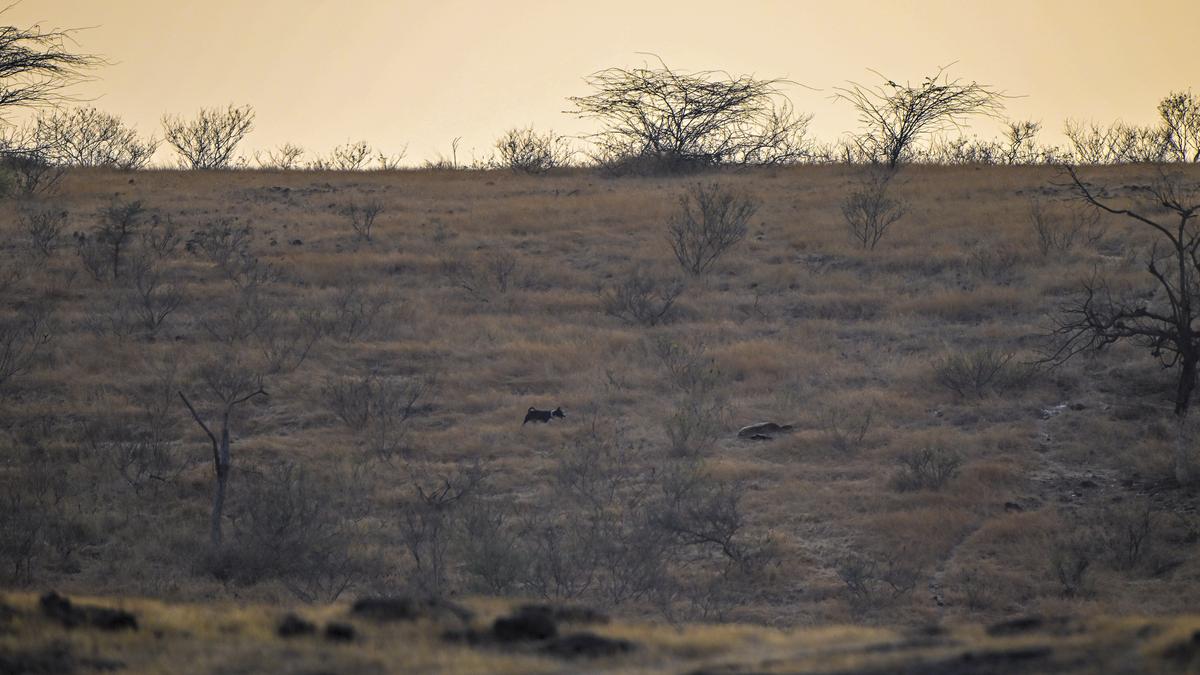
Who let the dogs out?
The Hindu
Kadbanwadi grassland on Deccan plateau faces threats from free-ranging dogs, impacting Indian grey wolf population.
Kadbanwadi (Pune)
The Kadbanwadi grassland of the Deccan plateau wear a different colour depending on the season: in summer the grass shimmers gold; in monsoon the grassland turn parakeet green. About 276 kilometres away from Maharashtra’s capital of Mumbai, atop a hill is the Kadbanwadi village, on the edge of the grassland that stretches across about 2,000 hectares, in Indapur tehsil of Pune district.
Here, the shepherd community — the Shegar Dhangar — has coexisted with animals and birds through time. The Bengal fox, striped hyena, and Brahminy kite are few in number. The Indian grey wolf is considered the guardian of the grassland. As an apex predator, it indicates the health of the ecosystem, regulating the numbers of smaller predators and herbivores.
These wolves, brown with black-and-white markings on their backs, are on the ‘Red List’ of the International Union for Conservation of Nature, an environmental network, meaning they are at risk of extinction. The species is also on India’s Schedule I list of animals, which receive the highest level of protection.
There are many reasons for the slow disappearance of these wolves. Among them is habitat loss, because of agriculture and semi-urban expansion into grasslands, say scientists and Forest Department officials. Over the past decade however, an additional threat has emerged: free-ranging dogs that hunt in packs.
These animals, descendants of domesticated dogs, have streaks of wild behaviour. They have begun to appear in villages around the grassland to scavenge on the waste dumped by cities.
Kadbanwadi has a few poultry farms, which are, as per the usual practice, located at some distance from urban centres. A poultry farm worker in Kadbanwadi says, “We are supposed to bury the dead, but the dogs come for the carcasses and become aggressive.”


Supreme Court affirms the public's right to critique its judgments while addressing concerns over an NCERT textbook's content.

Amit Shah reviews Manipur's security, urging the CM to tackle drug cartels and aid displaced communities after ethnic violence.

Kerala's fisherfolk urge political parties to address livelihood concerns, demanding fair pricing, rule enforcement, and better support during elections.

Moderate rainfall in Visakhapatnam brings relief but causes traffic disruptions and power outages across the city.

Shubman Gill’s Gujarat Titans banks on its tried-and-tested formula

Agriculture Ministry reviews unseasonal rains' impact, assesses farm losses, and discusses relief measures for affected farmers.

Premium petrol prices rise by ₹2 per litre, but government claims no impact on the common man amidst global oil tensions.

Kum. Veerabhadrappa’s acclaimed novel Aramane has been adapted into a television serial. Kannada channel DD Chandana (Doordarshan) has launched the serial with the same name. National Award-winning filmmaker Mansore is the director behind the project,

Diya Chitale and Manav Thakkar reach semifinals, while Yashaswini Ghorpade upsets top seed Sreeja Akula at National TT Championships.

DYFI criticizes A.P.'s job calendar for failing unemployed youth, demanding a revision to include 1 lakh posts and higher age limits.

‘Lethargic’ officials who left Chambal sanctuary to the mercy of sand miners will be held liable: SC
Supreme Court holds negligent officials accountable for enabling illegal sand mining in Chambal Sanctuary, emphasizing habitat protection laws.

Work on the Srisailam Left Bank Canal tunnel resumes after 13 months, with completion targeted by 2027-end, says Minister Reddy.

Ancient ‘Vanni’ tree at Sri Meenakshi Sundareswarar Temple tilts; steps on to restore it