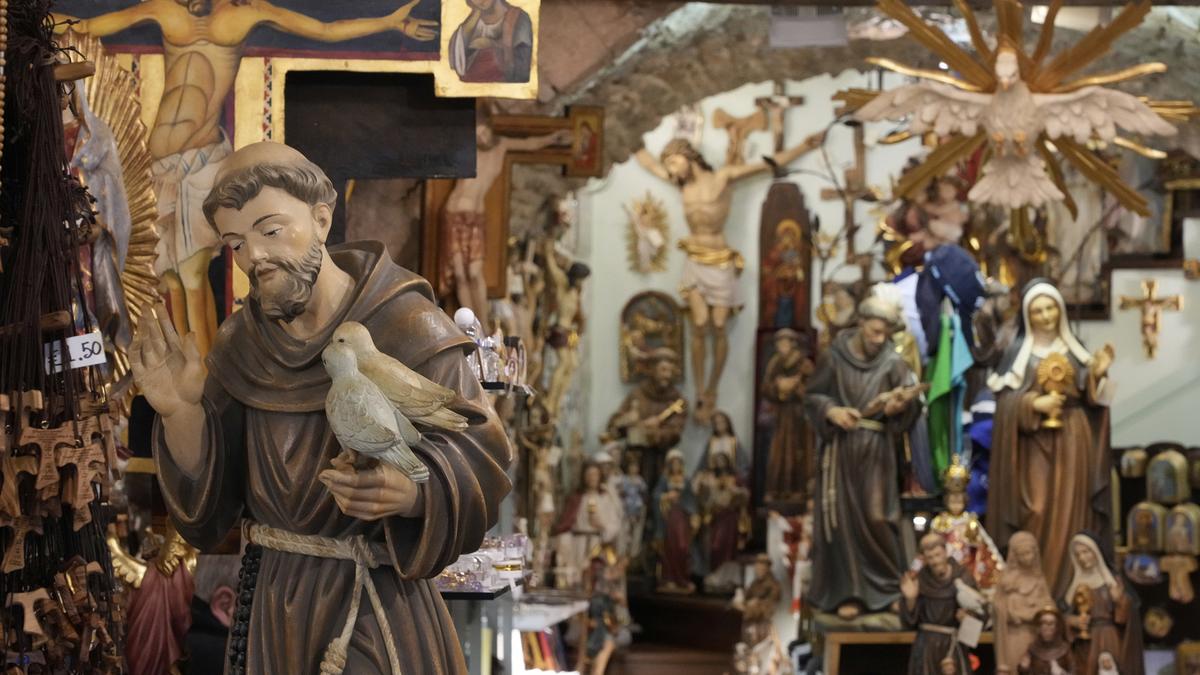
Who is St. Francis of Assisi? Why did the Pope chose to go by his name?
The Hindu
Pope Francis honors St. Francis of Assisi's legacy of peace, poverty, and respect for creation in Assisi, Italy.
When Cardinal Jorge Mario Bergoglio was anointed as the Pope, he chose to rename himself as Francis after St. Francis of Assisi, the medieval saint who founded the Franciscans, one of the largest orders in the Catholic Church.
St. Francis’ tomb is situated at the hilltop town on Assisi in Italy, where the saint was born here more than 840 years ago.
“The life of St. Francis teaches the way to holiness is giving up yourself, getting rid of things that hold us back in our life here, and just offer ourselves to the Lord,” said the Rev. Paul Vu, who was visiting in early March with a group of 50 Vietnamese-American parishioners from Santa Ana, California.
In 1182, St. Francis was born to a wealthy family in Assisi, which rises above a fertile valley in central Italy. Praying in front of a crucifix, he is said to have heard a call to reform the church. He aspired to strip everything down to the essentials in the service of God.
The Santuario della Spogliazione, which literally means stripping, is a sober stone church on the hillside. It marks the spot where he gave up even his clothes in front of his father, who disinherited him. St. Francis was accepted into the church by the bishop as an advocate of the poor and went on to found a religious order that’s still active globally today, the Franciscans.
For Assisi’s current bishop, the Rev. Domenico Sorrentino, St. Francis’ renunciation of material encumbrances also signaled his love of creation and of peace.
“Francis, stripping himself, came back to nature in some sense. So we must receive nature as a gift of God, and respect this gift,” Sorrentino told The Associated Press.


Russia claims control of Potapivka village in Ukraine's Sumy region amid ongoing military efforts to establish a buffer zone.

Iranian missile strikes on Israeli towns cause widespread damage and injuries, marking a significant escalation in the ongoing conflict.

As Gor makes first trip as U.S. Special envoy to South Asia, Delhi watches strategic signals closely
Sergio Gor's inaugural trip as U.S. Special Envoy to South Asia signals strategic U.S. engagement amid regional tensions.

Slovenians vote in a tight election between liberal and populist candidates, impacting the country's future domestic and foreign policies.

Netanyahu asserts U.S.-Israel alliance fights Iranian threats, emphasizing global security after missile strikes on Israeli and European targets.

Israeli settlers attack Palestinian villages in the West Bank, causing injuries and destruction amid ongoing settlement expansion.

Britain asserts no evidence of Iran planning missile strikes on Europe, despite Israeli claims of missile capabilities.

UNESCO reports over half of countries have banned phones in schools due to concerns about attention, cyberbullying, and social media impact.

Analysis reveals a U.S.-operated Patriot missile likely caused a pre-dawn explosion in Bahrain, injuring numerous civilians.

Sri Lanka raises fuel prices by 25% amid ongoing West Asia conflict, impacting petrol and diesel costs significantly.

Iran strikes near Israeli nuclear research center as Trump threatens attacks on Iranian power plants
Iran's missile strikes near Israel's nuclear site escalate tensions as Trump threatens retaliation against Iranian power plants.

Saudi Arabia intercepts one of three ballistic missiles targeting Riyadh amid ongoing regional tensions and threats from Iran.

Iran's death toll exceeds 1,500 amid escalating war, with heavy airstrikes and shifting U.S. and Israel strategies reported.