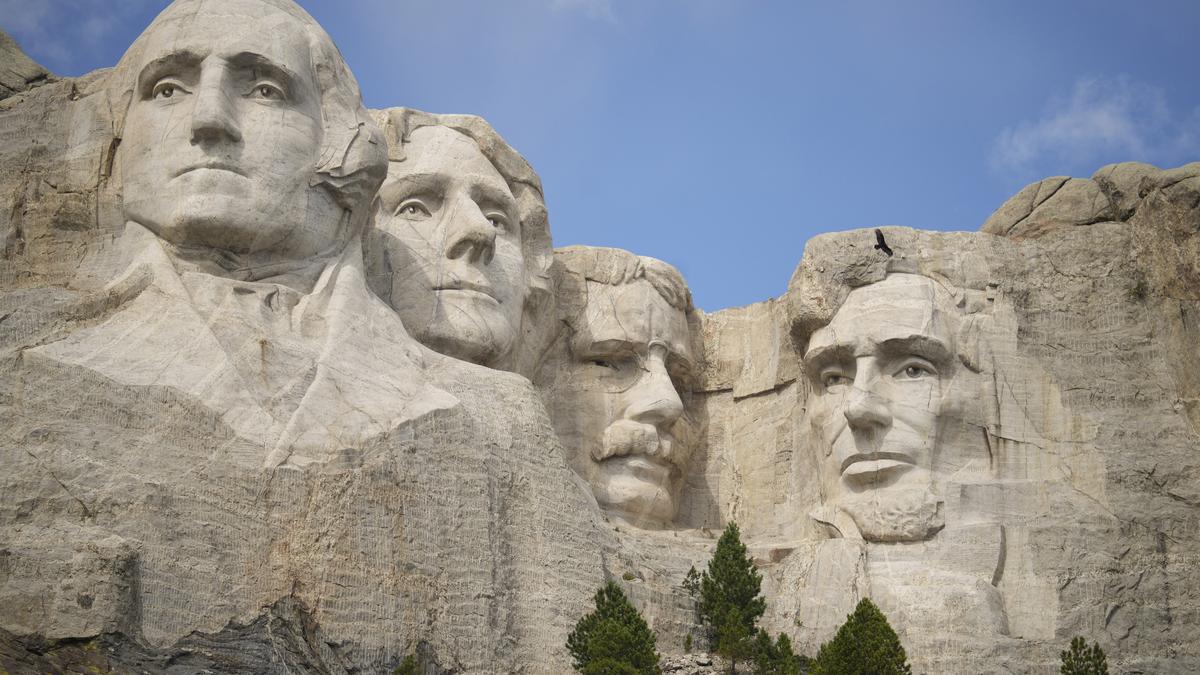
When U.S. presidents dabbled in science…
The Hindu
Thomas Jefferson and Abraham Lincoln are two of the greatest presidents that the U.S. has seen. You probably know that already. But did you know that Jefferson made what is considered the first contribution to American vertebrate paleontology? Or that Lincoln is the only U.S. president to receive a patent? What’s more, both their contributions have March 10 in common… 52 years apart. A.S.Ganesh hands you the details…
A man of many talents, Thomas Jefferson was the third president of the U.S. He was the author of the Declaration of American Independence and a founding father of the country. He was the nation’s first secretary of state (1790-93) and the second vice president (1797-1801) – a position he held after reluctantly standing for presidency and losing by three votes. He became the country’s third president after a bitterly fought election in 1801 and served two terms, holding the position till 1809.
Jefferson was responsible for the Louisiana Purchase from Napoleon for $15 million. Purchasing the Louisiana territory from the French in 1803 nearly doubled the size of the U.S., making it one of the largest countries in the world. Jefferson also authorised the exploration of the American west and north west through the Lewis and Clark expedition (1804-06).
Additionally, Jefferson was the founder and architect of the University of Virginia. And when he sold his personal library to the federal government in Washington in 1815, it served as the core of the Library of Congress.
Having come in second in the race to be the president behind John Adams in 1797, Jefferson became vice president according to the system that was in place then. He made a difficult 10-day journey to the capital – Philadelphia at that point – in order to be sworn in as the vice president.
At around the same time he became vice president of the nation, Jefferson was also made the president of the American Philosophical Society. Jefferson, whose interest in fossils was well known by this time and who had already received fossils from friends and acquaintances who knew of his interest for decades, decided to carry a wagon load of fossils to present to the society.
Among these were the gift sent by Colonel John Stuart of Greenbrier County, Virginia (now West Virginia) along with Stuart’s hypothesis stating the animal was “of the Lion kind.” Studying the bones, Jefferson too came to the conclusion that they were from an animal “of the lion kind, but of most exaggerated size.” He called it “the Great-claw or Megalonyx” owing to the animal’s bulk, which was expected to be three times that of a lion. With his induction as society president pending, Jefferson was scheduled to present a paper on March 10.
As fate would have it, Jefferson went to a book store following his arrival in Philadelphia in March 1797. Here, he encountered the September 1796 issue of London’s Monthly Magazine, which, as destiny would have it, contained an engraving of a fossilised skeleton. The fossils from Paraguay that were engraved – mounted by then in the Royal Cabinet of Natural History in Madrid, Spain – were very similar to Jefferson’s “Megalonyx,” but identified to be a relative of the sloth.


AI tool for sparrow conservation

BTS’s comeback with ‘Arirang’ marks a major global music event. When does the album release, and where can you watch their concert live stream? We have all the details

The 2026 U.S. cholesterol guidelines urge starting screening and treatment at 30 to prevent cardiovascular disease effectively.

Olam Festival 2026 in Thiruvananthapuram returns March 27-29 with 120+ vendors, music, art, and cultural zones.

A few storytellers in Thiruvananthapuram share their journeys, challenges, and evolving methods on World Storytelling Day, inspiring young minds.

76-year-old Kurian Jacob from Kerala triumphs with seven medals, including five golds, at the Open Masters Games in Abu Dhabi.

Explore the nature of the human mind as an emergent property of brain activity and complex neural interactions.

CERN's Large Hadron Collider discovers the Xi-cc-plus particle, enhancing understanding of quantum mechanics and baryon behavior.

Vibha Batra’s latest book, Spotless (Hachette India) is a novel in verse for young adults

In its first edition, the Madras Art Salon spotlights the works of journalist and artist Narayan Lakshman at The Botanical Club, a social space in the British Deputy High Commission, Chennai

Cholesterol enhances melanoma cell invasion by making nuclei squishier, revealing a potential treatment target in cancer progression.

The designers reinterpret the Swedish artist’s symbolic forms and colour energy through contemporary resortwear silhouettes

Discover the inspiring legacy of Bibha Chowdhuri, a pioneering woman in physics and a trailblazer in STEM history.