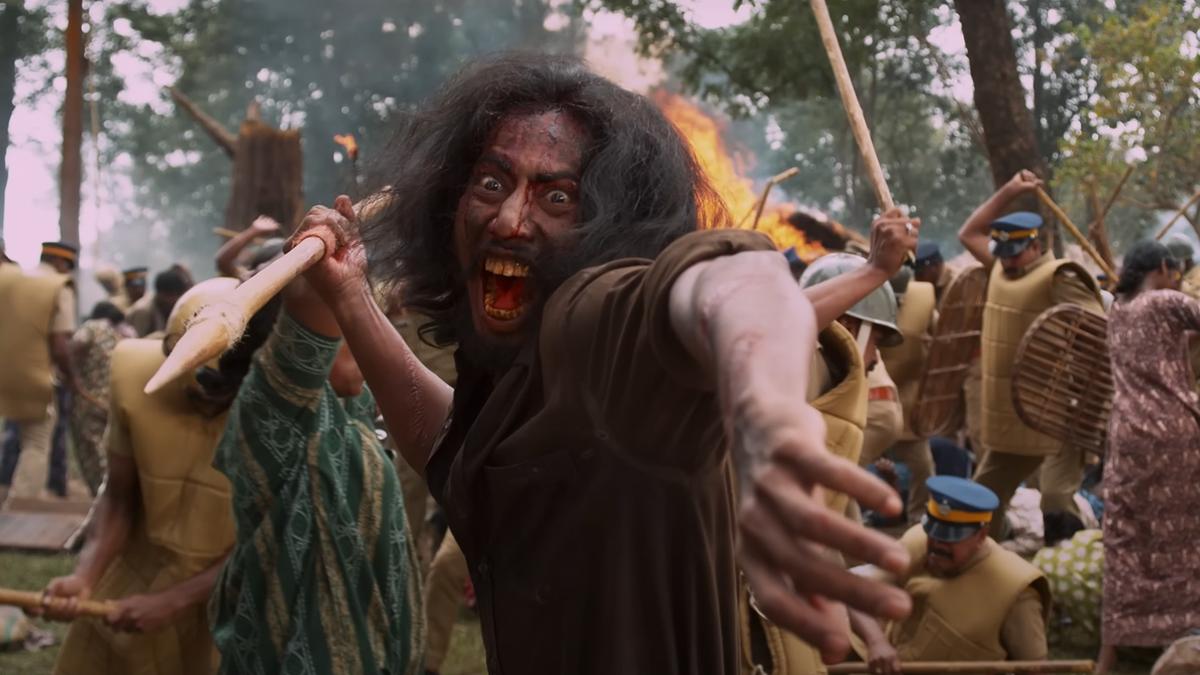
When the silver screen gives space to tribal land struggles
The Hindu
Malayalam films like Unda, Narivetta, and Photographer shed light on the struggles of tribal communities for land autonomy.
In Khalid Rahman’s Unda (2019), a police officer from Kerala, played by Mammootty, who is given the responsibility of leading a team of officers to ensure that elections are conducted smoothly in Maoist-hit areas of Chhattisgarh, says to a tribal boy, “This is your land, do not die”.
Kerala has a strong, eventful, and often forgotten history of land struggles by tribal societies. While often sidelined, these struggles occasionally get its hands bloody (or find itself bleeding) and land a blow on the conscience of mainstream society, becoming the topic of intellectual discussions for a while, after which they again move to the shadows.
However, once in a while, the Malayalam movie industry takes note of these events with either subtle nods inside a story or by creating an entire movie around such events.
While Ranjan Pramod’s Photographer (2006), K.M. Kamal’s Pada (2022) and the recently released Narivetta by Anuraj Manohar effectively do only what the events themselves did — that is, nudge these issues into discourse for a short while — by etching them permanently in film however makes sure that the struggles of some of the most exploited communities are not forgotten.
All three of the movies mentioned above are centred on or framed against the backdrop of the struggle of tribal communities in Kerala for autonomy over their own land, and how the State responded.
In Narivetta, which is based on the true events surrounding the Muthanga protests and subsequent police shootings and brutalities, theprotagonist finds himself being a complicit part of the state machinery that is working to put out a peaceful protest by tribals for land that was promised to them. In Photographer, starring Mohanlal, the protagonist encounters a tribal boy facing police violence in a forest area. This was also based on the Muthanga incident detailed in Narivetta.
In Pada, the makers revisit the actions of the ‘Ayyankali Pada’ — the youth organisation of the Kerala Communist Party formed under Maoist ideologies by former members of a Marxist-Leninist organisation that was dissolved in 1991. Pada shows how four members of the Ayyankali Pada held the collector of the Palakkad district hostage in response to amendments made to the Kerala Scheduled Tribes (Restriction on Transfer of Lands and Restoration of Alienated Lands) (KST) Act, 1975, in 1996. The KST Act deemed all tribal lands in the possession of non-tribal people through sale, lease, mortgage or by force after 1960 illegal, giving way for tribal people to take back their land. But it was never implemented in the way it was envisioned. In 1993, the Kerala High Court ordered the State government to implement the Act within six months, but that too went unfulfilled with the State asking for continuous extensions. And finally in 1996, the the Left-led government under E.K. Nayanar passed an amendment making transactions of tribal land made till 1986 legal.


The Spirit of the Land, a solo show by artist Shivakumar Sunagar, is a vista of Nature-inspired emotions

Tal Fry is all set for an exciting new performance season

Netflix is making a bold move by snagging InterPositive, the AI filmmaking company founded by Ben Affleck, in a deal that could hit $600 million

Watch the eerie trailer for 'Hokum,' where Adam Scott faces a witch haunting in a mysterious Irish inn.

Oscars 2026 security heightened amid FBI warnings of a potential Iranian drone threat ahead of the Hollywood ceremony.

Directed by Rahul Pandey, the series also stars Naila Grewal, Nidhi Bisht, Anant Joshi, Anjum Batra and Kusha Kapila

A tribute to the versatile actor and comedian V.K. Ramasamy in his birth centenary year.

‘One Piece’ Season 2 review: As the Straw Hats enter the Grand Line, Netflix’s live-action adaptation finds its sea legs with bigger islands, stranger villains and the same stretch-happy sense of boundless adventure

Geeta Gandbhir, the Indian-origin American filmmaker is waves at this year’s Oscars with not one, but two nominations. Her documentaries, ‘The Perfect Neighbor’ and ‘The Devil is Busy’ are in the race for the Academy Award

Directed by filmmaker and environmentalist Pradip Krishen, the film follows a group of "dope-smoking, bellbottom-wearing and vaguely idealistic" final-year students racing to complete their theses.

Alan Ritchson powers through 'War Machine', a lean sci-fi action thriller on Netflix. A competent, Reacher-style chase adventure with nonstop tension and solid set pieces

Explore the Unshelving Memories exhibition in Thiruvananthapuram, showcasing diverse book art by 61 talented artists until March 15.

Oscars 2026 date and timings: Watch the 98th Academy Awards live on March 15, 2026, at 4:30 a.m. IST in India on various platforms.