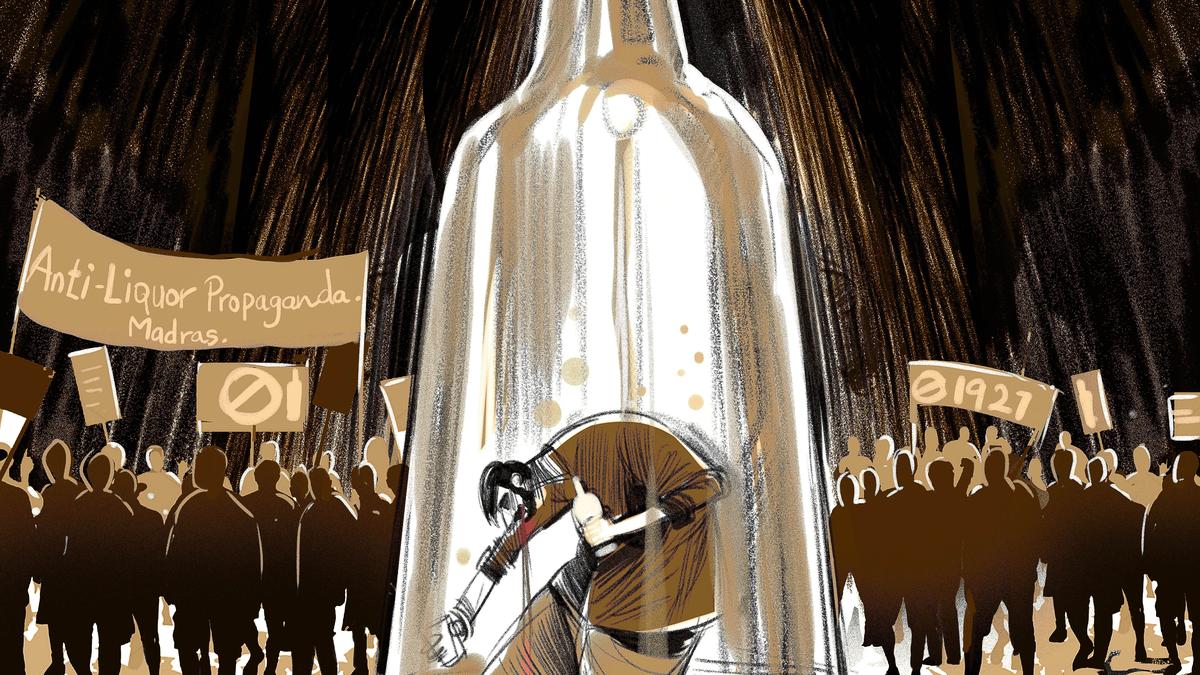
When ‘anti-liquor propaganda’ gathered momentum in Madras nearly a century ago
The Hindu
Anti-liquor propaganda in Madras Presidency aimed at educating the public on the evils of alcohol consumption.
A decade before liquor prohibition was introduced in Madras in 1937, an anti-liquor propaganda was attempted in the Presidency. On October 22, 1927, the Madras Legislative Council passed a resolution recommending to the British India government that total prohibition in the Presidency within a course of 20 years be declared its goal.
“The Excise Advisory Committee considered that the first essential step to give effect to the resolution was the creating of an active public opinion throughout the Presidency against the use of alcoholic drinks and the education of the masses on the evils of drink so that any temperance legislation undertaken might have the co-operation and support of the general public. On this recommendation Government decided that propaganda should be carried out throughout the Presidency and sanctioned a scheme for the purpose in June 1929,” writes G. T. Boag, an Indian Civil Service officer, in The Madras Presidency 1881-1931.
Highlighting this under the caption, ‘Anti-drink propaganda’, he said district committees were formed throughout the Presidency to take up the propaganda. Before the campaign started, there were extensive debates on the subject in the Madras Legislative Council. Back then, health officers, attached to the districts and municipalities, had a wide range of duties. They would give lectures on various subjects, like smallpox and how to prevent the spread of diseases such as smallpox and enteric. They were also connected with the baby health week and other institutions in the districts.
Talking about the health officers in the Madras Legislative Council in March 1927, J.A. Saldanha, a member, said, “We have got, in connexion with Baby Welfare, to preach on the evils of drinking, in any case, evils of excessive drinking and drinking bad liquors, or evils of drinking any liquor at all. That is one of the objects of the Baby Week. Unhealthy patients cannot get healthy children. If a father is addicted to drinking habits, his children cannot be healthy, but he will get rickety children. In order to have a really effective Baby Welfare work, one of the advices to be given to parents is by pointing out to them that unhealthy children are the result of evil habits, among which we must bear in mind this excessive drinking, drinking bad liquor or any liquor at all.”
Saldanha, who was also was an elected president of the Health and Welfare Associations in his district, noted that one of the principles of the association was that the health officers should preach on the subject, not entirely of prohibition, “but what we are more concerned with is temperance habits, moderation in drinking, moderation in eating, etc”. That being the object and scope of the duty of health officers, he was at a loss to see why the predecessor to the then incumbent Minister for Public Health went so far as “to prohibit these health officers from carrying on the propaganda against the drink evil”. Records from the proceedings of the Madras Legislative Council show that Saldanha questioned what was political in carrying on a propaganda for prohibition. “Is it against the British Government? Is our policy of prohibition anti-British,” he asked. He then went on to answer it: “This anti-drink policy is one for increasing the health of the people and the wealth of the people also.”
The former Excise Minister, Sir A.P. Patro, whose policy Saldanha thought was one of patronising intemperance rather than temperance, “went so far as to prohibit his officers from doing anti-drink propaganda”. These officers were only preaching to the people how to avoid ill-health. “In doing this, he [Patro] has done a great disservice to the State. When I asked the present Minister, he gave out that the order was standing still and when I asked him whether it would be cancelled, he replied in the negative and that it was still standing and that it could not be cancelled. Could he not say that he would cancel it?” Batting against patronage of liquor, he said, “I put all that as a test case and I have been very much exercised in our relations with that policy. I think the Minister ought to give an answer straight away, but if he does not, it is a case to consider whether this Ministry should remain in power at all.’’
Speaking on the subject, another Member of the Legislative Council, C.S. Ratnasabapati Mudaliyar, pointed out that the Ministry had stated that minimum of consumption is their policy and they will have prohibition by successive stages. “The Ministry having accepted that policy, Sir, I cannot understand why the health officers — I must also say the co-operative inspectors and supervisors — should not be empowered to undertake propaganda work on prohibition,” he said.


At Amar Khamar in Kolkata, a lunchroom rooted in Bengal’s landscape and literature works with women farmers, Sundarbans’ communities and beekeepers to revive rare rice, heirloom ingredients and disappearing food traditions

Delhi experiences a cooler morning at 16.6°C, with daytime temperatures expected to exceed 30°C and moderate air quality.

Know all about Assam's political landscape ahead of the 2026 Assembly Elections, analysing voting trends, turnout, and party dynamics.

Members of LGBTQIA+ communities held protests across Karnataka, categorically opposing the recently proposed Transgender Persons (Protection of Rights) Amendment Bill, 2026.

Congress criticises Modi government, citing reports about Pakistan's diplomatic role amid U.S.-Iran tensions, labelling it a setback for India.

Folk music with the Barmer Boys that crosses all boundaries

Tamil comic blockbuster Thaai Kizhavi releases on JioHotstar this week, as actress Radikaa Sarathkumar rewrites rules on pay, age, and women in Tamil films

"The jury has difficulty coming to a consensus regarding one defendant, do you have any advice on how to move forward?" the jurors told Judge Carolyn Kuhl

Maharashtra relocates 25 leopards to Gujarat's Vantara facility amid rising leopard and tiger populations, says Forest Minister Naik.

Assembly polls 2026: Follow updates from The Hindu on the upcoming elections in five States on March 24, 2026

Delhi's per capita income is projected to grow 7.09% by 2025-26, highlighting the city's economic progress and infrastructure challenges.

Review meeting held in Dharmapuri with election observers and nodal officers to discuss upcoming Assembly elections.

Execution of development projects, infrastructure augmentation to occupy centre stage in electioneering