What do Tim Cook, Satya Nadella, and Sundar Pichai envision for the tech industry in 2025?
The Hindu
What do leaders of major tech companies have their sights set on in 2025 for AI.
As another fork-in-the-road-esque time seems to be arriving for artificial intelligence, tech leaders mull over their next steps forward in 2025 with regard to user adoption, navigating a possible slowdown in pace of progress, and the matters of AGI.
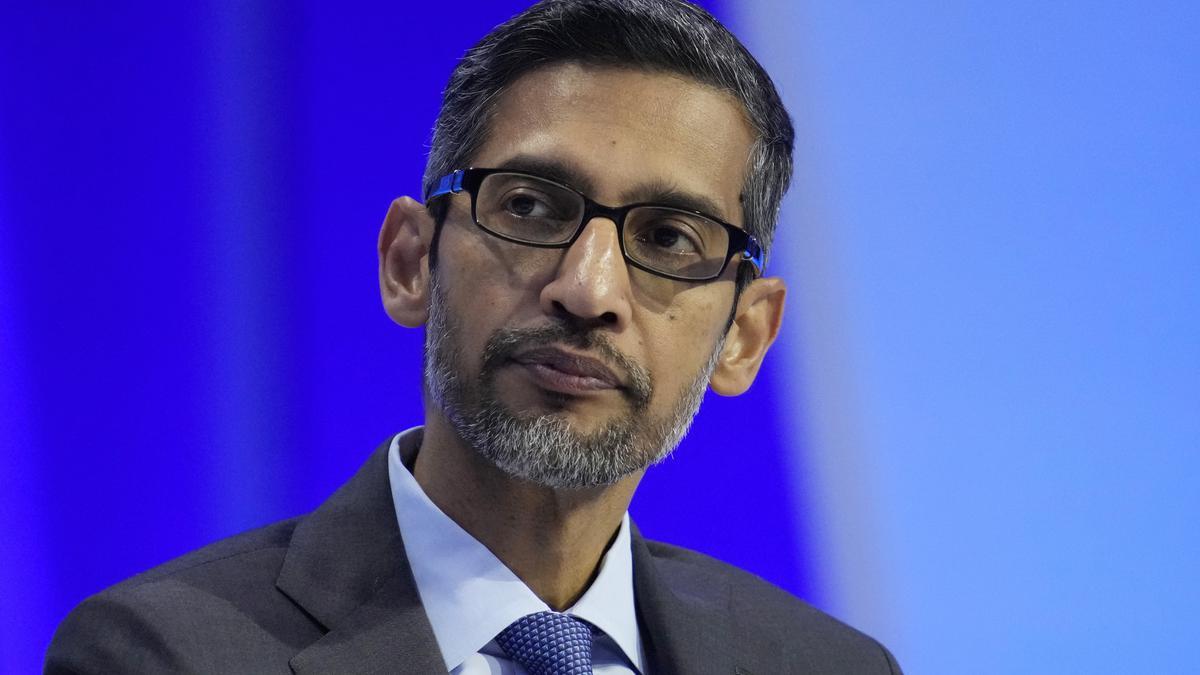
Google CEO Sundar Pichai underlined how crucial 2025 will be at an internal meeting held recently. Admitting that the unwieldy size of the company had meant it was playing catch-up in artificial intelligence, he added that they had to work faster. “I think it is really important that we internalize the urgency of this moment and need to move faster as a company. The stakes are high. These are disruptive moments. In 2025, we need to be relentlessly focused on unlocking the benefits of this technology and solving real user problems,” he noted.
Most of this forward momentum was dependent on their Gemini models, where most of the company’s focus would lie. Pichai said that while the Gemini app could soon be reaching half a billion users, they still had “some work to do in 2025 and close the gap and establish a leadership position there as well.” To push adoption among users and “scale Gemini on the consumer side would be their biggest focus next year,” Pichai said. Still, concerned employees expressed doubts that OpenAI’s ChatGPT was slowly becoming “synonymous with AI the same way Google is with search.” Pichai assuaged these fears, saying that historically it has been proven that coming first isn’t always necessary, executing a product better than everyone else was. “I think that’s what 2025 is all about,” he noted.
Contrary to Pichai view that a slowdown is imminent in AI advancements, OpenAI CEO Sam Altman believes next year will not be another instance of tech hitting a wall. A month ago, when he sat down with Garry Tan, CEO of startup incubator, Y Combinator, for a video interview, Altman said, “AGI? Yeah, excited for that.” Artificial General Intelligence, is essentially the point at which a machine starts working like a human - it is able to not just generate text, but infer and then continue learning as it goes. Altman, however, has recently tempered expectations for what people expect AGI to look like.
Earlier this month, in an interview with The New York Times, he said, “My guess is we will hit AGI sooner than most people in the world think and it will matter much less.” He added that the economic disruption due to AGI would take some time to manifest in the world. “There’s a lot of inertia in society. So, in the first couple of years, maybe not that much changes and then maybe a lot of changes,” he noted. There’s also a peculiar clause between OpenAI and Microsoft around the AGI goal post. A new report by The Information said that if an AI system can generate at least $100 billion in profits, it would be considered as AGI, without specifying any other technical indicator. Interestingly, a previous report had revealed that once AGI is reached, Microsoft will not have access to OpenAI’s AI models. This could explain why Altman is rushing towards it. In the same interview, he said that “Artificial Super Intelligence” would be way more significant - which is a state where machines are superior to human intelligence. Meanwhile, both OpenAI’s new o3 and a new o3 mini model are currently in testing and will be made available soon next year.
In a podcast appearance two weeks ago, Microsoft CEO Satya Nadella spoke on several contentious topics. He believes next year will be very competitive despite the company’s close ties with the market leader OpenAI. However, he shared that it wouldn’t be a case of “winner-takes-all,” as gains from AI were going to become more diverse. Nadella also conceded that while Google did have its omnipresent search browser and a widespread mobile distribution network as an advantage, he was looking forward to regain lost ground with CoPilot and Edge. “This is the best news for Microsoft shareholders - that we lost so badly that we can now contest it and win back some share,” he said.
Nadella is banking on AI agents and has predicted that the business applications exist could “collapse” in the agentic AI era. This could render SaaS solutions much less important he said.


Agriculture Ministry reviews unseasonal rains' impact, assesses farm losses, and discusses relief measures for affected farmers.

Premium petrol prices rise by ₹2 per litre, but government claims no impact on the common man amidst global oil tensions.

Kum. Veerabhadrappa’s acclaimed novel Aramane has been adapted into a television serial. Kannada channel DD Chandana (Doordarshan) has launched the serial with the same name. National Award-winning filmmaker Mansore is the director behind the project,

Diya Chitale and Manav Thakkar reach semifinals, while Yashaswini Ghorpade upsets top seed Sreeja Akula at National TT Championships.

DYFI criticizes A.P.'s job calendar for failing unemployed youth, demanding a revision to include 1 lakh posts and higher age limits.

‘Lethargic’ officials who left Chambal sanctuary to the mercy of sand miners will be held liable: SC
Supreme Court holds negligent officials accountable for enabling illegal sand mining in Chambal Sanctuary, emphasizing habitat protection laws.

Work on the Srisailam Left Bank Canal tunnel resumes after 13 months, with completion targeted by 2027-end, says Minister Reddy.

Ancient ‘Vanni’ tree at Sri Meenakshi Sundareswarar Temple tilts; steps on to restore it

Bengaluru Metro penalises 14 passengers for disrupting services with loud singing, following a viral clip of their antics.

ASR district plans a 122 km world-class trekking network, enhancing tourism and local employment across Araku, Paderu, and Lambasingi.

Development without impact: Coastal residents of Kanniyakumari and Nagercoil constituencies voice discontent

Environmentalists in Kakinada celebrate World Sparrow Day, urging conservation efforts for sparrows and migratory birds.

T.K. Govindan secures full support from K. Sudhakaran for Kerala Assembly polls 2026 as a UDF-backed Independent candidate.