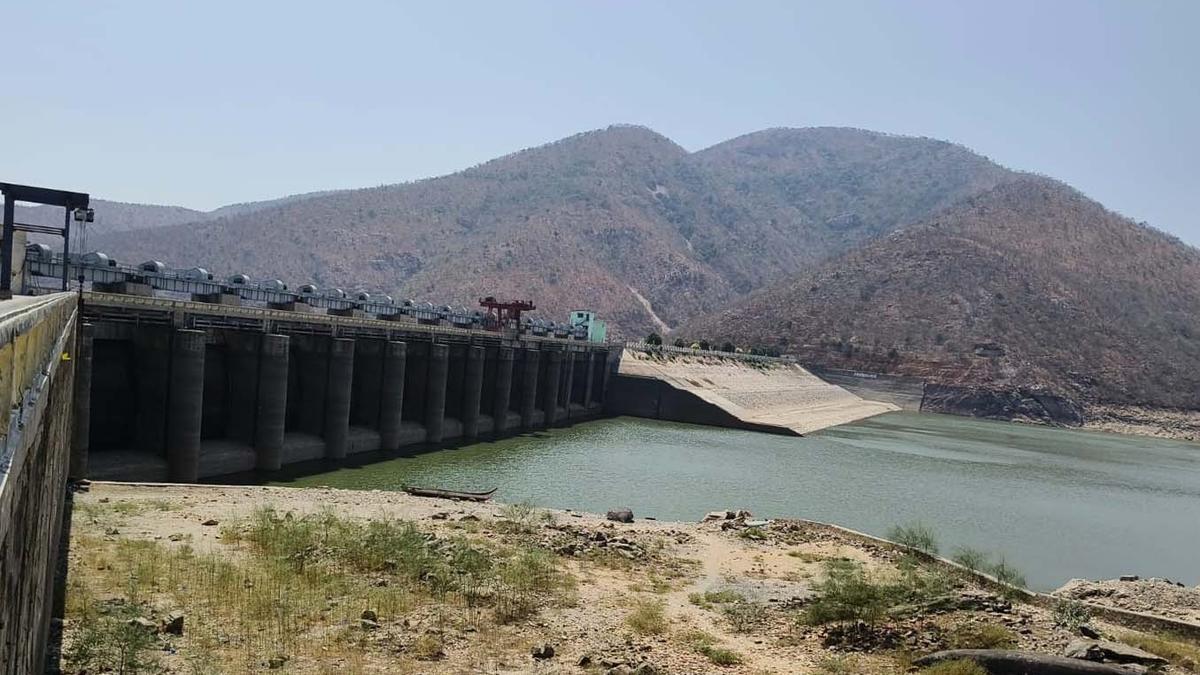
Water level at India's main reservoirs drops to 23%: CWC report
The Hindu
Water levels in India's main reservoirs are at 23%, 77% lower than last year, impacting regions differently.
The water level of the country's 150 main reservoirs has dropped to 23% and is 77% less than last year's levels at this time, according to Central Water Commission (CWC) data.
Last week, the live storage of these reservoirs was at 24%. The present storage is 77% of last year's levels and 94% of the normal storage, CWC data stated.
In its latest weekly bulletin, released on May 31, the Commission said that "the total live storage available is 41.705 billion cubic metres (BCM), equating to 23% of the total capacity".
"This is a significant decrease from the 53.832 BCM recorded during the same period last year and the normal storage level of 44.511 BCM. Consequently, the current storage is only 77% of last year's levels and 94% of the normal storage," it said.
The 150 main reservoirs monitored by the CWC have a combined live storage capacity of 178.784 BCM, which is around 69.35% of the total storage capacity created in the country.
Ten of the 150 reservoirs are located in the northern region — Himachal Pradesh, Punjab and Rajasthan — and have a live storage capacity of 19.663 BCM. This has dropped to 5.864 BCM (30% of total capacity), according to the CWC bulletin for the week of May 16 to May 31. Last year, during the corresponding period, storage was at 38%. The normal storage at this time of the year is 31%.
In the eastern region — Assam, Jharkhand, Odisha, West Bengal, Tripura, Nagaland and Bihar — there are 23 reservoirs with a total live storage capacity of 20.430 BCM. The available storage is 5.645 BCM, or 28% of the total capacity, the Commission said. In the corresponding period last year, it was 25%. The normal storage is 26%.


Indian vessels can freely sail through the Strait of Hormuz without needing permission, confirms a senior government official.

The Hindu Morning Digest gives a select list of stories to start the day. Read the top news today on March 25, 2026

An IndiGo flight at Vijayawada airport was grounded due to a tyre burst, but all 79 occupants are safe.

Tamil Nadu Assembly election 2026: TMC(M) gets five seats in NDA, to contest on BJP's 'Lotus' symbol
TMC(M) secures five NDA seats, to contest Assembly elections using BJP's 'Lotus' symbol in Tamil Nadu.

The Karnataka government will discuss with officials the possibility of creating a portal for unemployed youth to share their details and access job opportunities in micro, small and medium enterprises (MSMEs), Minister for Small Industries and Public Enterprises Sharanabasappa Darshanapur said in the Legislative Council on Tuesday.

AIADMK's 2026 manifesto promises free rations, women's benefits, education reforms, and economic growth initiatives for Tamil Nadu.

U.S.-Israel war on Iran LIVE: Follow The Hindu for updates on the West Asia conflict on March 24, 2026

Join the 'Click & Commit' campaign on World TB Day, uniting Chennai's community to pledge against tuberculosis.

Brahmin candidates join Naam Tamilar Katchi, marking a significant shift in Tamil Nadu's political landscape and inclusivity.

Over 750 wheelchairs are prepared in Thoothukudi for accessible voting, ensuring convenience for differently abled and elderly voters.

Madras HC dismisses S.P. Velumani's petition challenging I-T assessment of ₹7 crore as unexplained election expenses from 2016.

The Lok Sabha passes a contentious Transgender Bill, sparking praise from the government and criticism from opposition parties.

Kamal Haasan announces support for DMK in 2026 elections, emphasizing the need for 'Dravidian Model 2.0' for Tamil Nadu's welfare.