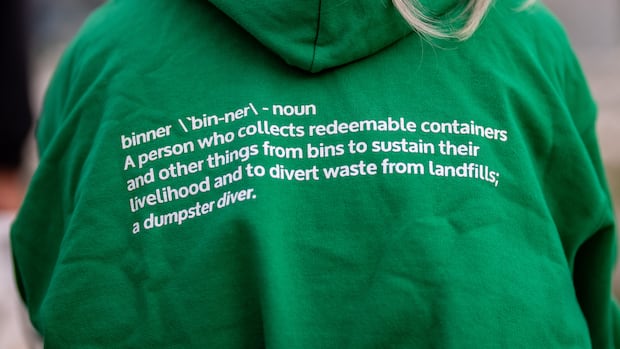
Waste pickers want deposits back on more materials — and it’s not just about the money
CBC
In the push to divert more waste from landfills, people known as binners — who scour cities for often discarded redeemable materials — could hold part of the solution.
Collecting cans or bottles for their 10 cent deposit keeps waste from ending up in the wrong place and provides wages for those who return them.
Now, waste pickers or binners say the important work they do should be afforded a bigger role.
“I think there's room to innovate and to grow … to find other items that could be collected and taken out of the landfill,” said Sean Miles, director of the Binners' Project, a collective of waste pickers in Vancouver trying to improve economic opportunities and reduce stigma over the practice.
Miles made the comments from an annual Vancouver event where, through government grants and private sponsors, the Binners' Project hands out thousands of dollars to people who brings disposable, single-use coffee cups to a downtown park.
It’s done to show the collective ability of waste pickers to manage items that often end up as trash or litter when they can be recycled, if they have value for the collector.
Over twelve years, the event has amassed more than 700,000 cups, which can be placed in residential blue boxes for recycling in places like Vancouver, but often end up in the trash or as litter.
This year, the Binners' Project handed out more than $21,000 — a record amount — to people who participated in the event, like Erica George who earns wages through bottle and can returns.
“I missed last year, so I wanted to make sure I got here this year,” she said. “I just follow my feet.”
At the coffee cup event this year, there were representatives from waste picker organizations across Canada and U.S. who shared best practices and advocated for progressive public policy that would enhance the work.
“If you didn't have waste pickers, we'd be swimming in plastic,” said Barbra Weber, a local waste-picker organizer from Portland, Ore., who is also on the executive of the International Alliance of Waste Pickers.
“The most important impact that we have is environmentally.”
She said there are more than 40 million recognized waste pickers around the world who have the ability to vastly influence the way waste is collected and kept from harming the environment.
“I think that everything should have a redeemable value,” she said, listing off items like single-use plastic, cigarette butts, electronic waste and single-use coffee cups.


The Agricultural Producers Association of Saskatchewan (APAS) found some reasons to celebrate the 2026-27 provincial budget, but it takes issue with the amount designated for the province's Water Security Agency (WSA).

The family of an Edmonton woman who died in Honolulu last year is pushing for Hawaiian authorities to re-open the case.

It was around this time in 2020 that everything changed.

With its emergency shelter beds frequently running at 50 per cent over capacity and demand so great that it's forced to refer some women escaping domestic violence elsewhere, Gillian's Place in St. Catharines will soon be able to offer a broader range of services to more victims of gender-based violence.

The ceiling of the CAW Student Centre at the University of Windsor is decorated by flags of numerous nations — among them, Iran.

Turmoil in Iran, a major disruption in world oil markets, and stratospheric gasoline prices in Canada and beyond. What's racking motorists and governments in 2026 also faced them in 1979, sparked by the Iranian Revolution.

Five decades later, and Thunder Bay's Music World Academy remains a family-run business.

Dalton Dubois of Guelph, Ont., made history at the recent Paris Fashion Week when she became the first transgender model to walk the runway for Chanel Exclusive.

Work is scheduled to begin over the summer at the site of the former Clinton Creek asbestos mine, about 65 kilometres northwest of Dawson City, Yukon.

They may be bitter rivals in the House of Commons, but outside the chamber, recent events may have led to Conservative Leader Pierre Poilievre and Prime Minister Mark Carney forging a bond.

Local fans and industry insiders say the province’s move to ban the reselling of event tickets for more than their original value is a step in the right direction, but some say there are still larger issues that need to be addressed.

This First Person column is the experience of Mehdi M. Kashani, who lives in Toronto. For more information about CBC's First Person stories, please see the FAQ.

A very quiet queue has formed in Europe where some of Canada's long-standing, closest allies are seeking shelter under France's small but robust nuclear umbrella.