Violence against doctors is a symptom. What is the disease? Premium
The Hindu
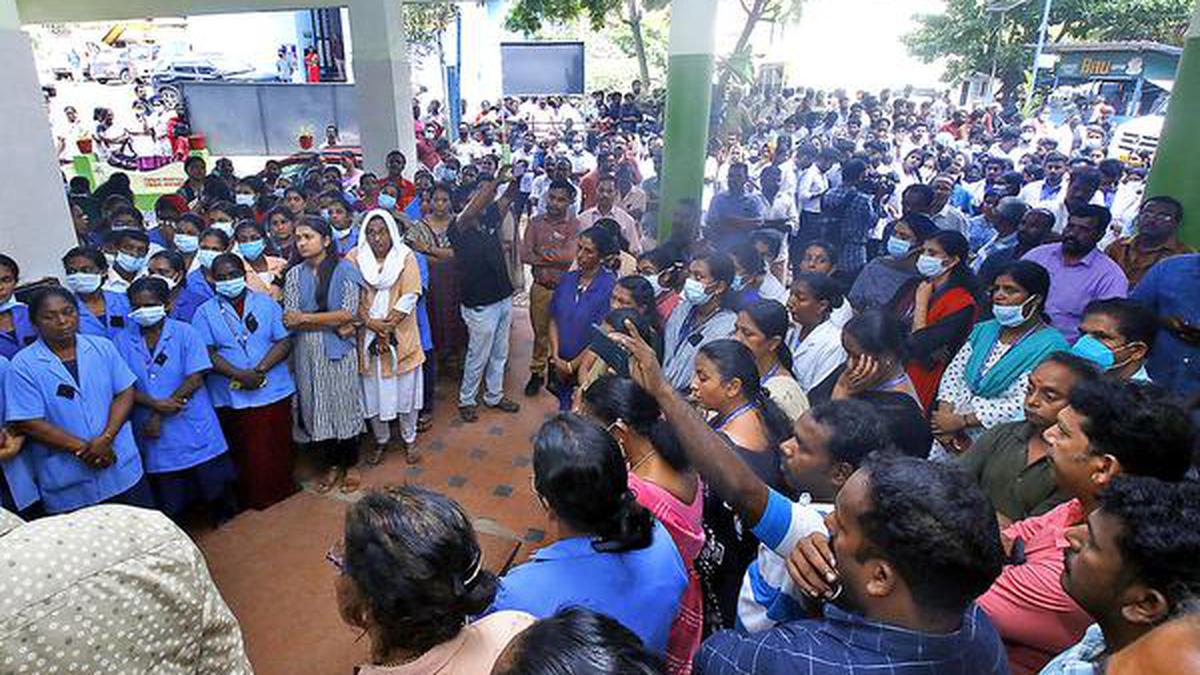
On May 10, 2023, Dr. Vandana Das was stabbed to death in the line of duty in Kollam district. Amid searing outrage from the medical fraternity, the tragedy brought to the forefront the increase in workplace violence faced by doctors all over India.
One chilly evening, I sat at the computer desk in the hospital I worked at as a junior doctor, typing out the discharge summary of a patient who was meant to go home in an hour. Suddenly, I saw a man twice my size charging at me. He slammed his hand loudly on my desk and my heart raced. “You guys have overcharged us for this admission,” he shouted as he loomed over me. Then he walked away to pay the bill, leaving me to collect my pounding heart and sweaty palms enough to finish typing the summary.
On May 10, 2023, Dr. Vandana Das was stabbed to death in the line of duty in Kollam district. Amid searing outrage from the medical fraternity, the tragedy brought to the forefront the increase in workplace violence faced by doctors all over India.
It was not the first time such a thing had happened. Over the years, there have been several episodes of physical and verbal violence. Each episode has the people at large passionately arguing the issue for a few days, only for their words to fade away until the next brutal incident. Doctors also stage protests but are ultimately honour-bound to return to duty, to reprise their roles as healers. The issue remains largely unaddressed.
According to a systematic review of recent research, published in the Journal of Postgraduate Medicine in July 2020, “In developing countries, more than 50% of doctors have faced patient-led verbal and physical abuse.” Such violence has been on a rising trend in economically developing countries, and is lowest in the developed ones.
Research has also found that workplace violence is mostly directed at junior doctors and residents, with the incidence progressively dropping against more senior healthcare workers.
The violence also happens more often in high-stake settings, such as the emergency department and intensive care units, as well as in departments with patients with compromised mental function.
The perpetrators of workplace violence against physicians are family members or relatives of the patient in 82.2% of cases, per a paper published in PLoS ONE in 2020. Some perpetrators become violent over concerns for the patient’s condition, such as actual or perceived deterioration of their condition or doubts about the wrong treatment being administered. Some others become violent due to issues such as high payment dues and protracted waiting times. Doctors aren’t responsible for either.


IRSO's NavIC system faces challenges as the last atomic clock fails, reducing operational satellites for navigation services.

Discover efficient pressure cooking techniques to save up to 50% on fuel. OPOS B Ramakrishnan tells you how

Mercedes-Benz CLA 250+ with EQ Technology review: design, performance, range and features explained. Discover how the new electric CLA combines advanced AI, long range, fast charging and futuristic styling for the next generation of luxury EVs.

Pi Day is celebrated every year on March 14, honouring the significance of the mathematical constant π and its applications in mathematics.

Discover how sculptural interior design transforms modern spaces, blending creativity and functionality to evoke emotion and identity.

A study reveals that certain antibiotics can cause long-lasting changes in gut microbiome diversity for up to eight years.

Indian scientists and international experts are divided over a study questioning the viability of a nuclear reactor fuel called HALEU-thorium; while critics cite safety risks, proponents argue the technology is vital to achieve national energy goals.

ISRO and AIIMS partner to enhance space medicine research, focusing on human health during long-duration space missions.

A practical guide to induction setups for students, families, and home food businesses as India’s LPG supply faces its biggest disruption in years

Explore the electrifying Oscars 2026 race, featuring standout films, baffling nominations, and memorable performances amid a cinematic transition.

Zai and Rom Whitaker’s latest book for young readers, The Book of Indian Snakes, tackles common misconceptions surrounding snakes, highlighting their utility to humans

Discover PC Mahalanobis's pivotal role in India's statistical revolution and his lasting influence on modern statistics in this episode.

Explore why nothing can exceed light speed and the paradoxes that arise if it were possible.