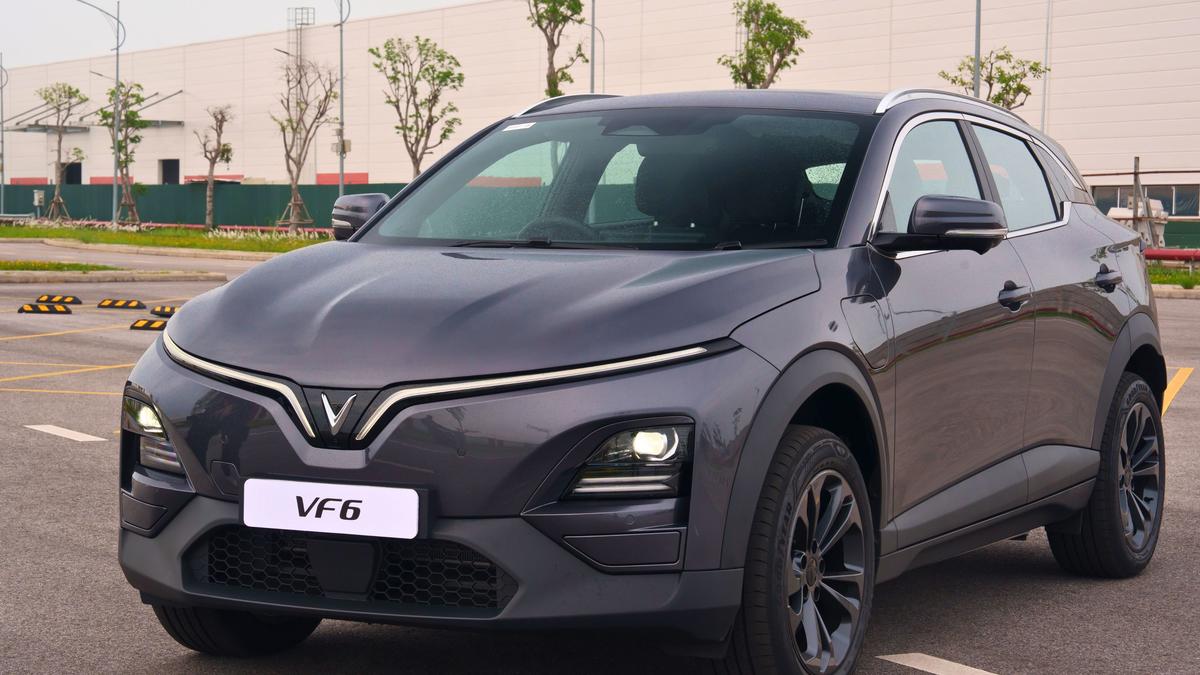
VinFast’s India strategy will have an entire EV ecosystem, including strong dealership presence in Tier two and three cities
The Hindu
VinFast’s entry into India is a strategic one, and it comes with real investment. The company is setting up a manufacturing facility in Tuticorin, Tamil Nadu, with an initial capacity of 50,000 vehicles per year, scalable to 150,000 units annually. With an investment of up to USD 500 million, this is not a soft launch—it is a full-fledged push into what is one of the world’s most promising auto markets.
I recently had the opportunity to visit VinFast’s headquarters in Hai Phong, Vietnam—a sprawling, vertically integrated manufacturing complex that reflects the company’s global ambitions. While there, I experienced the two models that will spearhead VinFast’s entry into India: the VF6 and VF7. I also got an inside look at how VinFast builds its cars, how it plans to build its presence in a competitive and complex market like India.
VinFast’s entry into India is a strategic one, and it comes with real investment. The company is setting up a manufacturing facility in Tuticorin, Tamil Nadu, with an initial capacity of 50,000 vehicles per year, scalable to 150,000 units annually. With an investment of up to USD 500 million, this is not a soft launch—it is a full-fledged push into what is one of the world’s most promising auto markets.
The India strategy is not just about assembling cars. VinFast plans to build an entire EV ecosystem — including charging infrastructure, service networks, and a strong dealership presence spanning both metro and Tier 2 and 3 cities. There is also a clear focus on localisation to improve cost efficiency, aligning with India’s “Make in India” initiative.
But ambition alone does not guarantee success — especially in a market where Tata Motors and Mahindra have already established themselves with localised EV offerings, extensive networks, and strong consumer trust. This is where VinFast’s products will have to do the talking.
Let us start with the VF6. At 4,241 mm in length and with a 2,730 mm wheelbase, it slots into the compact SUV category. But in terms of presence, it punches above its weight. The stance is confident, and design-wise, it manages to look futuristic without being flashy.
Under the skin is a 150 kW (201 bhp) motor that drives the front wheels and puts out 310 Nm of torque. The 0–100 km/h time of 8.89 seconds feels adequate for daily commutes, with a linear throttle response and quick off-the-line acceleration. The 59.6 kWh battery delivers usable range in the region of 400+km, and regenerative braking is adjustable across four levels.
What stood out to me during the drive was the ride quality. The MacPherson front and control blade rear suspension setup absorbed bumps well and gave the VF6 a planted, confidence-inspiring feel — something not every EV manages at this size and price point.


Mercedes-Benz CLA 250+ with EQ Technology review: design, performance, range and features explained. Discover how the new electric CLA combines advanced AI, long range, fast charging and futuristic styling for the next generation of luxury EVs.

Pi Day is celebrated every year on March 14, honouring the significance of the mathematical constant π and its applications in mathematics.

Discover how sculptural interior design transforms modern spaces, blending creativity and functionality to evoke emotion and identity.

A study reveals that certain antibiotics can cause long-lasting changes in gut microbiome diversity for up to eight years.

Indian scientists and international experts are divided over a study questioning the viability of a nuclear reactor fuel called HALEU-thorium; while critics cite safety risks, proponents argue the technology is vital to achieve national energy goals.

ISRO and AIIMS partner to enhance space medicine research, focusing on human health during long-duration space missions.

A practical guide to induction setups for students, families, and home food businesses as India’s LPG supply faces its biggest disruption in years

Explore the electrifying Oscars 2026 race, featuring standout films, baffling nominations, and memorable performances amid a cinematic transition.

Zai and Rom Whitaker’s latest book for young readers, The Book of Indian Snakes, tackles common misconceptions surrounding snakes, highlighting their utility to humans

Discover PC Mahalanobis's pivotal role in India's statistical revolution and his lasting influence on modern statistics in this episode.

Explore why nothing can exceed light speed and the paradoxes that arise if it were possible.

Scientists have engineered bacteria to produce designer proteins by smuggling artificial amino acids, enabling precise drug delivery and multifunctional applications.

Scientists successfully grew chickpeas in simulated lunar soil, paving the way for future extraterrestrial agriculture on the moon.