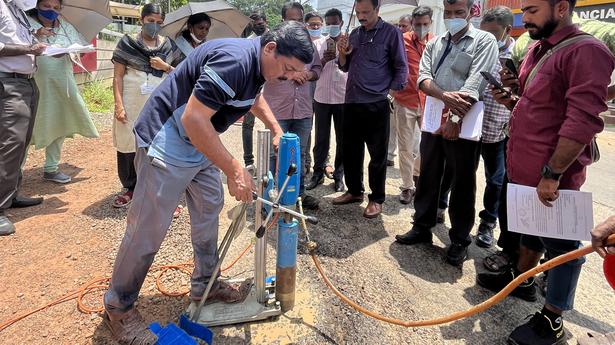
VACB raids on road quality reveal cartelisation in Kerala
The Hindu
Nexus between PWD officials, government contractors
Simultaneous surprise inspections of randomly selected Public Works department (PWD) road segments in Kerala by the Vigilance and Anti-Corruption Bureau (VACB) have revealed shoddy construction and poor maintenance work.
A senior official said the detections were just the tip of the iceberg. However, they revealed a corrupt, cooperative arrangement between PWD officials and government contractors that indicated cartel formation.
Kerala has about 3 lakh km of roads. The PWD roads division, PWD national highway division and Local Self-Government Institutions engineering division are responsible for reconstructing and maintaining at least 30,000 km of roads.
The poor condition of State-maintained roads had become a subject of public debate, with citizens lamenting the plight of pedestrians and motorists plagued by potholed roads and wrecked thoroughfares.
Manoj Abraham, Director, VACB, had ordered the operation, code-named Saral Rastha, based on a slew of public complaints.
The VACB found that PWD and LSGI roads often cratered before their warranty expired, resulting in fatal accidents and grievous injuries. Merely negotiating the roads caused prolapsed discs, twisted ankles, shredded tires and broken axles.
As per law, the government contractor must reconstruct the road at personal expense if it falls into disrepair during the warranty period. However, the rule remained mainly on paper. PWD officials re-tendered the work to the same contractor at a higher rate by turning a blind eye to the warranty violation.


Traders urge Election Commission to raise the ₹50,000 cash limit, citing inflation and practical challenges during Tamil Nadu elections.

Kerala CM Pinarayi Vijayan to file nomination from Dharmadam, seeking third term amid tough competition in 2026 polls.

Water level in Mullaperiyar dam was 114.05 feet

PM Modi discussed West Asia peace, condemned Oman's sovereignty violation, and emphasized safe navigation through the Strait of Hormuz.

Contact details of election observers in The Nilgiris released for submitting poll-related complaints during Assembly elections.

Collector directs return of seized cash upon valid document verification amid voter enrollment and election preparations in Erode district.

Telangana Deputy CM Bhatti Vikramarka to present 2026-27 budget on March 20, 2026 , likely to balance welfare, development amid huge fiscal and revenue deficits in the State.

HCLTech named as one of the World’s Most Ethical Companies® by Ethisphere for third consecutive year
HCLTech named as one of the World’s Most Ethical Companies® by Ethisphere for third consecutive year

Rahul Gandhi urges Uttam Nagar residents to maintain peace, blaming BJP for inciting violence and communal tension in Delhi.

West Asia tensions disrupt GCC coconut exports, causing local price drops and surplus for Tamil Nadu farmers.

DMK urges the Election Commission to align Puducherry elections with Tamil Nadu's April 23 polling date for logistical efficiency.

NHAI plans DPR for four-lane Tiruchi-Karur-Coimbatore greenfield highway and northern Tiruchi bypass to improve safety.

Defence Minister Rajnath Singh urges India to achieve self-reliance in drone manufacturing amid global conflict lessons.