University of Calgary launches initiative to study new relationship with the U.S.
CBC
Alberta is putting $6.5 million toward a new initiative at the University of Calgary to study how Canada's relationship with the United States is changing with U.S. President Donald Trump in the White House.
"It's no secret that our relationship has hit a rocky patch these past few months," said Premier Danielle Smith on Friday. "And while tensions have ridden high, let us be clear — this relationship is far from over."
The funds, to be provided over three years, will establish the New North America Initiative based in the university's School of Public Policy. Researchers will be tasked with developing a vision of what the continental relationship could become at a time of increasing trade uncertainty and geopolitical turmoil.
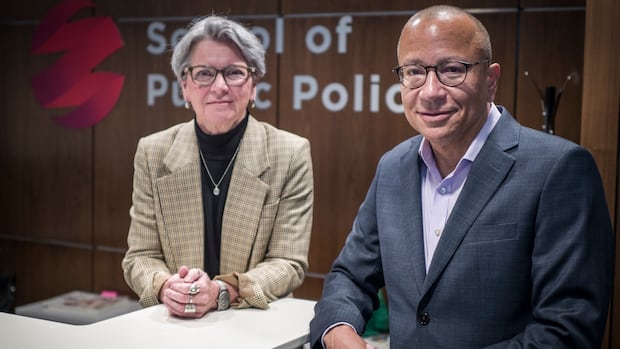
"I think it's clear to everyone that we aren't going back to where we were a few years ago, or even during the first Trump administration," said Carlo Dade, the School of Public Policy's international policy director.
Trump's first administration turned into a stress test for the federal government when he hit Canada with steel and aluminum tariffs and ripped up the North American Free Trade Agreement.
Negotiations on the deal that replaced NAFTA — the Canada-U.S.-Mexico Agreement on trade, or CUSMA — were tense, and former prime minister Justin Trudeau had a notoriously rocky relationship with Trump. The continental trade pact was still hailed a success.
Canadians who expected to see the friendly bilateral relationship with the U.S. restored with the passage of CUSMA were taken aback by the unprecedented tariffs and annexation threats that accompanied Trump's return to the White House.
Many were appalled when Canada became an early target of the president's insults — but many never expected Trump to follow through on his tariff threats.
"We have consistently misjudged what a Trump administration will do," Dade said.
Trump hit Canada with economy-wide duties in March, then partially walked them back a few days later for imports compliant with CUSMA. Canada is also being hit with levies on steel, aluminum and automobiles.
Canada can no longer continue "driving forward by looking in the rear-view mirror instead of looking clearly at what lies ahead and what's coming," Dade said.
Canadians must abandon their nostalgic attachment to the old relationship, he said, and imagine instead what it could become.
The university's initiative will have interrelated parts. It will conduct research on immediate challenges facing Albertans due to the deterioration of relations with the United States. It also will set up collaboration between Albertans and researchers at American universities to help them better understand each other.
Martha Hall Findlay, director of the School of Public Policy, said in a media statement that "we need new thinking and new ways of engaging, and we need the work behind this to come from new places and new voices on both sides of the border."


In advance of what is expected to be a hot summer, the City of Kamloops is encouraging homeowners to request a free assessment of their properties to make sure they are resilient in the face of wildfire.

Friday may have been the first day of spring, but winter storms are not over yet for Newfoundland.

Daniel Doody says his trip to the Yukon earlier this month was ruined when he learned his luggage wouldn't arrive with him.

The future of a national historic site in Fredericton is up for discussion at meetings across New Brunswick in the next few weeks as the Anglican diocese considers what to do about costly repairs needed at Christ Church Cathedral.

EDITOR'S NOTE: CBC has removed the names and photo from this story. Now that the people are no longer missing, their identity is no longer in the public interest.

Brandon’s firefighter-paramedic union is sounding the alarm about a new provincial directive it says could leave the city without local ambulances when residents need them most.

CBC's road trip series Land of Living Stories explores inspiring stories of community spirit from across Saskatchewan. In our latest visit, CBC-Radio Canada hit the road to La Ronge. This is the fifth of a multi-part series from that community.

Wildfire season has officially started in Alberta. As the snow starts to melt, people are starting to wonder: Will I have to evacuate this year?

Cassandra Lee is getting ready to pack up her home and family to move more than 3,200 kilometres across the Canada-U.S. border, in search of more "support" and "stability."

To earn the title of master sake sommelier, Yoshi Takaoka says it's not just about knowledge, "we need to demonstrate how to serve the sake perfectly."

Over 115 years ago, more than 150 members of Calgary’s Black community gathered at a venue called Eagle Hall on First Street S.W. for what a local newspaper called “one of the most successful balls of the season.”

Spring is heralded by the return of geese, but to many in Alberta's poultry industry, migration means something different.

Ontario's legislature is set to resume sitting Monday after a 14-week break that ended in a veritable deluge of news, partial proposals and headline-grabbing musings from Premier Doug Ford and his government.