UNB researchers reaching new heights with NASA observation mission
CBC
"A once-in-a-decade event" is how Jeffery Langille describes the University of New Brunswick's lead role in a NASA mission.
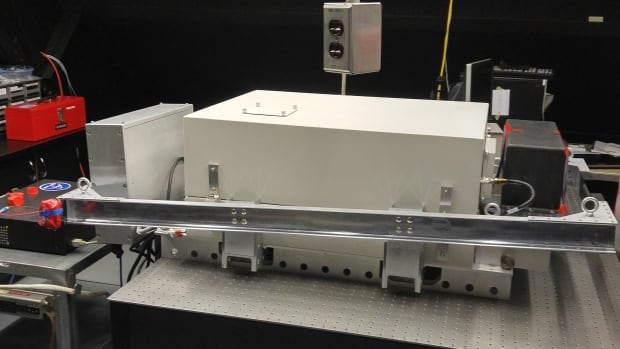
Langille is the lead instrument scientist for the spatial heterodyne observations of water, also known as the SHOW instrument. It's one of three specialized instruments that are part of the high-altitude aerosol, water vapour, and clouds, or HAWC, instrumentation.
HAWC will be deployed as part of NASA's Atmosphere Observing System mission.
The Canadian government announced this month that it would spend more than $200 million on the HAWC instrument, a project that includes researchers from 13 Canadian universities.
Langille said HAWC will measure the effects of climate change and then use that data to build better models to predict future change and extreme weather events.
He said it feels "absolutely awesome" to be involved with the project.
"Being able to see something that I've worked on with my own hands, you know, moving towards being something that gets launched into space is a really rewarding experience," said Langille.
The SHOW instrumentation, which Langille is working on, will help researchers understand the interaction between water vapour, clouds and aerosols, he said.
Langille said the challenge is that this interaction isn't being adequately picked up by current sensors.
The SHOW instrument will observe emissions from water vapour, while the two other instruments that are part of HAWC will observe aerosol and cloud processes.
Since the project isn't scheduled to launch until 2031, Langille said there's a development timeline they will go through over the next several years where they can develop instruments and lab facilities as well as train students, post-docs and scientists at UNB.
Langille said this particular project started as a concept in a lab at York University 20 years ago.
William Ward, the co-principal investigator for SHOW and a professor in the physics department at UNB, said the observations from SHOW will be the highest resolution satellite observations ever obtained for this process.
Ward said Langille was one of his graduate students who he recommended to do a post-doctorate at the University of Saskatchewan, one of the co-leaders for HAWC. So when Ward was contacted to be part of the university consortium and Langille was coming back to UNB, Ward said it was a natural position for him to fill.


Winter can be tough to bear. Even more so if you’re homeless.

Two future national First Nations leaders, a deputy premier and a city councillor are among the prominent Manitobans who appear in declassified intelligence files from years of RCMP spying on the Indigenous rights movement in the Cold War era.

Saskatoon city hall administration is planning to "refresh" the funding strategy for the proposed $1.2-billion downtown arena district amid a lack of commitments from higher levels of government.

A report of fraud tied to a walleye derby is under investigation after Montreal Lake Cree Nation said a participant allegedly violated derby rules and was asked to leave the fishing area.

An Edmonton architectural firm says it is in talks with the provincial government to potentially redevelop the former Royal Alberta Museum.

Does junior football have a future in Prince George?

People are descending upon the city for the dozens of events and live music performances this week as the Juno Awards are set to take place Sunday at Hamilton's TD Coliseum.

For nearly two decades, Amanda Loewen's world ended where the pavement did.

The notion that home ownership guarantees financial security in old age is being challenged by a recent survey.

The family of Nash Prystie has identified him as the man who died in an Ontario Provincial Police (OPP) shooting earlier this month north of Kenora, and is calling for more and quicker help for people with mental health challenges.

Playoff action in the Ontario Hockey League gets underway Thursday night for Guelph and Friday in Kitchener.

UPEI wants its faculty to sign on to an updated version of its sexual assault and discrimination policy, but the union that represents the school's academic staff says it wants the policies to be part of its collective agreement.

In Texas this week for a global energy conference, the federal natural resources minister is proclaiming "Canada is back" and ready to bolster its energy sector and grow exports.