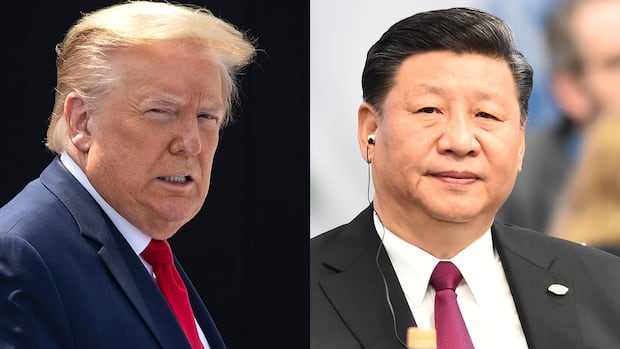
Trump has delayed the Beijing summit. China wonders if he'll ever come to the negotiating table
CBC
On the seventh floor of the immense Quan Ju De restaurant in Beijing, a small museum honours the "roast duck diplomacy" of the past.
Faded black and white photos show a smiling U.S. president Richard Nixon and secretary of state Henry Kissinger eating with the Chinese leadership, including premier Zhou Enlai, in 1972, a meeting that led to the normalization of relations between these cold war adversaries.
It serves as a reminder to modern diners that when American and Chinese presidents put their heads together over a meal, they can change the world.
Today, the question echoing through Beijing’s diplomatic and political circles is whether the current U.S. leader, Donald Trump, will show up to the table at all.
Distracted by a self-launched war in Iran and facing mounting domestic pressure, Trump has pushed the heavy China file to the side of his plate to focus on war strategy.
Previously, the White House had said the visit to China would begin on March 31. And while Trump told American media on Monday that the delay would likely only last "a month or so," the uncertainty is palpable.
China’s foreign ministry remained characteristically brief this week when a spokesman answered questions on the delay, stating only that the two sides remain "in communication" regarding the timing of the summit with President Xi Jinping.
Economic observers in Beijing say it's impossible to predict when the visit will happen.
"Nobody knows," said Xiang Songzuo, a prominent economist and professor at the Renmin University School of Finance. "We all know President Trump always changes his decisions. Tomorrow, maybe, he will make a new one."
Zichen Wang, deputy secretary general at the Center for China and Globalization, agrees that a month is a lifetime in the current political climate.
"Who knows what will happen in four weeks?" he told CBC News. "The uncertainties are immense."
There is, however, a silver lining for Beijing.
By blaming the delay on his own distractions rather than Chinese intransigence, Trump has inadvertently lowered the temperature between the geopolitical rivals.
"Beijing can breathe a sigh of relief because he’s not pointing the finger at China," Wang noted. "It also buys both sides time. The Americans, in particular, haven't done enough legwork to make a summit of this magnitude successful."


Police in Nova Scotia say a teen in Bridgewater and a youth from Manitoba have been arrested for allegedly planning simultaneous attacks at their local schools.

In the provincial budget released on Tuesday, tourism funding increased overall, but a few individual sites ended up on a list of cuts.

The owner of an Old Montreal building where seven people died in a 2023 fire is being charged with seven counts of manslaughter.

With no current plans to open new in-person rapid access to addiction medicine clinics, a woman who lost her brother to an overdose worries Manitoba's government is not doing enough to prevent substance-related deaths.

Gurpreet Singh, a 40-year-old Indian national, is suing the Canadian government and employees of the Canada Border Services Agency (CBSA), alleging they prosecuted him maliciously and violated his charter rights.

Edmonton orthopedic surgeons are warning of widespread surgery cancellations in coming weeks due to a funding dispute over how Alberta compensates another group of hospital doctors.

Advocates fear the looming closure of the Niagara Region's sole safe drug consumption site will result in a spike in overdose deaths and cases of blood-borne infections such as hepatitis C and HIV.

A potential sightseeing gondola overlooking Canmore is returning for a new stage of engagement under Alberta's All-Season Resorts Act.

CBC News has learned Vancouver police are investigating whether someone with access to the force's property office colluded with organized criminals to tamper with key evidence in a high-profile murder case.

A city-operated long-term care (LTC) facility in Thunder Bay, Ont., and a staff member face criminal charges following the death a year ago of an 86-year-old resident.

A group of parents of Black children in Guelph are asking for change within the Upper Grand District School Board (UGDSB).

There was a bit more optimism among Prince Edward Island producers at this year’s Seafood Expo North America in Boston — but that depended on which industry they were representing.

A new contractor will take over operations of the Inuvik Warming Shelter on April 1 — closely following a switch at another Inuvik shelter — as Housing N.W.T. takes a step back from operating the two locations.