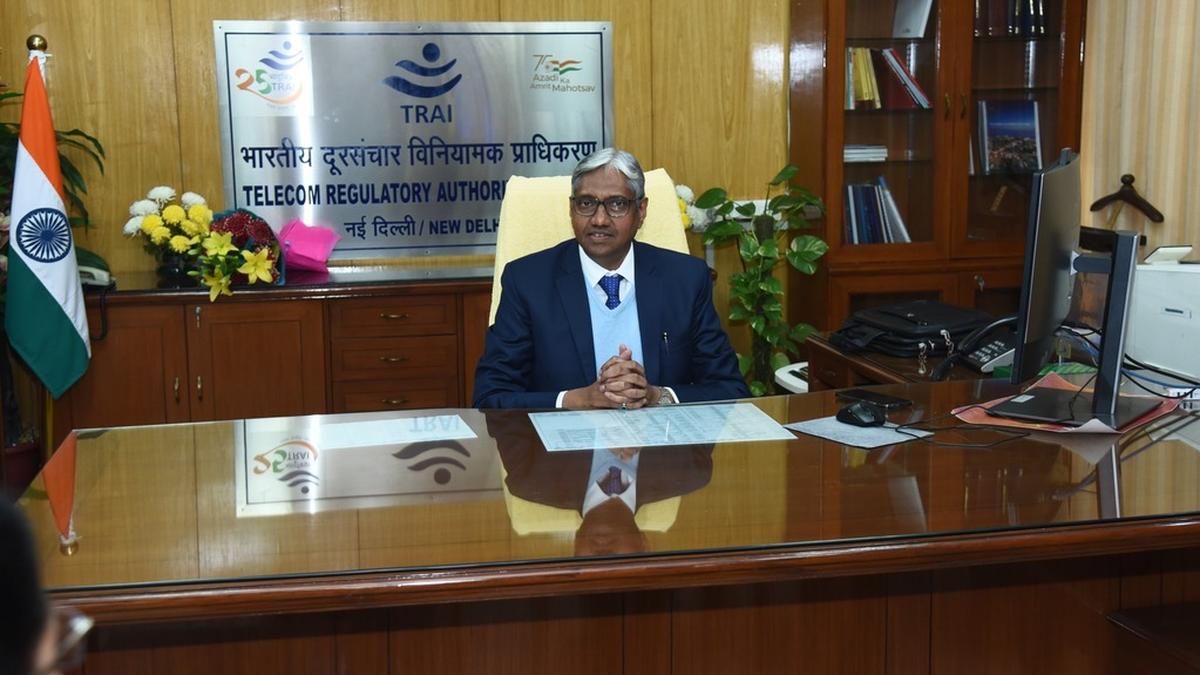
TRAI chief advocates balanced regulatory approach towards traditional and digital media
The Hindu
TRAI Chairman addresses regulatory disparities in broadcasting, emphasizing the need for fair regulations across all mediums.
Telecom Regulatory Authority of India (TRAI) Chairman Anil Kumar Lahoti on Thursday (May 1, 2025) said it was not in favour of creating an environment where regulatory disparities put one medium of broadcasting at a disadvantage over another.
Mr. Lahoti’s remark came days after the Supreme Court sought responses from the Centre and others concerned on a plea seeking a ban on the streaming of sexually explicit content on OTT and social media platforms.
He said: “...the issues which are coming forward now are the regulatory disparities between one medium of dissemination and another. While we do welcome and want technology to come up and provide better and better audio-video experience so that the consumer can enjoy the fruits of the development of the technology, yet we do not want to create an environment where regulation discriminates between two mediums and puts one medium of broadcasting at a disadvantage compared to another; or one medium at a relatively undue advantage compared to another medium.”
Also Read | Right time for ‘create in India, create for world’: PM Modi calls WAVES 2025 global celebration of creativity
Speaking to The Hindu on the sidelines of a panel discussion on ‘Regulating Broadcast in the Digital Age: Key Frameworks & Challenges’ as part of the WAVES 2025, organised by the Information & Broadcasting Ministry, Mr. Lahoti said India has a very progressive regulatory framework so far as the traditional broadcasting was concerned. It was being regularly revised and updated to give the industry the requisite freedom, and also to protect the interest of consumers and small players in the entire value chain, he said.
“TRAI as a regulator has been regularly engaging with the stakeholders to see the need for review and has been updating it regularly,” he said, adding that it issued a revised regulation last year, one that was welcomed by the entire broadcasting distribution industry.
Another significant work done by TRAI in this regard was a complete revamp of the licensing framework for both the television and the radio broadcasting industries, where — in the context of the new Telecommunications Act — it reviewed the framework of the past 30 years and prepared a simplified authorisation structure, enabling ease of doing business. The different terms and conditions of various mediums were harmonised. The entire regulation was made “more or less technology agnostic”, and yet it gave a lot of freedom to the industry for infrastructure sharing etc., he said.


The rupee declines 20 paise to 93.73 against the dollar as global oil prices rise and investor uncertainty persists.

Siemens said on Monday that the Iran war has led to customers holding back on new investments as prices increase for raw materials and energy.

OpenAI said its close ties with Microsoft could be a potential risk to its business, telling investors that the software company is responsible for “a substantial portion of our financing and compute,” CNBC reported

LPG crisis: Alternative solutions are being considered, with ammonia cylinders being increasingly used for industrial applications amid delays in commercial LPG deliveries.

India monitors U.S. military pause on Iran as oil prices dip; External Affairs Minister engages with GCC nations for support.

India monitors U.S.-Iran tensions as Trump pauses attacks, leading to a significant drop in oil prices.

Union Minister Ashwini Vaishnaw launches three initiatives to enhance India's creative economy through AI training, citizen platforms, and advanced tech access.

Two Indian-flagged LPG tankers approach the Strait of Hormuz, navigating safely amidst regional tensions to reach Indian ports.

Gold and silver prices plummet over 7% due to West Asia tensions, inflation fears, and a stronger dollar.

Asian shares fall as rising oil prices and escalating Iran conflict diminish hopes for U.S. interest rate cuts.

Japan's SoftBank Group said Saturday it plans to build a huge new gas-fired power plant in the US state of Ohio

Silver prices plunge 9% to ₹2.06 lakh per kg in futures trade amid weak global cues and rising macroeconomic pressures.

OpenAI plans to nearly double its workforce to 8,000 from 4,500 by the end of 2026, the Financial Times reported on Saturday, citing two people with knowledge