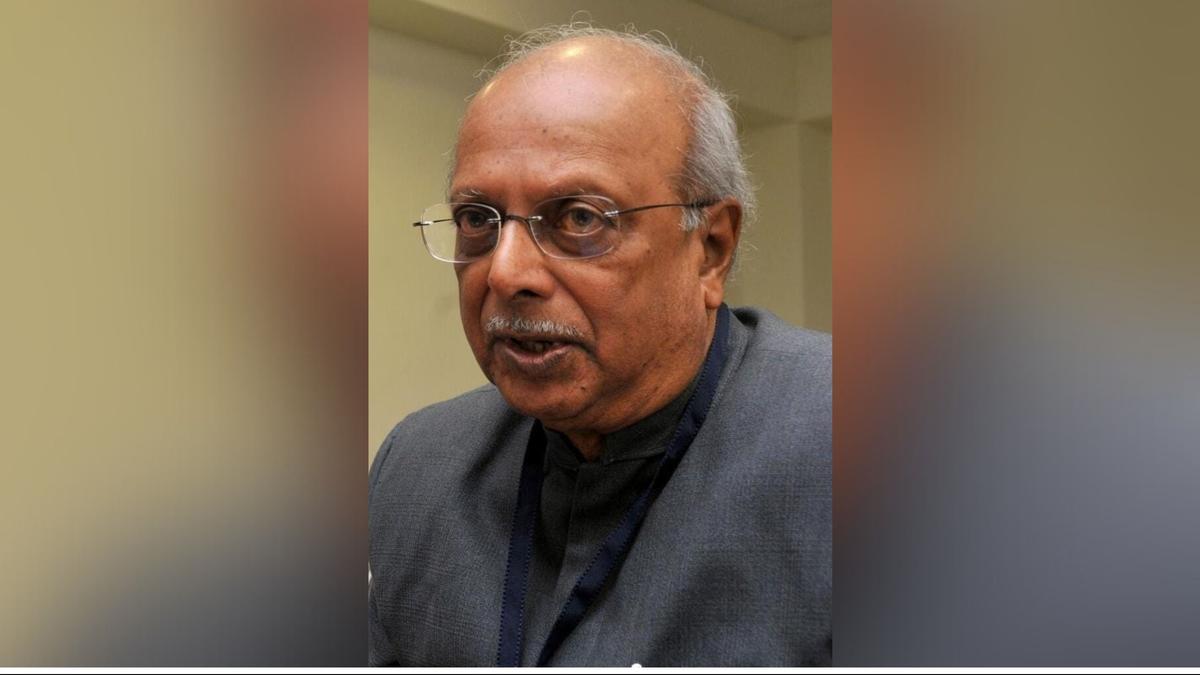
Tissa Vitarana, leader of Sri Lanka’s LSSP, dies at 91
The Hindu
Tissa Vitarana, influential Sri Lankan politician and LSSP leader, dies at 91, leaving a legacy in power devolution efforts.
Tissa Vitarana, leader of Sri Lanka’s leftist Lanka Sama Samaja Party (LSSP) and a key figure in the All Party Representative Committee (APRC) formed in 2006 to develop a political solution to the island’s civil war, died in Colombo early Friday. He was 91.
Drawn to politics in his student days, Prof. Vitarana studied medicine in Sri Lanka before moving into research — he obtained a PhD in virology from the University of London — while continuing his party activities covertly.
After retiring from government service and assuming party leadership, he became a steadfast supporter of former President Mahinda Rajapaksa, helming the science and technology portfolios in his Cabinet from 2004. In the following years, the civil war entered its final, bloody phase, with the Rajapaksa administration facing serious allegations of human rights violations against Tamil civilians, even as the military defeated the Liberation Tigers of Tamil Eelam (LTTE).
Like much of Sri Lanka’s old left, Prof. Vitarana believed that asserting national sovereignty and resisting imperialism called for unconditional support to Mr. Mahinda, who was seen to be opposed to neoliberalism and Western hegemony.
All the same, many — including in the Tamil polity — saw the APRC initiative led by him as a valuable starting point on power devolution to the Tamils. The Committee included 15 political parties and a panel of experts, reflecting diverse political engagement and deliberation on the Sri Lanka’s burning national question. “Prof. Vitarana was rather disappointed that Mahinda Rajapaksa did not make the Committee’s full report public,” said Jayampathy Wickramaratne, former LSSP member and senior lawyer. “That was his greatest contribution, the APRC process.”
M.A. Sumanthiran, General Secretary of Ilankai Tamil Arasu Katchi (ITAK), a prominent party representing Tamils of the island’s north and east, concurred, pointing to Prof. Vitarana’s “valiant efforts” to arrive at political solution that still eludes Tamils. The APRC report had some “excellent features” on power sharing, including doing away with the concurrent list, the former Jaffna MP noted. “When our party was engaged in the process of drafting a new Constitution later (2015-19), we compared it with the proposals that came out in 2000 under President Chandrika Bandaranaike Kumaratunga, and found that the APRC devolved more power to the provinces,” Mr. Sumanthiran said.


Tarique Rahman celebrates a historic election victory, poised to reshape Bangladesh's political landscape amid challenges from rivals and alliances.

UNSC report links Pakistan-based Jaish-e-Mohammed to Red Fort attack that killed 15, highlighting ongoing terrorism concerns.

EU leaders unite to enhance economic competitiveness against global pressures from Trump, China, and Russia through coordinated restructuring measures.

U.S. and Taiwan finalize a trade deal to reduce tariffs and increase purchases of American goods, enhancing economic ties.

Netanyahu seeks to revoke Israeli nationality from Palestinian citizens convicted of violent crimes, raising legal and ethical concerns.

Angela Merkel will deliver the inaugural Dr. Manmohan Singh Memorial Lecture on February 26, focusing on Germany-India relations.

U.S. diplomat Paul Kapur emphasizes the Quad's importance for strategic cooperation and defense in South Asia during a congressional hearing.

Polling for Bangladesh's parliamentary election and constitutional referendum concluded, with early results expected by February 13, 2026.

U.S. Judge denies BBC's stay request in Trump's defamation case, citing premature application and lack of demonstrated prejudice.

Roman Gautam critiques India's 'Neighbourhood First' policy, highlighting its failures amid rising political tensions in Bangladesh and Nepal.

Test your knowledge of Abraham Lincoln's life with our daily quiz celebrating his 217th birthday!

Seattle settles for $29 million with the family of Jaahnavi Kandula, tragically killed by a speeding police officer in 2023.

Pakistan's Supreme Court orders a medical board to assess Imran Khan's vision loss and allow communication with his children.