‘Thunderbolts*’ movie review: Florence Pugh shines amid the ennui of Marvel’s mid-life crisis
The Hindu
Wavering under the weight of multiversal expectations, ‘Thunderbolts*’ offers the MCU a welcome detour with its melancholic ensemble piece about has-beens learning to matter again
With Thunderbolts* (the asterisk denotes a little something that’s worth ceasing all phones at early screenings), Marvel Studios offers a strange something. Not a new beginning, not even an end, but a reluctant middle piece to its dwindling self-worth nearing the conclusion of Phase-5. After a decade-plus of spandex operatics, cosmic showdowns, and multiversal migraines, we’ve arrived at the era of mid-tier misfits and discards. The Avengers are either dead, de-aged, or trapped in development hell. The remaining bench is a set of weary characters staring down the abyss of their own irrelevance.
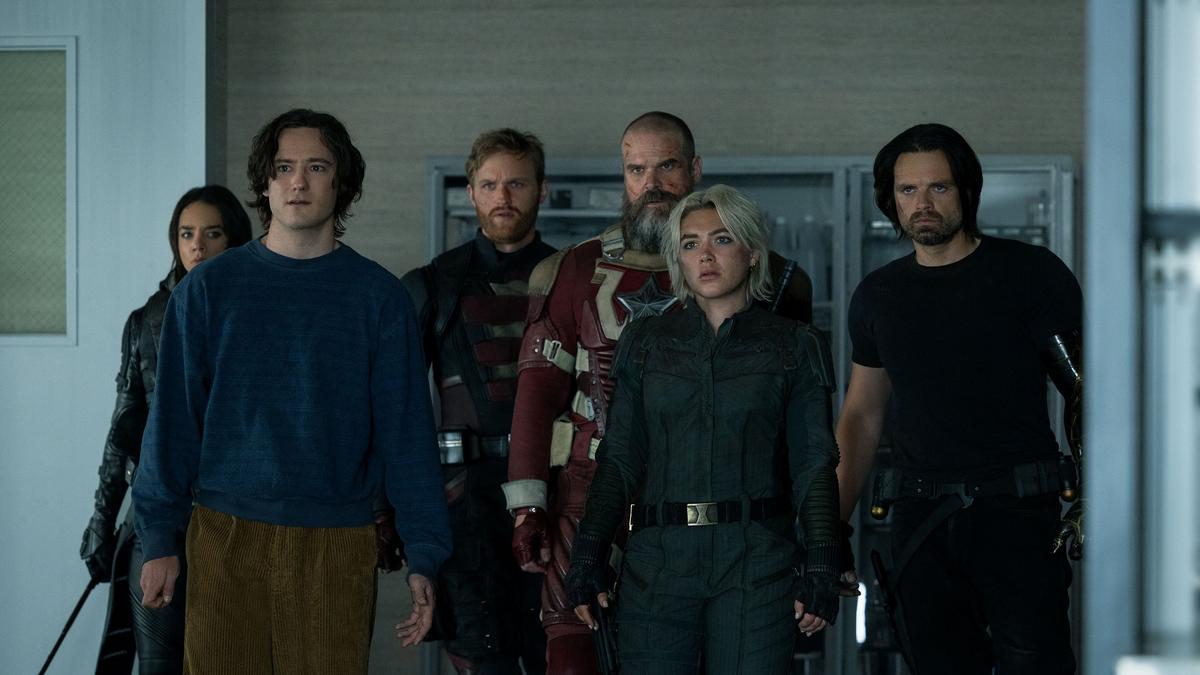
A former child assassin, a disgraced Captain America knockoff, a super-assassin turned congressman, a haunted quantum blur, a Soviet relic, and a human emotional contagion named Bob. They’ve been shelved, sidelined, and mostly forgotten — by their government handlers, by the world they supposedly saved, and, most damningly, by their jaded audiences who’ve long since moved on. What throws Thunderbolts* a lifeline in the slow, defibrillator rhythm of a post-Endgame Marvel is that Kevin Feige has finally started to admit that the party might just be over.
Once a promising successor to her late sister Natasha Romanoff’s Black Widow, Florence Pugh returns as Yelena Belova, still mourning her sister, still drolly Russian, and still the Phase-5’s most emotionally legible performer. She wears her disillusionment like a second skin and her job is no longer to avenge, but to merely trudge along begrudgingly, and that’s proving more difficult by the day. “Maybe I’m just bored,” she says early on, which feels like a discerning summation of the post-Endgame age.Thunderbolts* doesn’t solve that problem. But it does acknowledge it with unusual clarity, and that alone makes it one of Marvel’s more human efforts in years.
Director Jake Schreier (of Robot & Frank and the 2015 adapatation of John Green’s Paper Towns) brings a light indie touch to the proceedings. He doesn’t seem particularly interested in the convoluted lore or flashy pyrotechnica of modern superhero fare, and instead, lets his cast rattle around in desaturated corridors and puts them in vulnerable spots. No one could reinvent the MCU at this point, but he does subtly redirect it.
The plot, as is often the case, is the weakest link. CIA head honcho Valentina Allegra de Fontaine (Julia Louis-Dreyfus, whose dry wit is underserved by the script) tricks our assorted antiheroes into a mission that’s really a death trap. One by one, they realise they’ve been sent to eliminate each other, and we soon get a slow-burn mutiny of sad-eyed soldiers who would rather hug it out than throw punches, at least most of the time.
David Harbour’s Red Guardian continues his grumpy dad routine with winning goofiness. He gets some of the film’s funniest lines (Yelena’s pee-wee soccer team becomes an ongoing source of oddly affecting pride), but his real role is to tether the film’s sky-high gloom to something earthbound and foolishly tender. Sebastian Stan’s Bucky Barnes also reappears, with a more grounded gravitas that reminds you he once had a more engaging storyline. Wyatt Russell’s John Walker, still festering from The Falcon and the Winter Soldier, scowls his way through a majority of the film, and Hannah John-Kamen’s Ghost remains half-formed, but that feels appropriate — her power is literally to phase in and out. And Olga Kurylenko’s Taskmaster… well.
These are characters stuck in a kind of cinematic purgatory. They’re not quite important enough for franchise salvation, but not disposable enough to be killed off. They’re the narrative flotsam of past installments, with enough courage to question what actually happens to a superhero deferred. The action is competent but rarely thrilling and the colour palette leans hard on shadows and grime. But amid the industrial drabness, a freshness takes form and the characters begin to breathe.


Khalid Rahman is reuniting with Malayalam superstar Mammootty after Unda (2019). The Thallumaala director has teamed up with the veteran for Mattancherry Mafia.

Bollywood actor Akshay Kumar paid tribute to the martial arts grandmaster and Hollywood’s action star, Chuck Norris, who passed away on Thursday, March 19, 2026.

Renowned Odissi dancer Madhumita Raut, aged 59, dies of cardiac arrest, leaving behind a legacy of artistic achievements.

Chuck Norris, iconic martial arts master and actor, dies at 86, leaving behind a legendary legacy and internet memes.

South African naturalist Steve Boyes speaks on ghost elephants, ancestral tracking, and Werner Herzog’s documentary exploring Angola’s elusive highland giants

Actor-director Amol Palekar will receive META's Lifetime Achievement award for 2026 on March 25 in New Delhi.

India's artists unite against rising censorship, advocating for creative freedom and support for marginalized voices in the arts.

Written and directed by Kunal, the film also stars Sparsh Shrivastava and Vanshika Dhir

This year, Bharatnatyam artistes will present the Tyagaraja Aradhane as a dance performance

This year, Bharatnatyam artistes will present the Tyagaraja Aradhane as a dance performance

The actor, along with director Sushant Shah, speak about their upcoming series ‘Chiraiya’, Divya’s process of working on the dialect, Sushant’s approach to telling a story about women, and more

An independent video, ‘Feel the Spark’ by Raleigh Rajan with vocals by Ciera Dumas that celebrates Tamil literary giants, garnered 1.4 million views in less than 36 hours.

In ‘Jack Ryan: Ghost War’, John Krasinski is back as the savvy CIA analyst, diving headfirst into a high-stakes mission that unravels a deadly conspiracy and pits him against a rogue black-ops unit