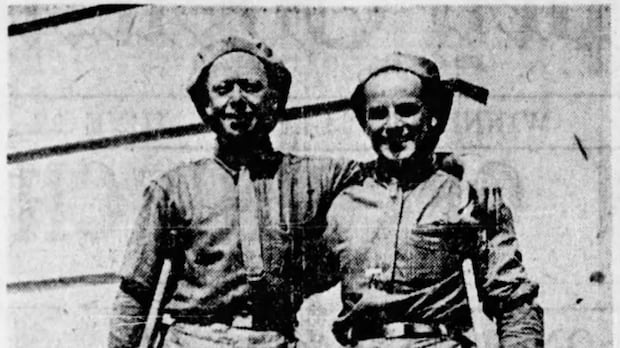
These WW I amputees hiked from Alberta to Ontario on crutches a century ago
CBC
More than 100 years ago, George Hincks and Marshall McDougall met in a Calgary military hospital and hatched a truly spectacular plan.
It was 1923, and both men were struggling to reintegrate into society after they each lost a leg during the First World War. Tired of being underestimated because of their disabilities, they decided to hike, on crutches, from Alberta to Ontario.
They embarked on their journey almost 60 years before Terry Fox made history with his Marathon of Hope.
But unlike Fox, Hincks and McDougall have been, by and large, forgotten by history — until historian Eric Story came across their names in an old military magazine and decided to share their incredible feat.
“It's truly unfathomable,” Story, a postdoctoral researcher at Western University in London, Ont., told As It Happens host Nil Köksal. “They're hiking 30 kilometres per day for almost two months ... and the technologies, the prosthetic technologies, crutches, they're not like they are today.”
Calgary’s Lauren McDougall, Marshall McDougall’s great-grandniece, came across the story herself a while back when she was researching her family tree and said she’s thrilled to see this buried history brought to light.
“I never understood why I didn't know of any of these people before my own research on them,” she told Köksal. “It's kind of crazy, but it's a pretty exciting story."
Her great-granduncle, she said, was known for having “a pretty good sense of humour and a positive energy."
So she suspects that when he and Hincks first hatched their plan in that Calgary hospital all those decades ago, he simply saw it as a fun challenge between two pals. But it quickly transformed into so much more.
“They do an amazing thing to bring awareness to the communities as they're going about what needs to happen and what supports need to be in place for these soldiers returning from the war, and especially those affected by amputation,” Lauren McDougall said.
Story, who traced the pair’s journey in newspaper coverage at the time, said the soldiers emerged from the war during a time when Canada was transitioning “from a rural agricultural society to one that was very much powered by industrial capitalism."
“It was in that transformation that people with disabilities were [beginning] to be regarded as inefficient workers and ultimately unproductive members of society because their bodies were not conformed to the tasks of an industrial capitalist society,” he said.
“These are kind of the ideas that Hincks and McDougall are really trying to tackle in their trek ... to show Canadians that they were not inefficient workers, they were not unproductive members of society. The very opposite, actually. They are trying to show that they had as much grit — even more grit — than other Canadians.”
The journey, indeed, took a lot of grit. While the duo initially planned to walk from Calgary to Ottawa, they called off the trip in Thunder Bay, Ont., because they were under too much physical duress. Decades later, Fox also ended his Marathon of Hope just outside the northern Ontario city, where a bronze statue of the young runner was unveiled in 1982.


Family and friends are expressing fears for a Penticton, B.C., woman and her daughter who have been detained by U.S. authorities in Texas and are currently in an immigration holding facility.

WARNING: The following story contains mature subject matter, including racist and hateful imagery.

This summer, approximately 65,000 soccer fans will swarm the city’s waterfront to cheer at Toronto Stadium and the Fort York fan festival, but with only three months to go, the TTC has yet to paint a clear picture of how it will handle the stream of visitors.

It seems like everything costs more these days, and chocolate is no exception.

Alberta Premier Danielle Smith is seeking security clearance to receive briefings on foreign interference in her province, but the leader of the Opposition says she shouldn't be trusted with it.

Big dogs are loyal canines, affectionate and sweet, but often overlooked when it comes to pet adoption, according to a city agency.

In advance of what is expected to be a hot summer, the City of Kamloops is encouraging homeowners to request a free assessment of their properties to make sure they are resilient in the face of wildfire.

The proportion of hours worked by Indigenous and northern workers on the Giant Mine Remediation Project has dropped over the last few years, according to figures provided to Yellowknife city council this week.

City officials say Calgary's water usage was once again above the recommended threshold of 500 million litres on Wednesday, after two consecutive days of landing in the "green zone."

Emergency crews are on the scene of a mudslide in Coquitlam, B.C., that knocked out power for about 5,000 customers on Thursday.

Calls for the judge in the Umar Zameer case to apologize for suggesting three Toronto police officers colluded and lied in the high-profile criminal trial are "unethical" and "inappropriate," Geoffrey Morawetz, the chief justice of the Ontario Superior Court, said Thursday.

Conservative Leader Pierre Poilievre sat down for a more than two-hour-long interview on The Joe Rogan Experience this week.

Brandon Tobin killed his grandmother after a drug-induced seizure. A judge will soon decide his fate
A sheet of white paper shook in Brandon Tobin's hands as he read aloud his message to the judge on Thursday morning.