The time-travelling dhurrie
The Hindu
Museum of Art & Photography collaborates with Microsoft to launch an AI-powered, interactive digital platform that guides the viewer through textile history across regions and eras
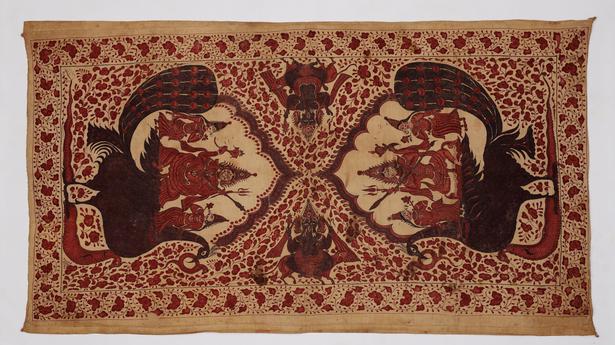
A Persian kalamkari wall hanging that dates back to the late 17th Century or early 18th Century is my starting point. A closer look at the fabric reveals a royal personage seated in a pavilion surrounded by crocodiles and an elephant-like figure beside which stand seven disciples in courtly attire. The scene is perhaps set in a garden. Boasting the kalamkari technique of hand painting and block printing that involves resist dyeing, the fabric is a welcome mix of red, maroon and indigo, outlined with black.
A single click away, connected to the former by an artery, is a carpet adorned with flower motifs that originated between 1750 and 1850, possibly in Armenia or Dagestan. Aided by more informative arteries, a rich textile history reveals itself on screen. Thanks to AI (Artificial Intelligence) and machine learning powered by Microsoft, Interwoven, a vast collection of South Asian textiles that the Museum of Art & Photography (MAP) prides itself on, has just become globally accessible.
The platform, which is fairly easy to navigate, has filters to explore connectors and differentiators between each piece of textile: patterns and motifs, geographies and cultures, date and eras, and the like. One also gets to devise a custom journey on selecting a single piece of art.
The still-growing collection of MAP has been in the works for one-and-a-half years. “The reason we chose textiles is because it uncovers all these connections between regions and cultures. Take South Asian textiles for instance: our craftsmen have mastered some of the most complex weaving techniques and produced exquisite textiles that travelled over the seas because of the strong trade connections that existed. We have been in the world market for centuries,” says Kamini Sawhney, director, MAP. Though Interwoven draws on the strong textile base in the museum’s collection, it also includes artefacts from institutes across the world, such as the V&A (London), MET (New York), Rietberg (Zürich), and the Royal Ontario Museum (Canada).
AI as a technology is clearly being adopted across multiple domains and sectors, Rohini Srivathsa, national technology officer at Microsoft India, quips. AI for Good is a Microsoft initiative that, over the next five years, will show significant commitment to use the technology to address some of the challenges as well as opportunities in the world. “AI for Cultural Heritage is one of five such programmes. And this collaboration is a marriage made in heaven,” she adds.
“The thinking behind the experience when you go on the site, in terms of the journeys that people go through, comes from the MAP academy. Behind the scenes, there is quite a bit of technology that plays in — AI text analytics, cognitive search, custom vision, computer vision... There is a tremendous amount of tagging of data and developing of training models that happens in the background. But once you create that, the machine learning and AI engines are able to recognise some interesting connections between MAP and the partner museums,” says Rohini. These are connections that the human eye will perhaps fail to see. “It opens up abilities to create a very personalised experience,” she adds. When the right tools are placed within the hands of domain specialists and experts, the technology takes on the role of a multiplier.
“There are two options for the viewer: the curated journey and the customised journey. The former is created by the educational research team at the MAP academy. For this, AI throws up connections between different global artefacts, and then the team researches and expands on them to create a journey. For example, in Leisure and Play, you would see motifs of hunting, reading or play. A colourful dhurrie from the 1940s depicts a hunting scene, leading you to an artefact from the Smithsonian Institute that shows the eagle dance from the 1830s.” Each time, the customised journey would be different (for the same viewer). Thus, an artist’s view would be different to that of a conservationist or a collector.


Mercedes-Benz CLA 250+ with EQ Technology review: design, performance, range and features explained. Discover how the new electric CLA combines advanced AI, long range, fast charging and futuristic styling for the next generation of luxury EVs.

Pi Day is celebrated every year on March 14, honouring the significance of the mathematical constant π and its applications in mathematics.

Discover how sculptural interior design transforms modern spaces, blending creativity and functionality to evoke emotion and identity.

A study reveals that certain antibiotics can cause long-lasting changes in gut microbiome diversity for up to eight years.

Indian scientists and international experts are divided over a study questioning the viability of a nuclear reactor fuel called HALEU-thorium; while critics cite safety risks, proponents argue the technology is vital to achieve national energy goals.

ISRO and AIIMS partner to enhance space medicine research, focusing on human health during long-duration space missions.

A practical guide to induction setups for students, families, and home food businesses as India’s LPG supply faces its biggest disruption in years

Explore the electrifying Oscars 2026 race, featuring standout films, baffling nominations, and memorable performances amid a cinematic transition.

Zai and Rom Whitaker’s latest book for young readers, The Book of Indian Snakes, tackles common misconceptions surrounding snakes, highlighting their utility to humans

Discover PC Mahalanobis's pivotal role in India's statistical revolution and his lasting influence on modern statistics in this episode.

Explore why nothing can exceed light speed and the paradoxes that arise if it were possible.

Scientists have engineered bacteria to produce designer proteins by smuggling artificial amino acids, enabling precise drug delivery and multifunctional applications.

Scientists successfully grew chickpeas in simulated lunar soil, paving the way for future extraterrestrial agriculture on the moon.