The Svedberg show Premium
The Hindu
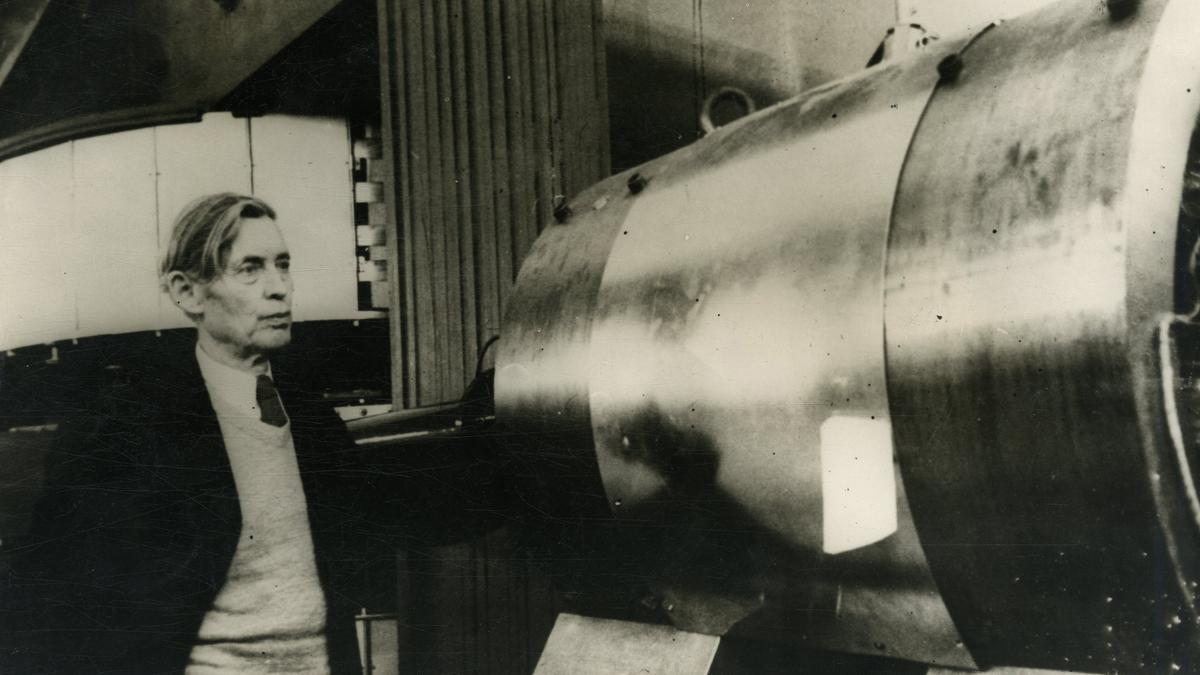
Theodor Svedberg, more commonly referred to as just The Svedberg, is a Nobel Prize in Chemistry 1926 winner “for his work on disperse systems.” He applied for one of his early patents on June 1, 1909, and spent a lifetime working with colloids, in addition to inventing the ultracentrifuge. A.S.Ganesh tells you more about The Svedberg…
Born on August 30, 1884 at Flerang in the parish of Valbo near Gavle, Sweden, Theodor (The) Svedberg was the only child of Elias Svedberg and Augusta Alstermark. The fact that his father was a works manager at different ironworks in Sweden and Norway meant that the family lived at a number of places in Scandinavia during his childhood. His father made it a point to take him out for excursions often, allowing him to develop a love for nature and a keen interest in botany.
Svedberg attended the Koping School, the Orebro High School and Gothenburg Modern School and had the privilege of being taught by some prominent teachers. These teachers were also understanding, allowing Svedberg to study on his own. This gained him access to laboratories after ordinary classes and Svedberg spent time in the afternoons at the physical and chemical labs of the school.
Stoked by the advent of new discoveries and inventions in both physics and chemistry, Svedberg went about building stuff on his own. He created a Marconi-transmitter and a Tesla-transformer this way and even arranged public demonstrations that included wireless telegraphy between two blocks of his school.
Even though he had a passionate interest in botany, he decided to study chemistry following his hands-on efforts in his school laboratories. This experience also put him in good stead when he went on to experiment with colloids later on.
After matriculating from school, Svedberg began a lifelong association with Uppsala University in January 1904. It was here that he received his Bachelor of Arts degree in 1905, his Master’s degree in 1907 and Doctor of Philosophy in 1908.
While still studying, Svedberg accepted a post as assistant in the Chemical Institute at Uppsala. This means that Svedberg’s scientific career set off in 1905, while he was still in his early 20s. By 1907, he was given the added responsibility of serving as lecturer in chemistry in the university. It wasn’t long before a special appointment as lecturer and demonstrator of physical chemistry came through in 1909. In 1912, he was elected Professor of Physical Chemistry, Uppsala University – a position he held onto until 1949, when he was made emeritus.
It was in 1949 that Svedberg took on the role of director of the Gustaf Werner Institute for Nuclear Chemistry at the University. He remained at this post until 1967 and the institute was renamed The Svedberg Laboratory in 1986, about 15 years after his death in 1971. The facility was permanently shut down in 2016, following a decision a year earlier to implement decommissioning.


Mercedes-Benz CLA 250+ with EQ Technology review: design, performance, range and features explained. Discover how the new electric CLA combines advanced AI, long range, fast charging and futuristic styling for the next generation of luxury EVs.

Pi Day is celebrated every year on March 14, honouring the significance of the mathematical constant π and its applications in mathematics.

Discover how sculptural interior design transforms modern spaces, blending creativity and functionality to evoke emotion and identity.

A study reveals that certain antibiotics can cause long-lasting changes in gut microbiome diversity for up to eight years.

Indian scientists and international experts are divided over a study questioning the viability of a nuclear reactor fuel called HALEU-thorium; while critics cite safety risks, proponents argue the technology is vital to achieve national energy goals.

ISRO and AIIMS partner to enhance space medicine research, focusing on human health during long-duration space missions.

A practical guide to induction setups for students, families, and home food businesses as India’s LPG supply faces its biggest disruption in years

Explore the electrifying Oscars 2026 race, featuring standout films, baffling nominations, and memorable performances amid a cinematic transition.

Zai and Rom Whitaker’s latest book for young readers, The Book of Indian Snakes, tackles common misconceptions surrounding snakes, highlighting their utility to humans

Discover PC Mahalanobis's pivotal role in India's statistical revolution and his lasting influence on modern statistics in this episode.

Explore why nothing can exceed light speed and the paradoxes that arise if it were possible.

Scientists have engineered bacteria to produce designer proteins by smuggling artificial amino acids, enabling precise drug delivery and multifunctional applications.

Scientists successfully grew chickpeas in simulated lunar soil, paving the way for future extraterrestrial agriculture on the moon.