The Supreme Court Looks At Further Loosening Campaign Finance Rules. What Could Go Wrong?
HuffPost
Experts argue it’s a decision the Supreme Court has no business making.
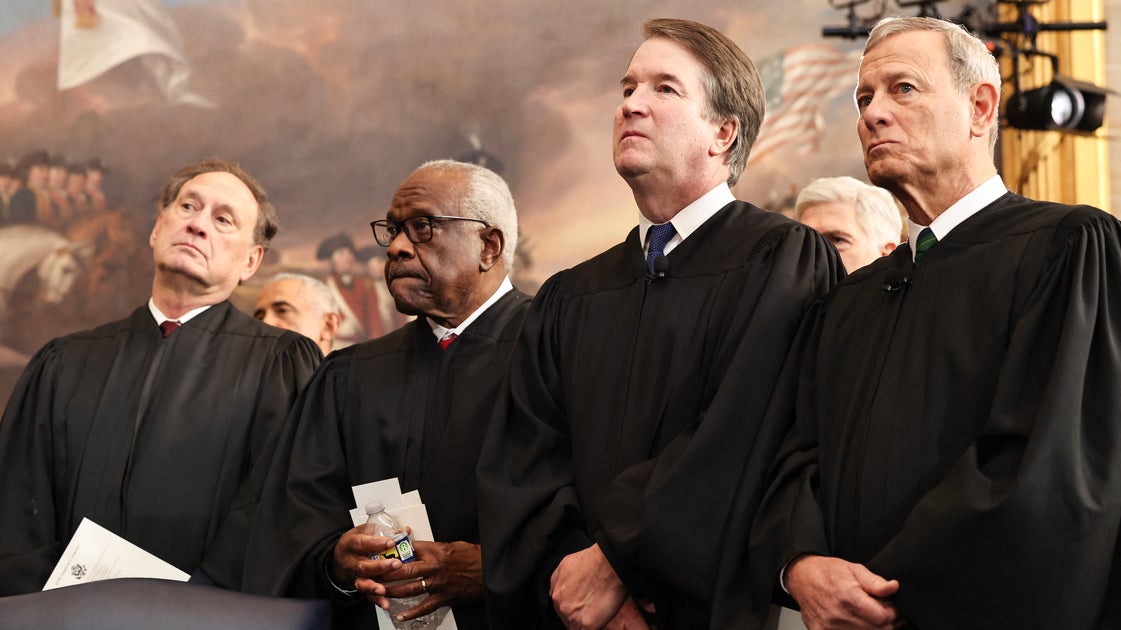
The Supreme Court has steadily loosened campaign finance rules in a series of decisions ever since Chief Justice John Roberts was confirmed in 2005. They will look to go further on Tuesday, when the court hears arguments in a case challenging the 50-year-old limits placed on coordinated spending between parties and candidates.
In NRSC v. Federal Election Commission, a Republican campaign committee is challenging limits placed on how much money political parties can spend in direct coordination with candidates. Those limits, which were put in place in the Federal Election Campaign Act of 1971, were intended as a companion to other rules on how much individuals can contribute to individual campaigns, preventing deep-pocketed contributors from using donations to parties as a work-around to those limits. The current limits on how much a party can spend in coordination with a specific candidate vary, from $63,600 for most House races up to $3.9 million for Senate races in California and even more for presidential candidates.
The case stems from Vice President JD Vance’s 2022 Senate campaign in Ohio. During the primary, Vance’s fundraising lagged behind his GOP opponents and he relied on outside spending from billionaire Peter Thiel to push him over the top. He continued to struggle to raise money in the general election against Democratic Rep. Tim Ryan. (Vance eventually won.) And so, the National Republican Senatorial Committee, the chief political committee for GOP Senate candidates, and Vance brought suit to allow the party to spend unlimited sums in direct coordination with their candidate, arguing the coordination limits infringed on core First Amendment rights for political speech.
Lawyers for the NRSC argue that the limits in question block constitutionally protected political speech and do not prevent corruption or its appearance. Since “no one seriously claims that parties are trying to bribe their candidates,” the limits have been defended and upheld in the past as preventing “quid pro quo-by-circumvention,” the NRSC brief states. But this justification was ruled out-of-bounds in the court’s 2014 decision in McCutcheon v. FEC and so the party coordination limits should be struck down, the brief argues.
Indeed, preventing the circumvention of contribution limits is at the heart of the coordinated spending limits. If a political party can raise nearly $1 million from a single donor who wants to spend that on a particular candidate, the party can effectively contribute that $1 million — or more — to the candidate’s campaign by funding, for example, their advertisements as a coordinated expenditure. Since candidates are limited to raising $3,500 per election from a single donor, this would be a major way to circumvent those limits, which are at the heart of campaign finance regulation.


Foreign Minister Abbas Araghchi says Iran is open to helping other countries' safe passage through the Strait of Hormuz.

Chris Wright boasted he's "proud" of Trump’s handling of the Iran war, claiming the president is "all about low gas prices, low diesel prices, low energy prices.”

Even some of the president's supporters are questioning his plan and his overall poll numbers are declining.

“Every time a new headline is dropped, it feels personal.”

With the help of millions in special interest cash, two former Illinois House members could head back to Washington.

The president shared an image on Saturday celebrating his impact on the free press.

Sen. Mark Kelly (D-Ariz.) was persecuted last year by Defense Secretary Pete Hegseth for reminding U.S. troops that they can defy unlawful orders.

The "Real Time" host on Friday expressed bewilderment about the U.S. failing to secure the Strait of Hormuz after previously admitting support for the war.

President Donald Trump lambasted news outlets over a report on Iranian missiles hitting U.S. tanker planes.

Trump already endorsed the Republican running in the coming special election, even though his home is not in the district and he is registered to vote at a motel a half hour away.

Trump announced the strike on Kharg Island just hours after the interview aired.

The report also said authorities have not revealed his real name.

Trump has previously suggested, without evidence, that Iran possessed Tomahawk missiles and may have been responsible for using them in a strike on an Iranian girls' school.