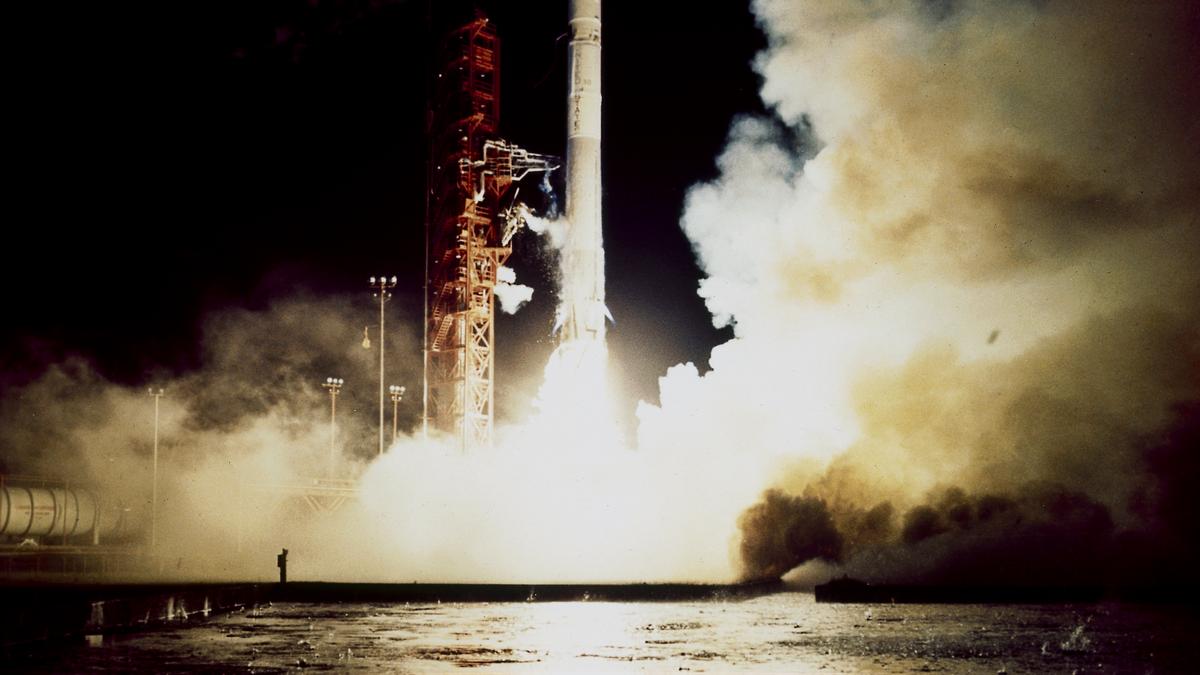
The first probe to encounter Saturn
The Hindu
Launched on April 6, 1973, Pioneer 11 was NASA’s robotic space probe that studied Jupiter and Saturn. Pioneer 11, in fact, was the first spacecraft to make direct observations of Saturn and discover its F ring. A.S.Ganesh takes you on a quick ride aboard Pioneer 11…
The late 1970s provided a rare alignment of Jupiter, Saturn, Uranus, and Neptune that scientists wanted to use to their advantage. Gravity assists, also known as slingshots or planetary swingby, are spaceflight manoeuvres that utilise the gravitational pull of a planet to change the spacecraft’s trajectory and velocity, thereby travelling farther and faster, while using up lesser fuel. During this particular alignment, which happens once in about 175 years, NASA planned to send a pair of Voyager spacecraft to study Jupiter and Saturn, and explore Uranus and Neptune too if that was possible. Before that, they had to make sure that a spacecraft could survive passing the asteroid belt and the strong radiation belts of Jupiter. The Pioneer spacecrafts – Pioneer 10 and Pioneer 11 – were envisioned as pathfinders for the Voyagers.
Following the successful launch of Pioneer 10 on March 2, 1972, its twin Pioneer 11, which was initially conceived as a backup, was launched on April 6, 1973. It sped away from Earth at a velocity of about 51,800 km per hour, matching the speed of its twin. In the interim 13 months, Pioneer 10 – the first spacecraft to travel beyond the orbit of Mars – had already gone past the asteroid belt and was on its way to fly by Jupiter in December 1973.
This meant that mission planners could tweak Pioneer 11’s course after Pioneer 10’s successful observations of Jupiter. Once Pioneer 11 crossed the asteroid belt without incident in mid-March 1974, two course corrections were carried out within 15 days of each other in April and the probe was retargeted in May such that it could use Jupiter’s gravity to make its way to Saturn. The new trajectory ensured a polar flyby of Jupiter, also taking Pioneer 11 much closer to the giant planet.
Pioneer 11’s encounter with Jupiter began in November that year, with the closest approach taking place on December 3, 1974. It managed to get three times closer than Pioneer 10 and was about 42,500 km from Jupiter’s cloud tops. Travelling at the speed of 1,71,000 km per hour by this time, Pioneer 11 was faster than any human-made object at the time. This high speed also meant that the probe’s exposure to Jupiter’s radiation belts was for a shorter time than Pioneer 10, even though it had gone closer than its predecessor.
Having first penetrated the Jovian bow shock (when a supersonic object moves through a medium and causes the material in the medium to pile up, compress, and heat up, then the result is a type of shock wave known as bow shock) on November 25, Pioneer 11 repeatedly crossed the planet’s bow shock. This indicates that the magnetosphere of Jupiter changes its boundaries as it is pushed roughly from side to side by the solar wind.
Pioneer 11 snapped plenty of pictures of Jupiter, including the most detailed images until then of the Great Red Spot. It also mapped Jupiter’s polar regions and clicked about 200 photographs of Jupiter’s satellites. Once through with Jupiter, it utilised the planet’s colossal gravitational field to swing back across the solar system – set on a course towards Saturn.
Following course corrections in May 1976 and July 1978 to sharpen its trajectory towards Saturn, Pioneer first detected the ringed planet’s bow shock on August 31, 1979 at a distance of about 1.5 million km from the planet. This was the first conclusive evidence of the existence of a magnetic field around the sixth planet of the solar system.


Discover groundbreaking research on Titan's lakes, bat vaccinations, and the unique aroma of ripening bananas in just one minute.

IRSO's NavIC system faces challenges as the last atomic clock fails, reducing operational satellites for navigation services.

Discover efficient pressure cooking techniques to save up to 50% on fuel. OPOS B Ramakrishnan tells you how

Mercedes-Benz CLA 250+ with EQ Technology review: design, performance, range and features explained. Discover how the new electric CLA combines advanced AI, long range, fast charging and futuristic styling for the next generation of luxury EVs.

Pi Day is celebrated every year on March 14, honouring the significance of the mathematical constant π and its applications in mathematics.

Discover how sculptural interior design transforms modern spaces, blending creativity and functionality to evoke emotion and identity.

A study reveals that certain antibiotics can cause long-lasting changes in gut microbiome diversity for up to eight years.

Indian scientists and international experts are divided over a study questioning the viability of a nuclear reactor fuel called HALEU-thorium; while critics cite safety risks, proponents argue the technology is vital to achieve national energy goals.

ISRO and AIIMS partner to enhance space medicine research, focusing on human health during long-duration space missions.

A practical guide to induction setups for students, families, and home food businesses as India’s LPG supply faces its biggest disruption in years

Explore the electrifying Oscars 2026 race, featuring standout films, baffling nominations, and memorable performances amid a cinematic transition.

Zai and Rom Whitaker’s latest book for young readers, The Book of Indian Snakes, tackles common misconceptions surrounding snakes, highlighting their utility to humans

Discover PC Mahalanobis's pivotal role in India's statistical revolution and his lasting influence on modern statistics in this episode.