‘The Bride!’ movie review: Maggie Gyllenhaal’s glam-goth Frankenstein can’t hold its stitches
The Hindu
‘The Bride!’ movie review: Jessie Buckley and Christian Bale spark a feral, fascinating chemistry, though even their undead romance struggles to animate Maggie Gyllenhaal’s unruly feminist monster mash
A goth-punk feminist revival of Mary Shelley refracted through noir fatalism, vaudevillian spectacle, and a lovers-on-the-run romance that echoes the outlaw mythology of Bonnie and Clyde sounds like the sort of delirious cinematic cocktail that could only thrive under the watch of a filmmaker eager to test the limits of studio indulgence, and Maggie Gyllenhaal’s The Bride! indeed begins with that spirit of gleeful overreach, hurling together the undead, gangsters, musical numbers, and a manifesto about female authorship with the manic enthusiasm of someone rummaging through a century of pop culture and literary memory at once. Yet, the experience of watching it involves a constant awareness of its fragility, because every new flourish is perched perilously on the edge of collapse, and the film repeatedly proves how difficult it is to sustain such a baroque assemblage without the seams giving way and the underlying machinery spilling into view.
The Bride! situates its monstrous romance in a stylised 1930s Chicago where mobsters dominate smoky restaurants, punk-jazz pulses through underground clubs, and the ghost of Mary Shelley hovers over events with a mischievous interest in rewriting her own literary legacy. Jessie Buckley appears first as Ida, a brash party girl whose confrontation with a gangster ends in a violent death that turns her into the perfect raw material for a lonely creature seeking companionship. Christian Bale’s Frank, the century-old survivor of Victor Frankenstein’s experiment, persuades a renegade scientist named Dr. Euphronious, to resurrect the corpse and craft the partner he believes will end his wandering solitude.
The revived woman awakens without memory and gradually assumes the mantle of the Bride, while fragments of Shelley’s spirit erupt through her consciousness in unsettling Tourettes-like bursts that transform her into a mouthpiece for rage, rebellion, and stray literary echoes. Their escape from Chicago evolves into a fugitive journey that stretches toward New York and beyond, while detectives pursue them and newspaper headlines mythologise their crimes, allowing the film to toggle between monster movie, gangster chase, and tragic romance.
Gyllenhaal constructs this world through a flamboyant collage of references that draw equally from Depression-era musicals, shadow-soaked noir, and the feverish iconography of gothic literature — the production design leans hard into that eclecticism by filling soundstage streets and nightclubs with art-deco textures, gleaming marquees, and velvety darkness that feels borrowed from classic studio melodrama.
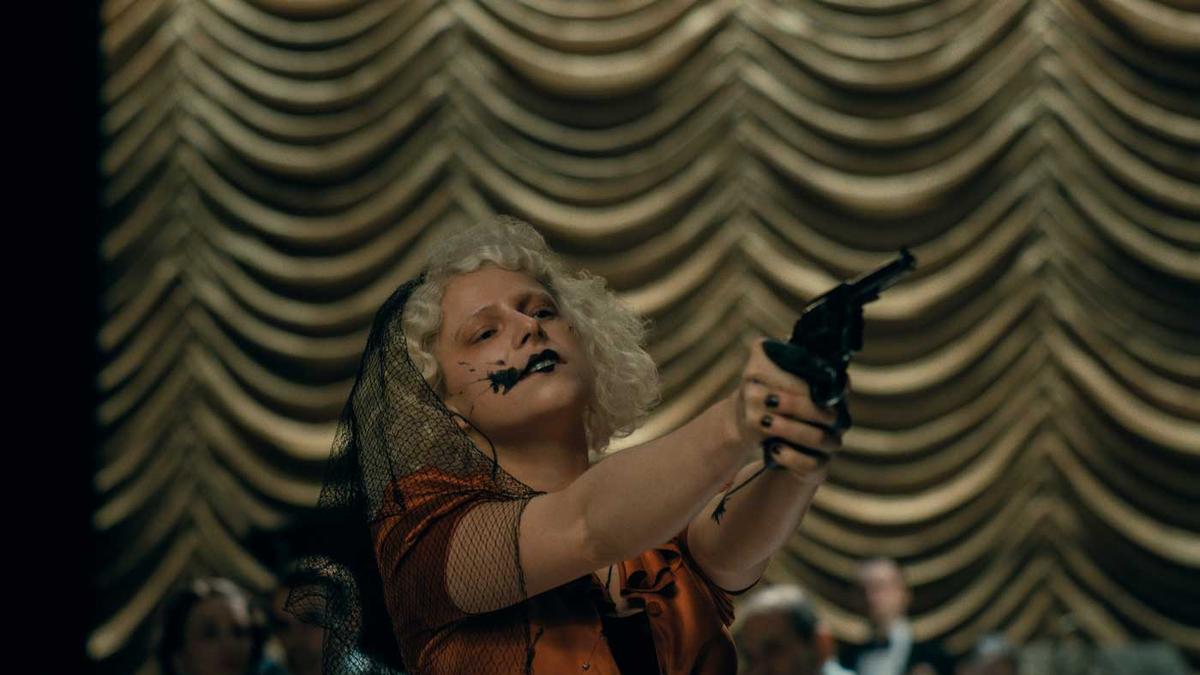
Sandy Powell’s costumes mix period silhouettes with a punk vocabulary that allows the Bride to move through flapper dresses, fur stoles, and streaks of anarchic black makeup as if the 1930s had collided with a modern underground fashion show, while Lawrence Sher’s cinematography bathes the film in a mixture of smoky chiaroscuro and theatrical spotlights that evoke the vintage tension of his work on Todd Phillips’ Joker and its egregious sequel. And the hair and makeup design pushes the monster imagery toward something feral and glamorous at once, with Buckley’s frizzed lightning-streaked hair and chemical black stains across her lips creating a visual signature that echoes Elsa Lanchester’s iconic silhouette while dragging it into a contemporary register of rebellious self-display.
Buckley and Bale are the film’s most persuasive anchors because they commit to the material with a conviction that rescues even the clumsiest passages from total implosion. Buckley’s Bride becomes a vessel for violent mood swings and sudden eruptions of Shelley-inspired (and at times, Wollstonecraftian) rhetoric, and the script occasionally stumbles upon an intriguing idea when those eruptions resemble involuntary bursts of historical consciousness, as if a Victorian intellectual spirit were hijacking a modern rebel body in flashes of manic clarity. The actor throws herself into these moments with ferocious abandon, turning the Bride into a creature who oscillates between wounded curiosity and volcanic fury. There is also a peculiar twist of timing hovering over the film’s reception, because Buckley’s ferocious performance arrives just as the Irish actor stands in the wake of major awards recognition for her delicate work in Chloe Zhao’s Hamnet, which creates the curious oddity of her likely accepting an Oscar next week while this unruly monster romance lurches into theaters.


French street artist Kashink's mural unveils in Chennai, showcasing feminist themes as part of Wall Art India's national initiative.

From temple courtyards to A.R. Rahman’s ‘Wonderment Tour’: The journey of thavil artiste Amirthavarshini Manishankar

Warner Bros. is developing a Game of Thrones film with Beau Willimon as the writer, expanding the franchise beyond television.

Anand Seshadri’s Beethoven 32 Project promises to be less a series of concerts and more an evolving conversation

Mohammad Rasoulof criticizes Ayatollah Khamenei as “the most hated figure” in Iran after his death in a U.S.-Israel strike.

César Awards dismiss Jim Carrey clone rumours, say actor ‘worked on his speech in French for months’
César Awards clarify Jim Carrey's appearance, dismissing impersonation rumors and highlighting his dedication to delivering a French speech.

Discover 'Oh Butterfly,' a gripping Tamil thriller about secrets and consequences, releasing in theatres on March 6.

Directed by Geetu Mohandas and produced by KVN Productions and Monster Mind Creations, ‘Toxic: ‘A Fairy Tale for Grown-Ups’

Choreographed by Anita Guha, Anjali Hariharan’s dance included a thoughtfully curated repertoire of bhakti‑laden kirtanams, expressive varṇams to a graceful tillana.

The vampire thriller triumphed over Paul Thomas Anderson’s ‘One Battle After Another’, which was considered the top contender after earlier wins during the awards season

Malayali rapper ThirumaLi discusses his impactful music video 'Nonsense', addressing substance abuse

‘Masthishka Maranam’ movie review: Krishand’s latest offering is a wild, wild ride for sci-fi lovers
Masthishka Maranam blends humor and socio-political satire in a dystopian sci-fi adventure