Textile art: more than a trend?
The Hindu
Even as a thematic curation attracts eyeballs at Delhi Contemporary Art Week, what the practice needs is commercial viability — for its makers and supporters
From the mundane to the myth, India’s identity is deeply intertwined with its textiles. They have nurtured craftsmanship, built communities, played a role in national revolutions, and paved the way to create world trade networks. Yet, despite its rich history spanning centuries, it has garnered few enthusiasts as a medium within the arts. Today, textile-based shows are slowly working to change this narrative.
Threads That Bare at the ongoing Delhi Contemporary Art Week (DCAW) showcases how artists can draw inspiration from India’s diverse textile traditions to create multifaceted storytelling. It is being presented at a significant time — when curators and galleries are exhibiting a growing number of textile-based shows in the subcontinent. From Vayan – The Art of Indian Brocades, curated by Mayank Mansingh Kaul, at Delhi’s National Crafts Museum (2023), to Sutr Santati at NGMA in Mumbai (2024), and Entwined - Edition 2 by Apparao Galleries.
Artist Natasha Das, traditionally trained in oils, shifted to textiles after finding limitations with paint. Working with thread, fabric, and the weaving communities of Assam, she finally got the space to be vulnerable through her art. “I shifted to memories and touch,” she says. “When the pandemic hit, I closed my studio and started working with thread, layering it like oil. Textiles gave me a platform to feel, bond, and be present. My choice to use eri and muga silk in my works stemmed from this experience.”
At DCAW, her work Lahe Land 2 (lahe lahe means ‘slowly’ in Assamese) is an ode to the culture of the region and its landscape. “It is a visual map constructed from memory. I started by stitching and attaching, creating blocks of colour that are dense, and playful threads that connect these spaces,” she explains. “The beautiful violet you see is the water hyacinth of Assam; the onion green eri silk is earthy. Each thread carries a memory and has a tale to tell.”
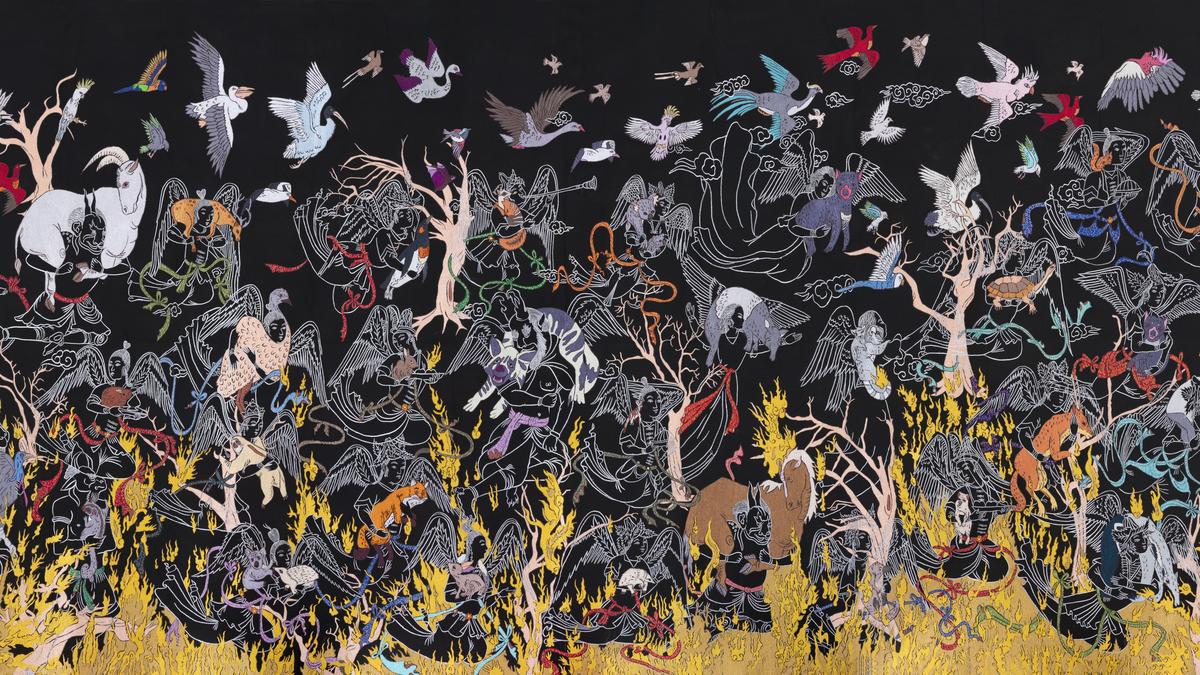
Also at Threads That Bare — which features 14 artists — are Geeta Khandelwal and Khadim Ali. Khandelwal has dedicated decades to studying and practising the art of quilt-making. On display are her meticulously recreated miniature royal garments from the 18th and 19th centuries using techniques such as hand-sewing and quilting. Ali, meanwhile, draws from miniature and tapestry traditions. His body of work bears witness to his family’s migrations, loss, and trauma resulting from the conflict zones of Afghanistan and Pakistan, which he still calls home. In his monumental mixed-media work, I’m the Third Script 2, he employs embroidery on cotton and silk, intricately weaving his childhood memories on fabric.
While for some fibre artists, a concept or experience serves as inspiration, for others, it’s the inherent nature of the material itself. “They have the ability to adapt, making them receptive to different ideas, stories, identities, and emotions,” says Rajarshi Sengupta, art historian and practitioner, whose textile works inspired by the kalamkari tradition were part of Entwined last month. “My practice also recognises coexistence as a key theme that connects questions of visual and sensory elements, shared histories and future directions.”
Sengupta’s inquiry into the history of kalam began with master carvers Kondra Gangadhar and Kondra Narsaiah, in their woodblock-making workshop in Andhra Pradesh’s Machilipatnam region. He also ventured into the dyeing practices — of coastal communities of the Coromandel — that have an impact on the application of colours on textiles. His work Catalogue Konda is an extension of this exploration and ethnographic studies of Deccani textiles and their artisanal histories.


Indian vessels can freely sail through the Strait of Hormuz without needing permission, confirms a senior government official.

The Hindu Morning Digest gives a select list of stories to start the day. Read the top news today on March 25, 2026

An IndiGo flight at Vijayawada airport was grounded due to a tyre burst, but all 79 occupants are safe.

Tamil Nadu Assembly election 2026: TMC(M) gets five seats in NDA, to contest on BJP's 'Lotus' symbol
TMC(M) secures five NDA seats, to contest Assembly elections using BJP's 'Lotus' symbol in Tamil Nadu.

The Karnataka government will discuss with officials the possibility of creating a portal for unemployed youth to share their details and access job opportunities in micro, small and medium enterprises (MSMEs), Minister for Small Industries and Public Enterprises Sharanabasappa Darshanapur said in the Legislative Council on Tuesday.

AIADMK's 2026 manifesto promises free rations, women's benefits, education reforms, and economic growth initiatives for Tamil Nadu.

U.S.-Israel war on Iran LIVE: Follow The Hindu for updates on the West Asia conflict on March 24, 2026

Join the 'Click & Commit' campaign on World TB Day, uniting Chennai's community to pledge against tuberculosis.

Brahmin candidates join Naam Tamilar Katchi, marking a significant shift in Tamil Nadu's political landscape and inclusivity.

Over 750 wheelchairs are prepared in Thoothukudi for accessible voting, ensuring convenience for differently abled and elderly voters.

Madras HC dismisses S.P. Velumani's petition challenging I-T assessment of ₹7 crore as unexplained election expenses from 2016.

The Lok Sabha passes a contentious Transgender Bill, sparking praise from the government and criticism from opposition parties.

Kamal Haasan announces support for DMK in 2026 elections, emphasizing the need for 'Dravidian Model 2.0' for Tamil Nadu's welfare.