Telangana had more preventable C-sections among southern States Premium
The Hindu
Study reveals preventable C-section rates in southern Indian states, highlighting risks and trends in maternal healthcare practices.
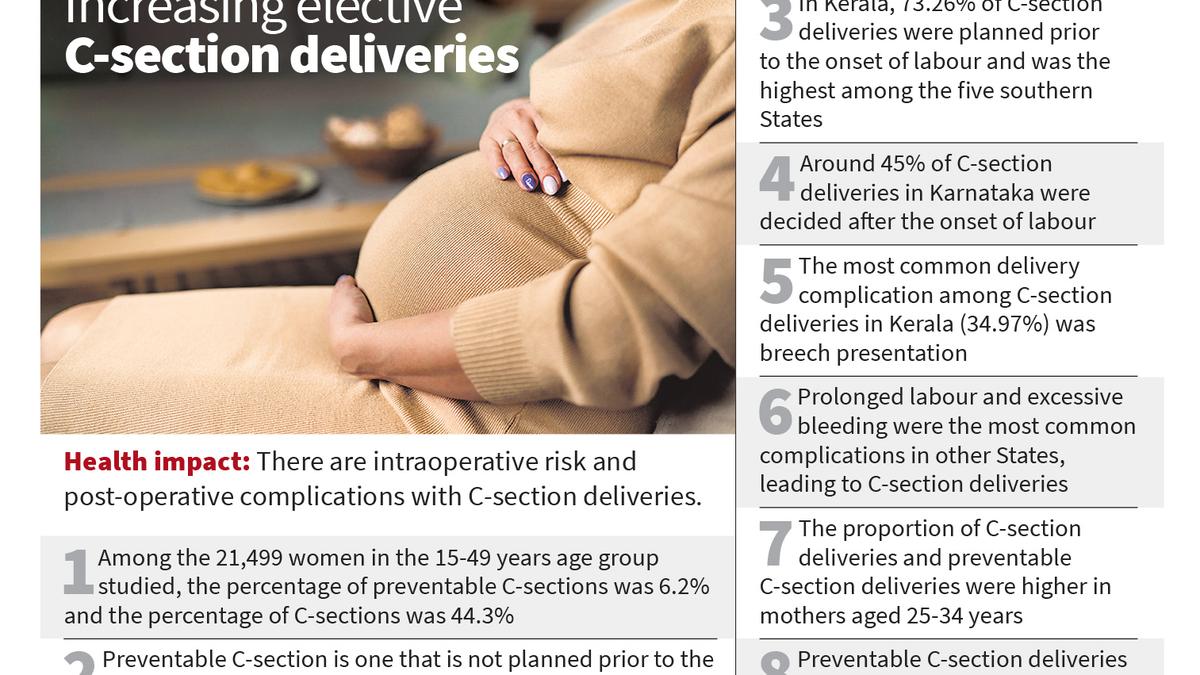
A study found that preventable Caesarean sections or C-sections constitute between 3.1% and 8.4% of all deliveries in the southern States of Andhra Pradesh, Kerala, Karnataka, Tamil Nadu, and Telangana. Among the 21,499 women studied, the percentage of preventable C-sections was 6.2%, and the percentage of C-sections was 44.3%. The percentage of preventable C-sections among overall C-section deliveries was 13.9%.
At 3.1%, Kerala had the lowest number of preventable C-sections, while Telangana had the highest at 8.4%. Preventable C-sections were 5.4% for Andhra Pradesh, 6.2% for Karnataka, and 7% for Tamil Nadu. Preventable C-section was defined as a C-section delivery that was not planned prior to the onset of labour, conducted at full term, and done without any intrapartum complications such as breech presentation, transverse lie, prolonged labour, and excessive bleeding. The classification was based on gestational age, mode of delivery, timing of the decision, and absence of intrapartum complications. Besides high out-of-pocket expenses, preventable C-sections result in “inefficient use of health system resources, intraoperative risk, and post-operative complications that impact the mother’s and child’s future health and well-being”, notes the study.
The study included 21,499 women in the age group 15-49 years who had given birth within the last five years. Data from the National Family Health Survey-5 was used in this study. The study was published on April 23, 2025 in the journal PLOS ONE.
At 96.5%, institutional deliveries are indeed high in the southern States and comparable with some of the countries in Western Europe and North America. These States also have substantially higher percentage of C-section deliveries — 31.5% to 60.7% — possibly due to high percentage of institutional deliveries.
In Kerala, 73.26% of C-section deliveries were planned prior to the onset of labour and were the highest among the five States studied. While deciding on C-sections before the onset of labour does indicate access to high-quality antenatal care, it might also reflect that a significant proportion of mothers might be opting for an elective C-section. Compared with Kerala, around 45% of C-section deliveries in Karnataka were decided after the onset of labour, the study carried out by Population Council Consulting, New Delhi, AIIMS Delhi, and TISS, Mumbai found.
The most common delivery complication among C-section deliveries in Kerala (34.97%) was breech presentation, while prolonged labour and excessive bleeding were the most common complications in other States. Excessive bleeding was the most common complication observed in Andhra Pradesh and Telangana. According to the study, the risk of post-partum haemorrhage is strongly associated with the absence of antenatal care — full antenatal care coverage (i.e., at least four antenatal care visits) was lowest in Andhra Pradesh and Telangana compared with the other three southern States.
The study found that the proportion of C-section deliveries, as well as preventable C-section deliveries, was higher in mothers aged 25-34 years. “Mothers with higher education — primary schooling and above — have at least a 30% greater chance of undergoing a preventable C-section compared to those without education,” they write. “Higher prevalence was found among uninsured, richer, and unemployed women, and higher preventable C-sections were found to occur with increased antenatal care visits and in private health care facilities.”


The 2026 U.S. cholesterol guidelines urge starting screening and treatment at 30 to prevent cardiovascular disease effectively.

Olam Festival 2026 in Thiruvananthapuram returns March 27-29 with 120+ vendors, music, art, and cultural zones.

A few storytellers in Thiruvananthapuram share their journeys, challenges, and evolving methods on World Storytelling Day, inspiring young minds.

76-year-old Kurian Jacob from Kerala triumphs with seven medals, including five golds, at the Open Masters Games in Abu Dhabi.

Explore the nature of the human mind as an emergent property of brain activity and complex neural interactions.

CERN's Large Hadron Collider discovers the Xi-cc-plus particle, enhancing understanding of quantum mechanics and baryon behavior.

Vibha Batra’s latest book, Spotless (Hachette India) is a novel in verse for young adults

In its first edition, the Madras Art Salon spotlights the works of journalist and artist Narayan Lakshman at The Botanical Club, a social space in the British Deputy High Commission, Chennai

Cholesterol enhances melanoma cell invasion by making nuclei squishier, revealing a potential treatment target in cancer progression.

The designers reinterpret the Swedish artist’s symbolic forms and colour energy through contemporary resortwear silhouettes

Discover the inspiring legacy of Bibha Chowdhuri, a pioneering woman in physics and a trailblazer in STEM history.

Discover the inspiring legacy of Bibha Chowdhuri, a pioneering woman in physics and a trailblazer in STEM history.

Ashdeen’s Spring 2026 collection features saris inspired by the designer’s Parsi gara archive