Tech-driven forest fire management project implemented in Hosur Forest Division
The Hindu
A tech-driven forest fire management project by WWF-India and Microsoft enhances fire prediction in Hosur Forest Division.
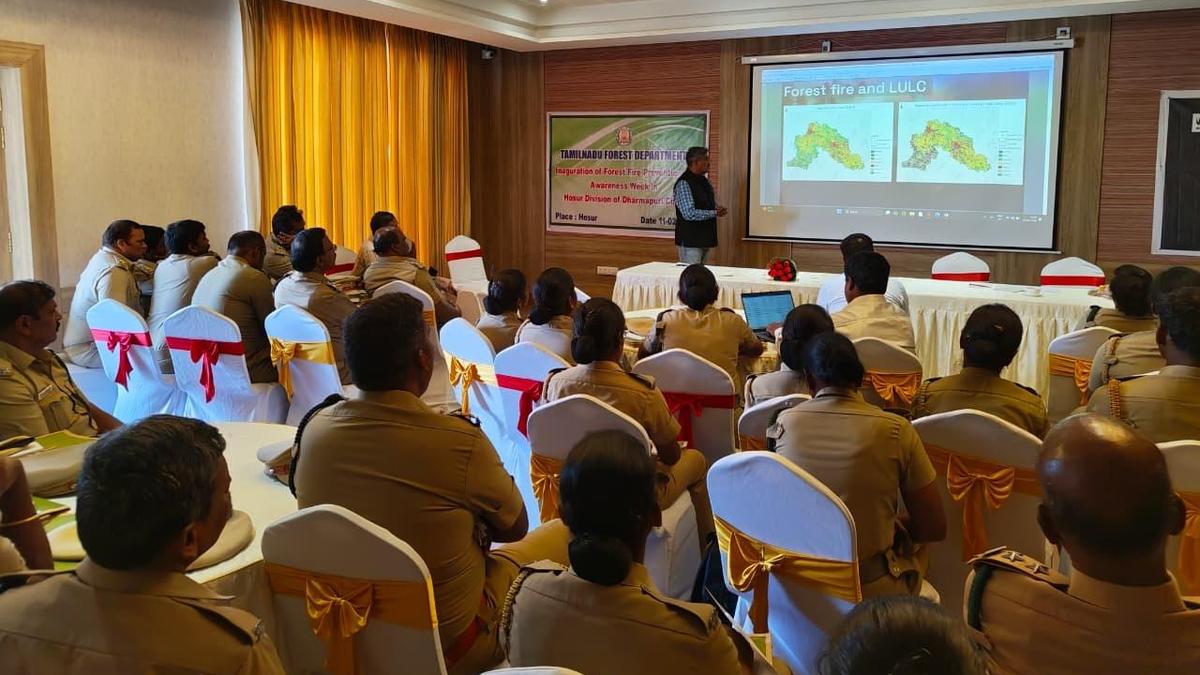
A forest fire management project under the World-Wife Fund for Nature (WWF)-India to predict forest fire in fire-prone areas is being implemented in Hosur Forest division.
The initiative – Tech for Conservation - in partnership with Microsoft, is a technology-driven forest fire management project leveraging advanced geospatial and artificial intelligence techniques to predict forest fire in fire prone areas, according to WWF-India, that conducted a forest management training programme earlier this week. The on the ground operation of the initiative was also demonstrated.
According to WWF-India, the study, led by Dr. G. Areendran, Director, Tech for Conservation and team, was conducted across Tamil Nadu, Kerala, Sikkim, Uttarakhand, and Karnataka, selected based on ecological significance and historical fire incidence. A multi-temporal, GIS-based analytical framework was developed using historical datasets spanning approximately 13 years, integrating topographic parameters, climatic variables, and anthropogenic factors. These datasets were spatially processed, normalised, and used as input features for predictive modeling.
In Hosur Forest Division, analysis on the forest fire hotspots during the January–April fire season for the period 2012–2025 revealed a persistent concentration of fire activity in several beats. The emergence among the most affected beats in 2025 suggested a spatial shift in fire activity patterns compared to the long-term trend. “The overall analysis indicates the presence of new hotspots, sporadic hotspots, oscillating hotspots, and oscillating cold-spots within Hosur Forest Division, reflecting dynamic fire occurrence patterns over time. Specifically, for 2025, the hotspot analysis revealed the presence of an oscillating cold-spot,” according to WWF-India.
The core of the study involved machine learning and deep learning approaches, trained on historical fire occurrence data and subsequently applied to generate future forest fire susceptibilitty maps, classifying regions into multiple fire-risk categories. All analytical outputs were integrated into a user-friendly, interactive dashboard, providing a robust decision-support framework to strengthen early warning systems, enhance fire preparedness, and support long-term forest fire management and conservation planning, the organisation added.
Earlier this week, the WWF India jointly with the Forest Division organised a forest fire management meeting with the forest frontline staff, NGO members and the Village Forest Council presidents and over 70 members participated. The training programme was conducted under the guidance of the Wildlife Warden, Hosur K. Rajangam, IFS.


A tech-driven forest fire management project by WWF-India and Microsoft enhances fire prediction in Hosur Forest Division.

Expressing concern over increase in the number of youth from Dakshina Kannada and other parts of country getting trapped in ‘digital slavery’ abroad, Member of Parliament Brijesh Chowta has urged the External Affairs Ministry to take tough action against fake recruitment agencies sending youth to West Asia and other nations from where cyber criminals entrap Indian youth into ‘digital slavery’.

Enhanced security and traffic regulations are in place for Sivaratri celebrations at Aluva Mahadeva Temple, ensuring public safety.

KKRTC suspends bus conductor for dropping off elderly couple midway, sparking public outrage and an inquiry into the incident.

British doctor who endeared himself to Jammalamadugu returns to 130-year-old hospital

South Chennai may soon see reduced flooding as the restoration of the Okkiyam Maduvu channel nears completion, enhancing flood mitigation efforts.

Govt. school students in Karaikudi launch satellite to detect fungi in atmosphere

Thousands of devotees attended Kapila Theertham to witness the grand Kalpavriksha Vahanam procession during the annual Brahmotsavam.

Anbumani Ramadoss claims DMK will ensure Congress' defeat in the Assembly election due to internal alliance conflicts.

D.K. Shivakumar predicts winning 141 seats, highlighting government welfare programs and questioning opposition contributions during his speech in Haveri.

Vizag Beach Road buzzes with excitement as the Indian Navy rehearses for the IFR and MILAN 2026 maritime events.

African Union chair calls for an end to the "extermination" of Palestinians, highlighting ongoing suffering and instability in the region.

Dakshina Kannada Member of Parliament Captain Brijesh Chowta has urged the Union government to establish a Marine Finfish Hatchery in the district to address the acute shortage of quality marine fish seed and to promote sustainable mariculture along the country’s west coast.