New SWM Rules 2026: highlight is a four-bin system
The Hindu
Here is what a cross-section of people from the city have to say about the revised Solid Waste Management (SWM) Rules 2026 that comes into effect on April 1, 2026
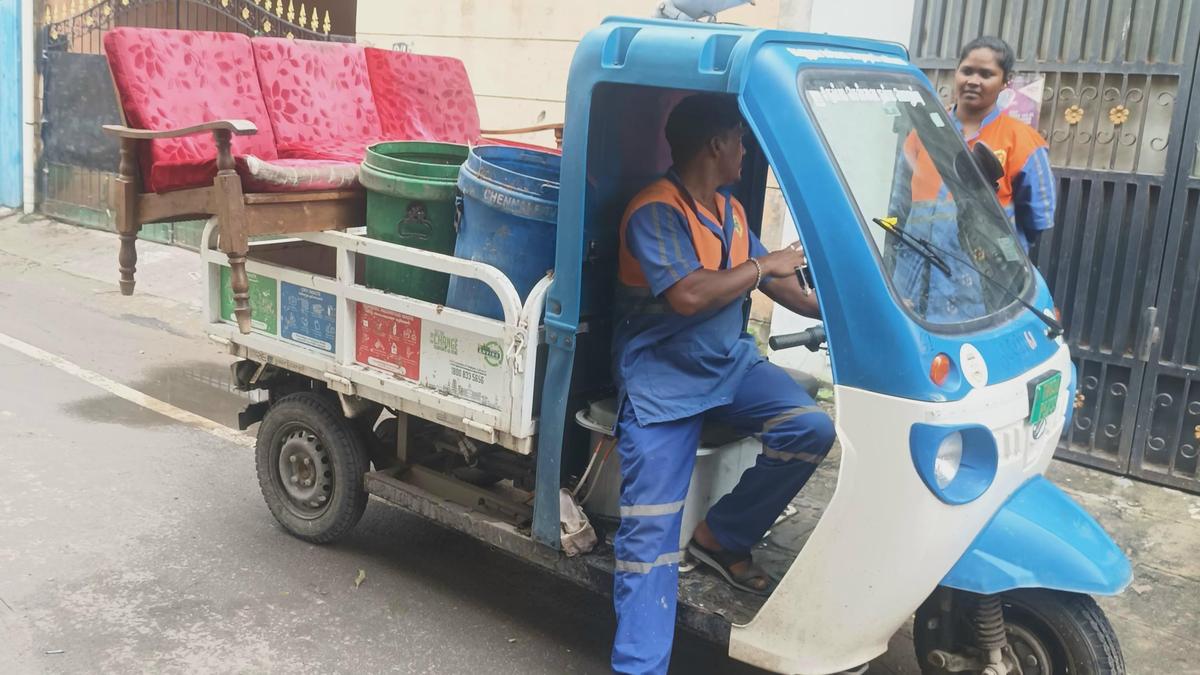
If waste segregation is still not part of the daily routine in your home, then get ready to fall in line. New rules are coming into effect on April 1, 2026. Under the revised Solid Waste Management (SWM) Rules 2026, notified recently by the Union Ministry of Environment, Forest and Climate Change, four-stream segregation of solid waste at source has been made mandatory. This means your household waste is required to be segregated into wet waste, dry waste, sanitary waste and special care waste; the later includes paint cans, bulbs, mercury thermometers and medicines.
The revised rules, which supersedes Solid Waste Management Rules, 2016, integrate the principles of circular economy and extended producer responsibility, with a specific focus on waste segregation and management.
Those working in this space say some major concerns in Chennai include gaps in availability of collection vehicles and processing facilities. There is also a need to enforce rules strictly for all stakeholders.
All bulk waste generators are expected to process wet waste in situ or obtain an Extended Bulk Waste Generator Responsibility (EBWGR) certificate stating that on-site processing is not feasible. Bulk waste generator includes entities with a floor area of 20,000 square metres or more, or water consumption of 40,000 litres per day or more, or solid waste generation of 100 kg per day or more.
Material recovery facilities (MRFs) are again in the spotlight. Under the revised rules, local bodies are responsible for the collection, segregation and transportation of solid waste in coordination with MRFs which may also act as deposition points for e-waste, special care waste, sanitary waste and other waste streams for further processing. MRFs have been formally recognised as facilities for sorting of solid waste, says the note.
Local bodies have been encouraged to generate carbon credits.


A tech-driven forest fire management project by WWF-India and Microsoft enhances fire prediction in Hosur Forest Division.

Expressing concern over increase in the number of youth from Dakshina Kannada and other parts of country getting trapped in ‘digital slavery’ abroad, Member of Parliament Brijesh Chowta has urged the External Affairs Ministry to take tough action against fake recruitment agencies sending youth to West Asia and other nations from where cyber criminals entrap Indian youth into ‘digital slavery’.

Enhanced security and traffic regulations are in place for Sivaratri celebrations at Aluva Mahadeva Temple, ensuring public safety.

KKRTC suspends bus conductor for dropping off elderly couple midway, sparking public outrage and an inquiry into the incident.

British doctor who endeared himself to Jammalamadugu returns to 130-year-old hospital

South Chennai may soon see reduced flooding as the restoration of the Okkiyam Maduvu channel nears completion, enhancing flood mitigation efforts.

Govt. school students in Karaikudi launch satellite to detect fungi in atmosphere

Thousands of devotees attended Kapila Theertham to witness the grand Kalpavriksha Vahanam procession during the annual Brahmotsavam.

Anbumani Ramadoss claims DMK will ensure Congress' defeat in the Assembly election due to internal alliance conflicts.

D.K. Shivakumar predicts winning 141 seats, highlighting government welfare programs and questioning opposition contributions during his speech in Haveri.

Vizag Beach Road buzzes with excitement as the Indian Navy rehearses for the IFR and MILAN 2026 maritime events.

African Union chair calls for an end to the "extermination" of Palestinians, highlighting ongoing suffering and instability in the region.

Dakshina Kannada Member of Parliament Captain Brijesh Chowta has urged the Union government to establish a Marine Finfish Hatchery in the district to address the acute shortage of quality marine fish seed and to promote sustainable mariculture along the country’s west coast.