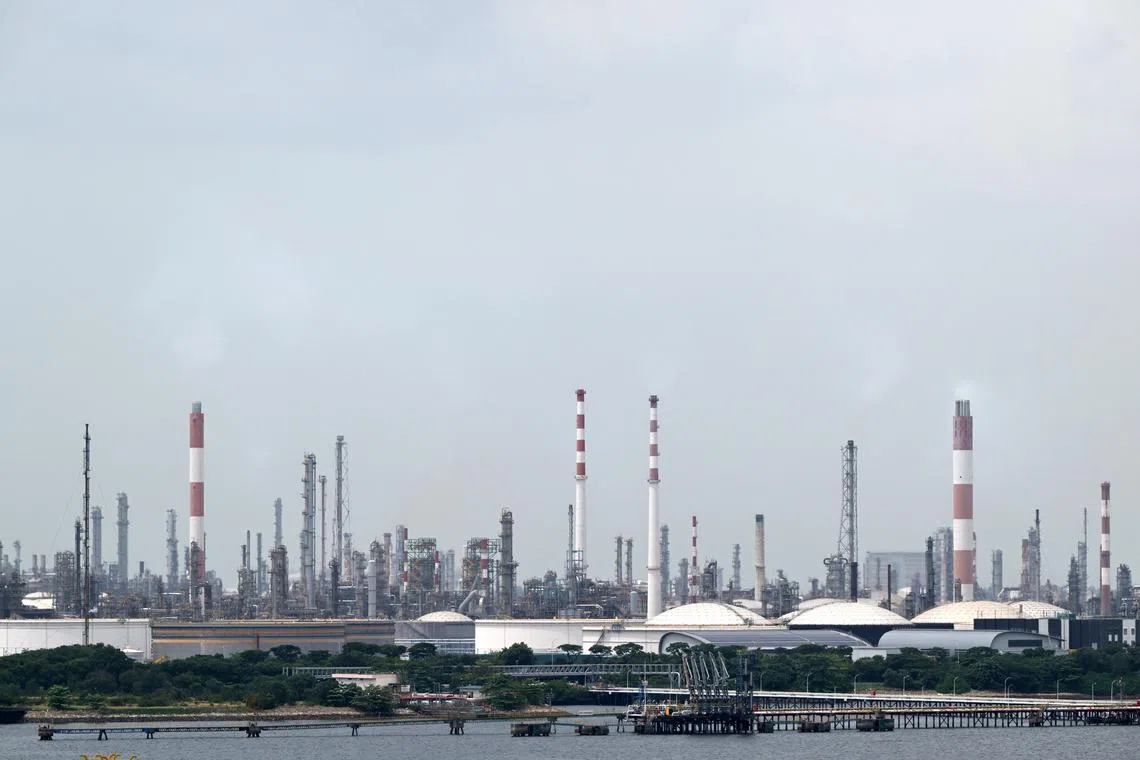
Study finds Jurong Island power plant may not impact corals, but experts raise questions on methods
The Straits Times
Study assesses Jurong Island power plant's impact on corals, but experts question the environmental impact assessment methods. Read more at straitstimes.com.
SINGAPORE – An environmental study for one of the first developments in an area of Jurong Island carved out for low-carbon technologies has found that its impacts on the marine environment would be limited.
Slated to be up and running by 2029, electricity retailer PacificLight’s 670MW hydrogen-compatible natural gas power plant and energy storage system will be able to power more than 864,000 four-room flats for a year.
Much of the 430-page report, published online in mid-February, was focused on identifying the development’s impacts on the marine environment, which are likely to arise from discharge released by the power plant.
This includes stormwater run-off from the premises and seawater that is taken in to cool the plant and subsequently released. Such discharge could be heated and contain chlorine, which can stress marine life and even cause death at elevated levels.
Hard corals, in particular, are sensitive to heat. When stressed by warmer waters during a marine heatwave, corals turn ashen white in a phenomenon known as coral bleaching.
The nearest known coral reef to the power plant is known as the Helios Secondary Reef, and is located about 700m away from the discharge outlet. It is made up of corals that colonised the seawall and artificial structures at the southern hook of Jurong Island.


Jessie Wee, Singaporean pioneer of children’s literature and creator of Mooty The Mouse, has died at 88 after a long illness. Read more at straitstimes.com.

There are also two unique art exhibitions: one in a Tiong Bahru walk-up and the other in Telok Kurau. Read more at straitstimes.com.

Peh Gao Coffeeshop's menu offers a mix of Asian comfort food. Read more at straitstimes.com.

The Neapolitan-style pizzas are made with a 72-hour fermented dough. Read more at straitstimes.com.

There are opportunities for firms to develop expertise in sustainable development and climate risk assessment, she said. Read more at straitstimes.com.

Ong Keng Sen directs Jacintha and Dick Lee at Sifa 2026; plus Jeremy Tiang’s Obie Award-winning play
Ong Keng Sen directs Jacintha and Dick Lee at SIFA 2026, plus Jeremy Tiang’s Obie Award-winning play. Read more at straitstimes.com.

The move came after recent reports about his abuse of employees at Noma. Read more at straitstimes.com.

The other two restaurants that made the cut are La Bottega Enoteca at No. 31 and Fortuna at No. 33. Read more at straitstimes.com.

Some residents say subsidising private estates is a bold move; others warn against relying on subsidies. Read more at straitstimes.com.

The firm and 800 Super also said 160 segregated recycling bins will be deployed in Pasir Ris and Bedok by 2027. Read more at straitstimes.com.

Passengers excited as Disney Adventure cruise embarks on its first public sailing from Singapore after delays. Read more at straitstimes.com.

The recognition enables HSA to serve as a global reference for other regulators worldwide. Read more at straitstimes.com.

Motor traders and academics agree that the COE system needs review but are split on merging car categories A and B in Singapore. Read more at straitstimes.com.