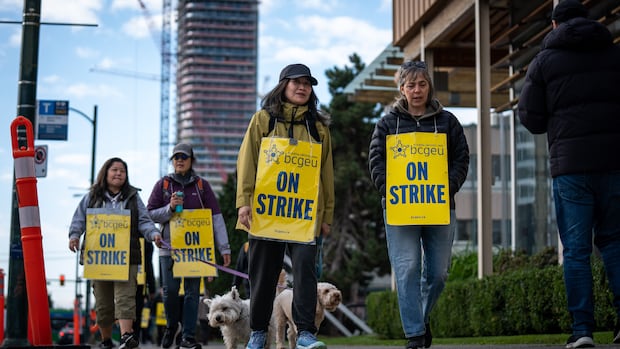
Striking B.C. public service workers announce tentative deal with province
CBC
The B.C. General Employees' Union (BCGEU) has struck a tentative deal with the provincial government, which could end the weeks-long strike that has impacted everything from liquor distribution to wildfire fighting.
The Professional Employees Association (PEA) also announced it will take down its picket lines and return to bargaining with the B.C. government.
More than 25,000 workers represented by the BCGEU and more than 1,600 workers represented by the PEA have been on some form of job action since Sept. 2.
The BCGEU says it is also taking down its picket lines, and members of both unions will return to their jobs on Monday.
The BCGEU's tentative agreement, which still needs to be ratified, includes a three per cent general wage increase per year over the next four years.
The BCGEU's tentative deal, announced Sunday, comes after mediated talks with the province.
BCGEU president Paul Finch said in an interview that the tentative agreement was reached just after 7 a.m. PT on Sunday, and he is "incredibly happy" with it.
"This comes after a very hard-fought victory, you know, for our members — and really, broadly, for working people in B.C.," he said.
In a statement, the BCGEU said the proposed agreement marks "significant progress" on issues like wages and affordability, but it will be up to the 34,000 public service workers to ratify it.
Most of them have been on strike for eight weeks, setting up picket lines at government offices, B.C. Liquor Stores, Liquor Distribution Branch facilities and more — leading to a strained supply of booze and cannabis in particular.
A number of government-run programs — from student loans to IVF funding and correctional services — were impacted by the strike.
The agreement would improve working arrangements for telework and remote workers, and include targeted pay hikes for the lowest-paid public servants, the union says.
Finch said that information on the ratification process would be given to members over the next week, and voting itself would begin the week after.
A simple majority of workers will need to vote in favour of the agreement for it to be ratified, Finch said.


Public Safety Minister Gary Anandasangaree faced pointed questions Tuesday about why the federal government has deported one Iranian official, despite longstanding concerns about how the regime operates in Canada and abroad.

An RCMP-led corruption investigation is underway and search warrants were executed on a number of properties including the homes of former mayor Jyoti Gondek, former councillor Sean Chu and sitting councillor Andre Chabot.

Toronto police say they are creating a counter-terrorism unit and a specialized task force that will see officers with semi-automatic rifles stationed at key locations in the city.

ATCO Ltd. says it's taking a 40 per cent ownership stake in the company building the Grays Bay Road and Port project.

Justice Minister Sean Fraser says he has no plans to change how judges are appointed in Canada despite four premiers writing to Prime Minister Mark Carney to ask for more of a say in the process.

An RCMP-led corruption investigation is underway and at least one current and one former Calgary city councillor, as well as a business were subject to search warrants executed last week, CBC News has learned.

Ontario’s education minister is telling school boards to ensure their upcoming graduation ceremonies don’t express any “political views” or “engage in divisive or contentious issues of any kind,” according to an internal memo obtained by CBC News.

A new daily non-stop flight between Charlottetown and Montreal is set to begin this summer.

The Crown has dropped mischief charges for a second time against a London, Ont., doctor accused of spraying ketchup on the office of a local MP during a 2024 protest.

An RCMP-led corruption investigation is underway into at least one current Calgary city councillor as well as a business, CBC News has learned.

Much of Newfoundland is digging out of a blustery and messy day as another storm slams into the island.

Timiskaming—Cochrane MPP John Vanthof recalls the meeting in Thunder Bay earlier this month. He was part of the nine-day road trip along Highways 11 and 17 with other NDP MPPs.

A bill before the Nova Scotia Legislature is proposing raising the age limit for support for young people who have been in the foster care or group home system to 26.