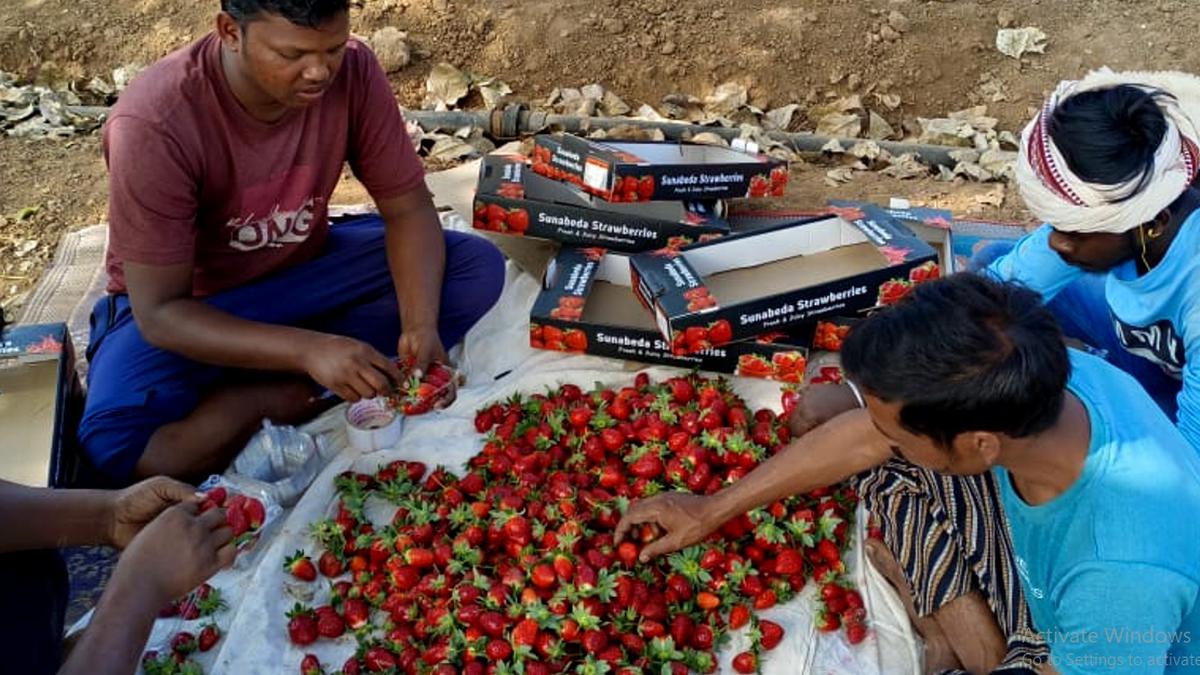
Strawberry farming making waves in tribal heartland of Odisha Premium
The Hindu
The State government’s experiment with the fruit has yielded a good crop and an even better fortune for those living in the Sunabeda Wildlife Sanctuary
The rugged Sunabeda plateau, 3,000 feet above sea level, along the Odisha-Chhattisgarh border, has always been difficult terrain to traverse, but for Yuvraj Chhatria, it is just a part of his journey. The 30-km ride from the top of the plateau to the plains in the Nuapada district of Odisha and the subsequent gruelling 550-km bus journey down bumpy roads to Bhubaneswar, located near the coast, would leave anyone exhausted.
Despite the physical demands of this journey, Mr. Chhatria, a member of the Chuktia Bhunjia tribe, one of the particularly vulnerable tribal groups (PVTGs), has a smile on his face. He has brought with him a fresh harvest of strawberries, and the fruit is selling out. He counts his cash in hand – at ₹37,500 for 1.5 quintals, this is the highest single-day profit he has ever made. He hopes to witness another bumper sale over the next two days at the Adivasi Mela 2023.
The strawberry harvest has triggered a celebration in the houses of 10 farmers who live in one of the 56 villages in the tropical deciduous forest of the Sunabeda Wildlife Sanctuary. The farmers, who from April to October plant paddy, were initiated into strawberry cultivation in November 2022.
“I had never heard about strawberries before. The government officers persuaded us to take up this new kind of farming, and we went for it. The government supplied saplings and gave us financial assistance to dig a borewell,” says Mr. Chhatria, adding that each family has been given 10 acres, and 20,000 saplings planted on each acre. The horticulture department was roped in for mulching and drip irrigation. Farmers took loans from women’s self-help groups (SHGs) to fund the labour component. Mr. Chhatria took a loan of ₹2 lakh.
He and his father have grown the fruit on 2.5 acres of land, earning ₹4.2 lakh to date. They hope it will touch ₹9 lakh by March end. This is an unexpected return from any crop in the region that sends a very high percentage of migrant labours to other States.
Most people in Sunabeda are from the Chuktia Bhunjia tribe, one of 13 PVTGs found in Odisha. They were given the requisite training by the Nuapada district administration and the Chuktia Bhunjia Development Agency (CBDA), established in 1994-95 by the State government to work for the development of the tribe, especially in livelihood programmes.
“A CBDA team had gone to Mahabaleshwar in Maharashtra, which accounts for 80% of India’s strawberry production. We found that the altitude and climate there are similar to that of Sunabeda. In fact, the soil quality of Sunabeda is better,” says CBDA Special Officer Himansu Mohapatra, who was a part of the group. He adds that the saplings provided were from Mahabaleshwar. In winter, the maximum daytime temperature of Sunabeda remains at around 25 degree Celsius and at night it drops to 10 degree Celsius, making it just right for strawberry cultivation.


Pinarayi Vijayan criticizes Rahul Gandhi and Congress for allegedly aiding BJP's rise in various states during Kerala polls.

Sonia Gandhi is responding well to treatment for a systemic infection and remains under observation at a Delhi hospital.

J&K Police's Counter Intelligence Wing conducts raids in three districts linked to a transnational terror module operated by Lashkar-e-Taiba.

Vaccination policies must prioritize saving human lives over individual choice amid rising vaccine skepticism, asserts scientist Dr. Virander Singh Chauhan.

Seven Indian fishermen from Rameswaram arrested by Sri Lankan Navy, sparking protests and calls for government intervention.

Kerala cyber police file a case against X for an AI video allegedly defaming PM Modi and the Election Commission.

iKure and Izawa Co. partner to combat avoidable blindness by integrating innovative eye care technology into rural healthcare networks.

Thousand Lights MLA from the DMK N. Ezhilan, in an interview to The Hindu, observes that any popular personality entering politics will attract the limelight. But only a structured party machinery combined with popularity can ensure success. In this interview, he speaks about his tenure as first-time MLA from Thousand Lights Assembly constituency in Chennai, Vijay’s political entry shaping the 2026 elections, redressal of key grievances and more.

Abhishek Banerjee challenges BJP's Suvendu Adhikari in Nandigram, pledging community health initiatives if Trinamool Congress wins.

Rising LPG shortages in Karnataka boost firewood demand, reviving an informal market as households and hotels seek alternatives.

Against the backdrop of intense poll activity, a 400-metre stretch of an arterial road in the outskirts of Chennai (technically in Madurapakkam panchayat under Tambaram assembly constituency) presents a salute to the idea of res publica, which underpins India’s system of governance, where citizens have a say, at least before a government is securely ensconced in the seat of power. A Republic Day initiative shines bright every night

Fadnavis claims zero FIR in Ajit Pawar crash is a defamation attempt by Karnataka against Maharashtra's investigation efforts.

Set to unfold as a one-day pop-up on April 5, the Easter Sadya brings together both vegetarian and non-vegetarian menus, offering a peek into the food traditions of the Syrian Christian (Nasrani) community. While the traditional Sadya is often associated with dishes such as sambar, avial, and rice, this version expands to include community-specific festive dishes.