State on tightrope walk in finalising budget proposals for 2025-26
The Hindu
State Finance department struggles to finalize budget amid revenue shortfall, mounting expenses, and limited resources for welfare schemes.
The Finance department is on a tightrope walk in finalising the budget estimates for the financial year 2025-26 as the State is a long way from realising the targets of revenue receipts set for the current fiscal.
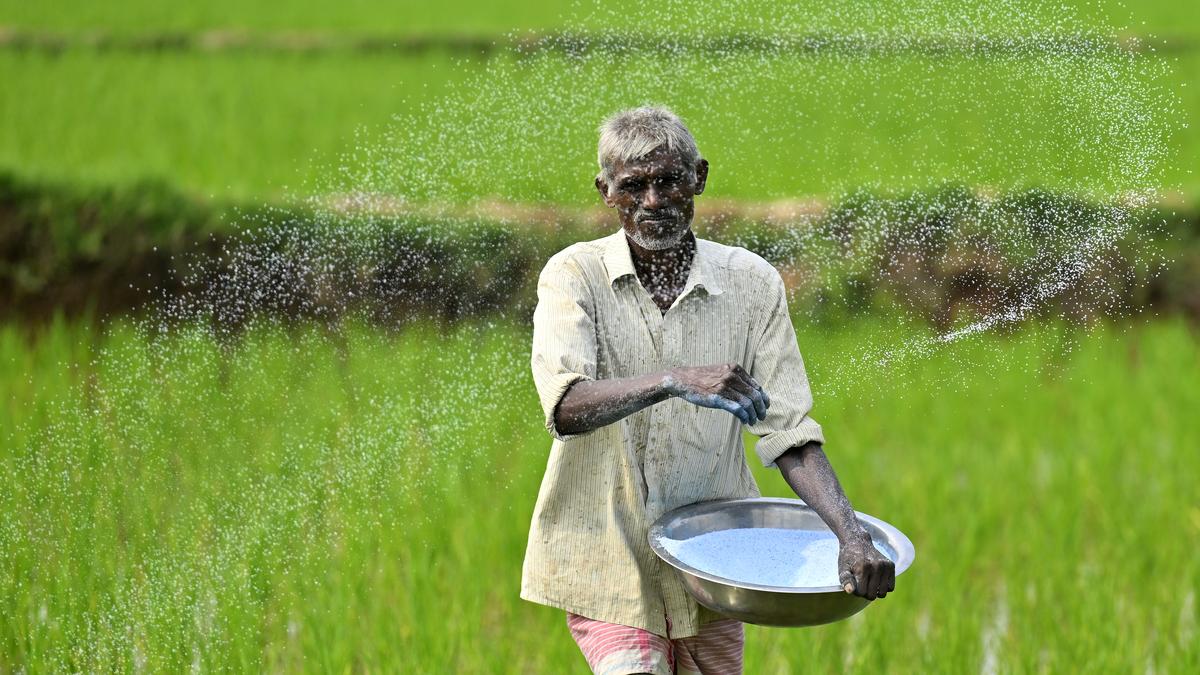
The State has to make provisions for Rythu Bharosa involving close to ₹20,000 crore, subsidies, including free power to farm sector estimated around ₹15,000 crore, salaries and pensions and interest payment besides reimbursement of expenditure incurred on account of free bus travel to women. Though the government has ensured uninterrupted implementation of various welfare schemes, it is struggling hard to raise resources to strike a balance between committed expenditure and continuation of welfare schemes.
With little over a month remaining for the conclusion of the current fiscal, the State’s revenue receipts are not up to the expectations with overall revenue receipts reaching ₹1.82 lakh crore — 66.57% of ₹2.74 lakh crore of budget estimates. This includes borrowings of ₹58,586 crore, constituting almost one-third of the receipts.
Revenue through major heads like Goods and Services Tax (72.8%), Sales Tax (79.90%) and State Excise Duties (60.84%) and State’s share of Union taxes (83.42%) registered impressive figures till January end. However, accruals in the form of Non tax revenue at 16.66% — ₹5,866.4 crore of the ₹35,208.44 crore and grants in aid and contributions at ₹5,176.72 crore, 23.93% of the ₹21,636.15 crore of budget estimates are lagging far behind the projected figures.
Revenue expenditure in the form of interest payment, salaries and pension payment and subsidies is however mounting with interest alone accounting to ₹22,056 crore till January end much higher than the ₹17,729 crore projected in the budget estimates with two more months to go. Coupled with this was the Central government’s alleged negligence in making allocations to major projects in the Union budget presented in the Parliament earlier this month.
The neglect comes at a time when Chief Minister A. Revanth Reddy and his Cabinet colleagues made several rounds to the national capital seeking liberal assistance for key projects like the Regional Ring Road. In addition, the State’s borrowings had been restricted by the Union Finance citing over borrowings during the previous years leaving the government to fend for itself for raising the required resources.
Deputy Chief Minister Mallu Bhatti Vikramarka who holds the Finance portfolio, is conducting series of pre-budget meetings with the departments to understand their requirements and plan the allocation accordingly. Given this background, it will be interesting to see how the State government strikes a fine balance in budgetary allocations amid limited resources.


Pinarayi Vijayan criticizes Rahul Gandhi and Congress for allegedly aiding BJP's rise in various states during Kerala polls.

Sonia Gandhi is responding well to treatment for a systemic infection and remains under observation at a Delhi hospital.

J&K Police's Counter Intelligence Wing conducts raids in three districts linked to a transnational terror module operated by Lashkar-e-Taiba.

Vaccination policies must prioritize saving human lives over individual choice amid rising vaccine skepticism, asserts scientist Dr. Virander Singh Chauhan.

Seven Indian fishermen from Rameswaram arrested by Sri Lankan Navy, sparking protests and calls for government intervention.

Kerala cyber police file a case against X for an AI video allegedly defaming PM Modi and the Election Commission.

iKure and Izawa Co. partner to combat avoidable blindness by integrating innovative eye care technology into rural healthcare networks.

Thousand Lights MLA from the DMK N. Ezhilan, in an interview to The Hindu, observes that any popular personality entering politics will attract the limelight. But only a structured party machinery combined with popularity can ensure success. In this interview, he speaks about his tenure as first-time MLA from Thousand Lights Assembly constituency in Chennai, Vijay’s political entry shaping the 2026 elections, redressal of key grievances and more.

Abhishek Banerjee challenges BJP's Suvendu Adhikari in Nandigram, pledging community health initiatives if Trinamool Congress wins.

Rising LPG shortages in Karnataka boost firewood demand, reviving an informal market as households and hotels seek alternatives.

Against the backdrop of intense poll activity, a 400-metre stretch of an arterial road in the outskirts of Chennai (technically in Madurapakkam panchayat under Tambaram assembly constituency) presents a salute to the idea of res publica, which underpins India’s system of governance, where citizens have a say, at least before a government is securely ensconced in the seat of power. A Republic Day initiative shines bright every night

Fadnavis claims zero FIR in Ajit Pawar crash is a defamation attempt by Karnataka against Maharashtra's investigation efforts.

Set to unfold as a one-day pop-up on April 5, the Easter Sadya brings together both vegetarian and non-vegetarian menus, offering a peek into the food traditions of the Syrian Christian (Nasrani) community. While the traditional Sadya is often associated with dishes such as sambar, avial, and rice, this version expands to include community-specific festive dishes.