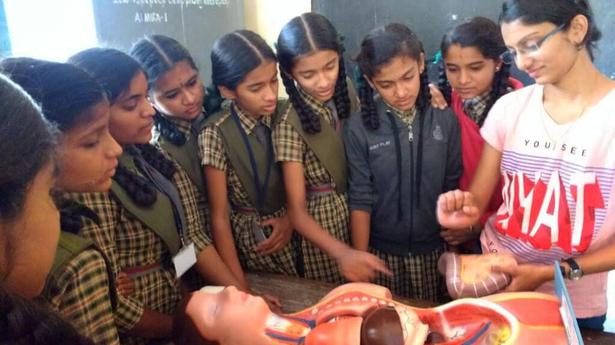
Sparking the scientific curiosity among children
The Hindu
During the pandemic, when children, especially those in government schools, were struggling in the absence of regular classes on campus, several institutes and research organisations in Karnataka stepped in to help bridge the gap
During the pandemic, when children, especially those in government schools, were struggling in the absence of regular classes on campus, several institutes and research organisations stepped in to help bridge the gap.
The digital kids’ zone, an online initiative by the Science for Rural India from the Indian Institute of Science (IISC) that began during the pandemic, conducted science experiments and uploaded clips online. They also conducted competitions to get more children to participate.
“We focus on showing the experimental module with household items. Even during visits to several government schools in Karnataka, we make sure that we use items that are available to them. For instance, we created a rainbow in their classroom using a basic beaker, mirror, glass of water, and measuring instruments,” said Suyog Mahulkar, PhD researcher in IISc., who created the programme.
Another online webinar programme, ‘talk to a scientist’, which commenced during the peak of the pandemic, saw scientists and researchers interacting with children.
“Children should be exposed to the scientific processes, the beauty of science. They should have a questioning mindset. I feel that children at the age of six or seven are not ready to take in high-end, new age scientific processes of coding and robotics. They should be instilled with curiosity first,” said Smita Jain, Associate Director, Academic and Government Relations (India), Cactus Communications, a technology company that is accelerating scientific advancement.
Most children are glued to their mobile phones, laptops, and other gadgets. While constant exposure to screen time can be detrimental to their health, but the good part is that they tend to show interest in technology from quite an early age.
“Can’t we, as adults, be responsible and make their screen time productive too,” asked Chandrakala B.M., Project Manager at KiddyPi, a Bengaluru-based STEM learning institute for children. “We always try to make learning fun and interactive for the children. We want to use this interest to help them keep their minds sharp and evolve in the fields of science and technology in their near future.”


Pinarayi Vijayan criticizes Rahul Gandhi and Congress for allegedly aiding BJP's rise in various states during Kerala polls.

Sonia Gandhi is responding well to treatment for a systemic infection and remains under observation at a Delhi hospital.

J&K Police's Counter Intelligence Wing conducts raids in three districts linked to a transnational terror module operated by Lashkar-e-Taiba.

Vaccination policies must prioritize saving human lives over individual choice amid rising vaccine skepticism, asserts scientist Dr. Virander Singh Chauhan.

Seven Indian fishermen from Rameswaram arrested by Sri Lankan Navy, sparking protests and calls for government intervention.

Kerala cyber police file a case against X for an AI video allegedly defaming PM Modi and the Election Commission.

iKure and Izawa Co. partner to combat avoidable blindness by integrating innovative eye care technology into rural healthcare networks.

Thousand Lights MLA from the DMK N. Ezhilan, in an interview to The Hindu, observes that any popular personality entering politics will attract the limelight. But only a structured party machinery combined with popularity can ensure success. In this interview, he speaks about his tenure as first-time MLA from Thousand Lights Assembly constituency in Chennai, Vijay’s political entry shaping the 2026 elections, redressal of key grievances and more.

Abhishek Banerjee challenges BJP's Suvendu Adhikari in Nandigram, pledging community health initiatives if Trinamool Congress wins.

Rising LPG shortages in Karnataka boost firewood demand, reviving an informal market as households and hotels seek alternatives.

Against the backdrop of intense poll activity, a 400-metre stretch of an arterial road in the outskirts of Chennai (technically in Madurapakkam panchayat under Tambaram assembly constituency) presents a salute to the idea of res publica, which underpins India’s system of governance, where citizens have a say, at least before a government is securely ensconced in the seat of power. A Republic Day initiative shines bright every night

Fadnavis claims zero FIR in Ajit Pawar crash is a defamation attempt by Karnataka against Maharashtra's investigation efforts.

Set to unfold as a one-day pop-up on April 5, the Easter Sadya brings together both vegetarian and non-vegetarian menus, offering a peek into the food traditions of the Syrian Christian (Nasrani) community. While the traditional Sadya is often associated with dishes such as sambar, avial, and rice, this version expands to include community-specific festive dishes.