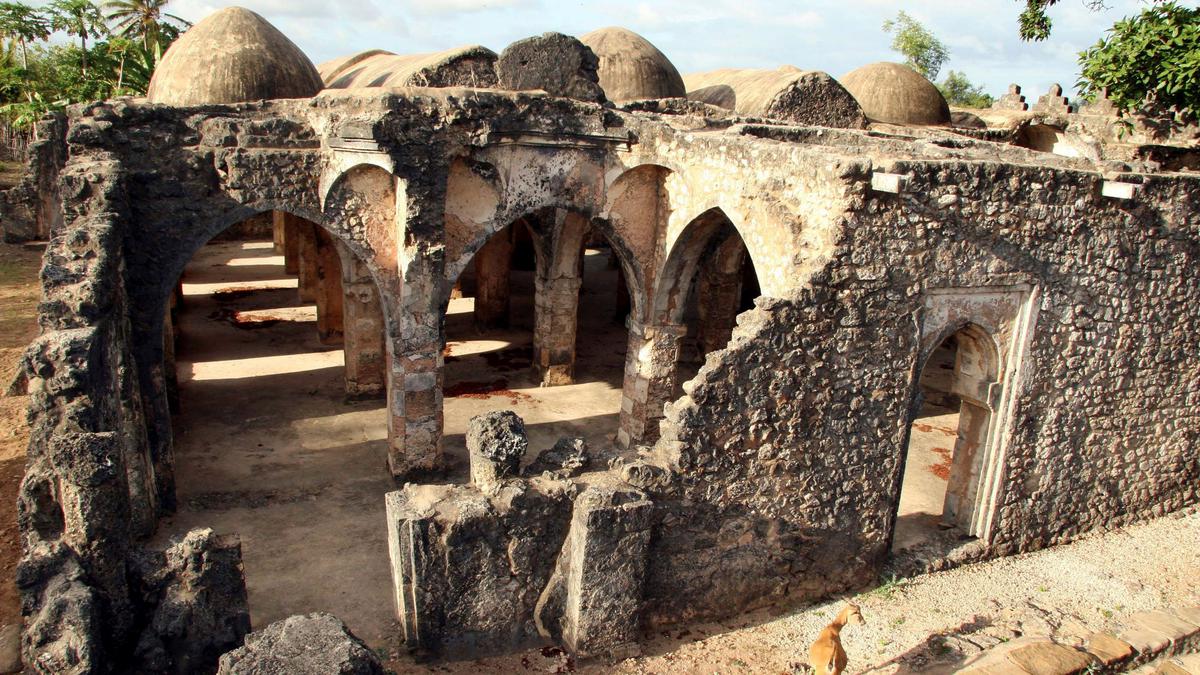
Some Indian ancestry in the genes of mediaeval Swahili people: new study
The Hindu
A study of centuries-old DNA has deciphered the complex ancestry of coastal East Africa’s Swahili people with traces from Persia and India.
A study of centuries-old DNA has deciphered the complex ancestry of coastal East Africa's Swahili people, revealing how a cosmopolitan and prosperous medieval civilization arose thanks in large part to women from Africa and men arriving from Persia.
Researchers said on Wednesday they examined the DNA of 80 people from five sites in Kenya and Tanzania dating to about 1250 to 1800 AD. More than half of the genetic input in many of them traced to female ancestors from Africa's east coast while a significant contribution also came from Asia, of which about 90% came from men from Persia - modern Iran - and 10% from India.
After around 1500 AD, the bulk of the Asian genetic contribution shifted to Arabian sources, the study showed.
Also Read | Caste system has left imprints on genes: study
The Swahili coast region stretches roughly from the Somali capital Mogadishu at the north to Tanzania's Kilwa island at the south and also includes parts of Kenya and Malawi and the Indian Ocean archipelagoes of Zanzibar and Comoros.
The medieval Swahili people in city-states such as Mombasa and Zanzibar exported goods from the African interior including ivory, gold, ebony and sandalwood, as well as slaves, to destinations across the Indian Ocean. They also were among the first practitioners of Islam among sub-Saharan people.
"The sex-bias in the African-Asian admixture raises questions about the social dynamics and gender roles. On the one hand, you have Persian men mixing with African women, which might highlight social inequalities, usually with the female mixing population of a lower status," said Harvard University geneticist Esther Brielle, lead author of the study published in the journal Nature.


Mercedes-Benz CLA 250+ with EQ Technology review: design, performance, range and features explained. Discover how the new electric CLA combines advanced AI, long range, fast charging and futuristic styling for the next generation of luxury EVs.

Pi Day is celebrated every year on March 14, honouring the significance of the mathematical constant π and its applications in mathematics.

Discover how sculptural interior design transforms modern spaces, blending creativity and functionality to evoke emotion and identity.

A study reveals that certain antibiotics can cause long-lasting changes in gut microbiome diversity for up to eight years.

Indian scientists and international experts are divided over a study questioning the viability of a nuclear reactor fuel called HALEU-thorium; while critics cite safety risks, proponents argue the technology is vital to achieve national energy goals.

ISRO and AIIMS partner to enhance space medicine research, focusing on human health during long-duration space missions.

A practical guide to induction setups for students, families, and home food businesses as India’s LPG supply faces its biggest disruption in years

Explore the electrifying Oscars 2026 race, featuring standout films, baffling nominations, and memorable performances amid a cinematic transition.

Zai and Rom Whitaker’s latest book for young readers, The Book of Indian Snakes, tackles common misconceptions surrounding snakes, highlighting their utility to humans

Discover PC Mahalanobis's pivotal role in India's statistical revolution and his lasting influence on modern statistics in this episode.

Explore why nothing can exceed light speed and the paradoxes that arise if it were possible.

Scientists have engineered bacteria to produce designer proteins by smuggling artificial amino acids, enabling precise drug delivery and multifunctional applications.

Scientists successfully grew chickpeas in simulated lunar soil, paving the way for future extraterrestrial agriculture on the moon.