Since Chandrayaan-3, what has India’s space programme been up to? | Explained Premium
The Hindu
India's space programme in 2023-2024, including lunar and solar missions, astronaut training, and future plans for space exploration, on the occasion of National Space Day.
After a busy 2023, things have been quiet at Sriharikota, India’s spaceport. But silence at the spaceport does not imply that India’s space programme itself has been dormant. A lot has been happening since the Indian Space Research Organisation (ISRO) successfully landed the lander of its Chandrayaan 3 mission, Vikram, on the surface of the moon.
Prime Minister Narendra Modi has declared this date, August 23, India’s National Space Day.
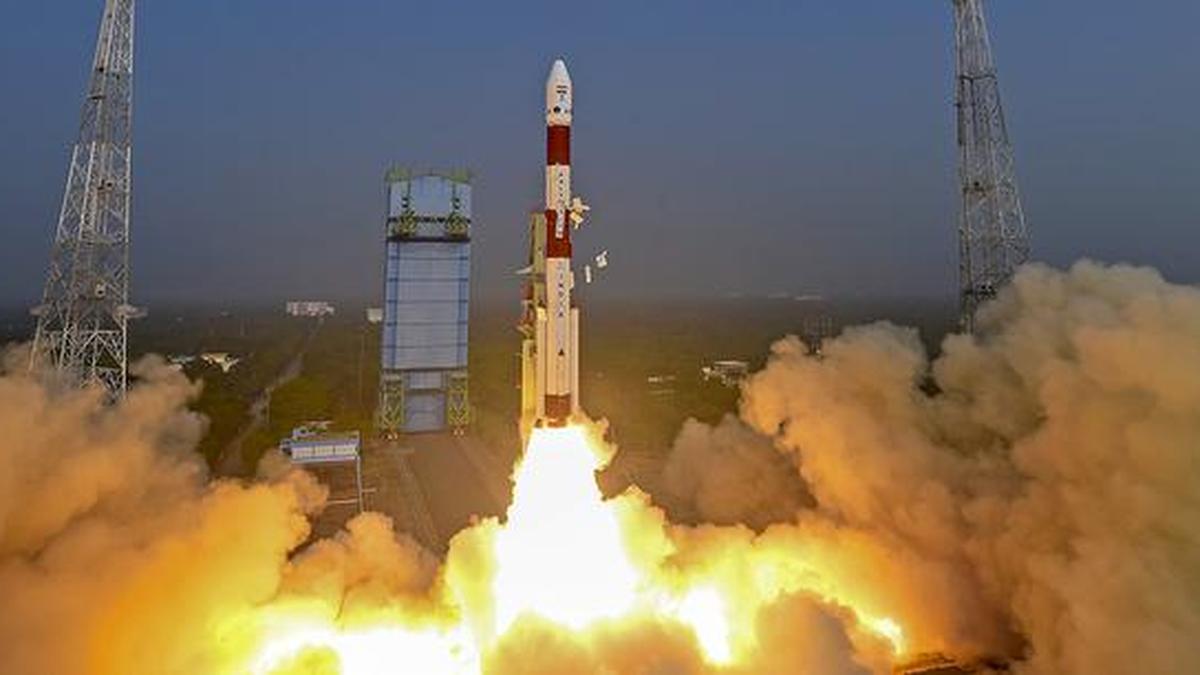
Aditya L1: India followed its lunar success with the successful launch of its solar science mission Aditya-L1 on September 2, 2023. The launch was the easiest part of the mission, onboard ISRO’s workhorse Polar Satellite Launch Vehicle (PSLV). The spacecraft executed a series of manoeuvres to move into an orbit around the first earth-Sun Lagrange point, called L1, on January 6, 2024. It completed its first orbit around L1 on July 2, 2024. In this time, it studied a solar storm in May 2024 together with observatories on the ground and spacecraft in lunar orbit.
Gaganyaan TV-D1: ISRO used a modified L-40 Vikas engine to build its Test Vehicle (TV) that it used to perform the first abort mission (TV-D1) on October 21, 2023, as part of its ‘Gaganyaan’ human spaceflight mission. The mission demonstrated the ability of the Crew Escape System (CES) to separate from the TV, take the crew module to safety, and the crew module’s ability to decelerate before splashing down in the Bay of Bengal. The crew module at the test’s end was recovered by the Indian Navy vessel INS Shakthi.
XPoSat: ISRO celebrated the new year with the launch of its X-ray Polarimeter Satellite (XPoSat) on January 1, 2024. The satellite will study how radiation is polarised and thus learn more about various sources of radiation in space. It is the second such space-based observatory after NASA’s Imaging X-ray Polarimetry Explorer (IPEX), launched in 2021. The two instruments on board XPoSat, called XSPECT and POLIX, began operating after launch on January 5 and 10.
INSAT-3DS: ISRO launched the meteorological satellite INSAT-3DS on February 17 onboard a Geosynchronous Satellite Launch Vehicle (GSLV). This mission was important to prove the vehicle’s credibility before the critical NASA-ISRO Synthetic Aperture Radar (NISAR) mission, now expected to be launched in the first quarter of 2025. This version of the GSLV had previously successfully launched the NVS-01 satellite in 2023.
RLV-TD: ISRO used a downscale version of the Reusable Launch Vehicle, called Pushpak, to conduct two landing experiments (LEX-02 and LEX-03) on March 22 and June 7 at its Aeronautical Testing Range in Challakere, Karnataka. The tests simulated landing conditions from space by dropping the Pushpak vehicle from a Chinook helicopter. While LEX-02 dropped Pushpak along its landing path, LEX-03 dropped it 500 metres to one side. The success of these tests gave ISRO the confidence to move on to the Orbital Return Flight Experiment (OREX).


Explore 2026's wallpaper trends in India, highlighting botanicals and handmade designs that enhance modern homes with nature-inspired aesthetics.

Mercedes-Benz CLA 250+ with EQ Technology review: design, performance, range and features explained. Discover how the new electric CLA combines advanced AI, long range, fast charging and futuristic styling for the next generation of luxury EVs.

AI tool for sparrow conservation

BTS’s comeback with ‘Arirang’ marks a major global music event. When does the album release, and where can you watch their concert live stream? We have all the details

The 2026 U.S. cholesterol guidelines urge starting screening and treatment at 30 to prevent cardiovascular disease effectively.

Olam Festival 2026 in Thiruvananthapuram returns March 27-29 with 120+ vendors, music, art, and cultural zones.

A few storytellers in Thiruvananthapuram share their journeys, challenges, and evolving methods on World Storytelling Day, inspiring young minds.

76-year-old Kurian Jacob from Kerala triumphs with seven medals, including five golds, at the Open Masters Games in Abu Dhabi.

Explore the nature of the human mind as an emergent property of brain activity and complex neural interactions.

CERN's Large Hadron Collider discovers the Xi-cc-plus particle, enhancing understanding of quantum mechanics and baryon behavior.

Vibha Batra’s latest book, Spotless (Hachette India) is a novel in verse for young adults

In its first edition, the Madras Art Salon spotlights the works of journalist and artist Narayan Lakshman at The Botanical Club, a social space in the British Deputy High Commission, Chennai

Cholesterol enhances melanoma cell invasion by making nuclei squishier, revealing a potential treatment target in cancer progression.