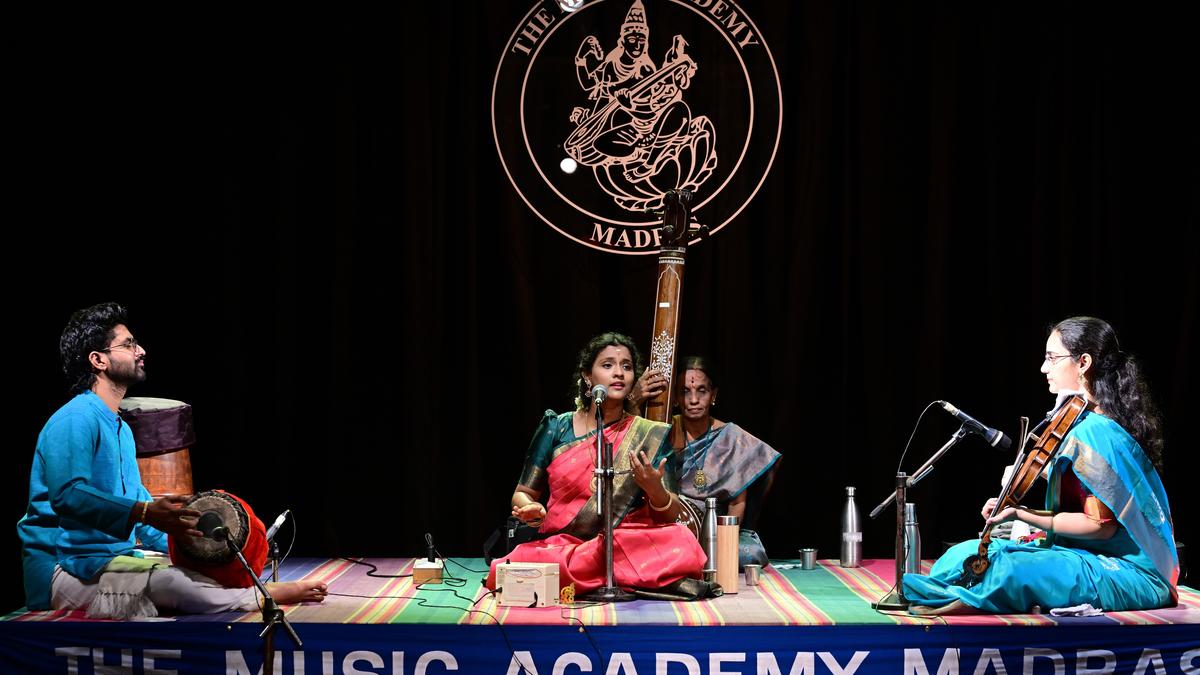
S. Swarathmika chose only Pratimadhyamam ragas for her concert themed on Gopalakrishna Bharathi
The Hindu
Swarathmika paid rich musical tribute to composer Gopalakrishna Bharati through an unusual choice of ragas
It came as no surprise that S. Swarathmika’s concert, dedicated to the compositions of Gopalakrishna Bharathi and presented under the aegis of The Music Academy at the Kasturi Srinivasan Hall, was a fitting reflection of the steady strides she has been making in her budding career. What did come as a surprise, however, was her choice of pratimadhyamam ragas only — Purvikalyani and Varali — for exploration, bypassing the more abundant suddhamadhyamam variety. Given Swarathmika’s lineage — she is the granddaughter of the late Leelavathy Gopalakrishnan — one might have expected her to strike a balance by drawing from her sizeable repertoire within the composer’s corpus.
That said, the vocalist carved out a compelling performance, invoking the grace of the cosmic dancer, Nataraja. She was well-supported by Chaganti Ramya Kiranmayi on the violin and Kundurthi Aravind on the mridangam.
Gopalakrishna Bharathi, a 19th-century composer singularly devoted to the dancing deity of Chidambaram, elevates Nataraja not just as a religious icon but as a cosmic principle — a metaphysical embodiment of the universe — connecting divinity, motion, matter and time. His portrayal of the Lord’s dance is not merely mythic or artistic; it is a profound philosophical metaphor for the rhythm of the universe, as discernible in several of his compositions.
Swarathmika struck a note of surrender to the Lord through ‘Saranagatham enru’ in Gowlai, setting a brisk opening. She enhanced its appeal with a swara sequence that was as lively as it was nuanced. ‘Chidambaram enroru tharam sonnaal’ in Begada, which suggests the shortcut to the divine sanctuary, was sung with devotional fervour.
The Purvikalyani alapana unfurled loopy phrases, flashy forays, swirling sancharas, and long notes, particularly in the upper registers, and brought out the raga’s evocative mood in ample measure. Ramya Kiranmayi’s bow work produced an interpretation that closely mirrored the vocalist’s ideas. After a delectable rendition of the song ‘Natamadum nathan’, set to Khanda Chapu, Swarathmika led the well-crafted swara exchanges in which the concluding avarthanam stood out.
‘Thaa thaa thaa nee’ in Karaharapriya, a seldom-heard song with a delicate pallavi, was an interesting choice. Swarathmika negotiated it with calm assurance.
Swarathmika featured Varali as the main raga and her delineation progressed, gathering flair and momentum, textured with polished gamakas. Ramya Kiranmayi once again displayed a keen melodic sensibility in her response. The composition ‘Adiya paadhame gatiyenru’ followed. There is an unmistakable felicity in her kriti rendition, and this challenging song was no exception. The niraval at the anupallavi opening ‘Naadu pugazhndhidum’ was a graceful exposition, and the kalpanaswaras sparkled with vitality. Mridangist Aravind, brought in a lively rhythmic presence, and his Adi talam tani carried interesting patterns and vibrant strokes.


BTS's comeback concert in Seoul drew over 100,000 fans, featuring their new album "ARIRANG" and a global livestream.

Khalid Rahman is reuniting with Malayalam superstar Mammootty after Unda (2019). The Thallumaala director has teamed up with the veteran for Mattancherry Mafia.

Bollywood actor Akshay Kumar paid tribute to the martial arts grandmaster and Hollywood’s action star, Chuck Norris, who passed away on Thursday, March 19, 2026.

Renowned Odissi dancer Madhumita Raut, aged 59, dies of cardiac arrest, leaving behind a legacy of artistic achievements.

Chuck Norris, iconic martial arts master and actor, dies at 86, leaving behind a legendary legacy and internet memes.

South African naturalist Steve Boyes speaks on ghost elephants, ancestral tracking, and Werner Herzog’s documentary exploring Angola’s elusive highland giants

Actor-director Amol Palekar will receive META's Lifetime Achievement award for 2026 on March 25 in New Delhi.

India's artists unite against rising censorship, advocating for creative freedom and support for marginalized voices in the arts.

Written and directed by Kunal, the film also stars Sparsh Shrivastava and Vanshika Dhir

This year, Bharatnatyam artistes will present the Tyagaraja Aradhane as a dance performance

This year, Bharatnatyam artistes will present the Tyagaraja Aradhane as a dance performance

The actor, along with director Sushant Shah, speak about their upcoming series ‘Chiraiya’, Divya’s process of working on the dialect, Sushant’s approach to telling a story about women, and more

An independent video, ‘Feel the Spark’ by Raleigh Rajan with vocals by Ciera Dumas that celebrates Tamil literary giants, garnered 1.4 million views in less than 36 hours.