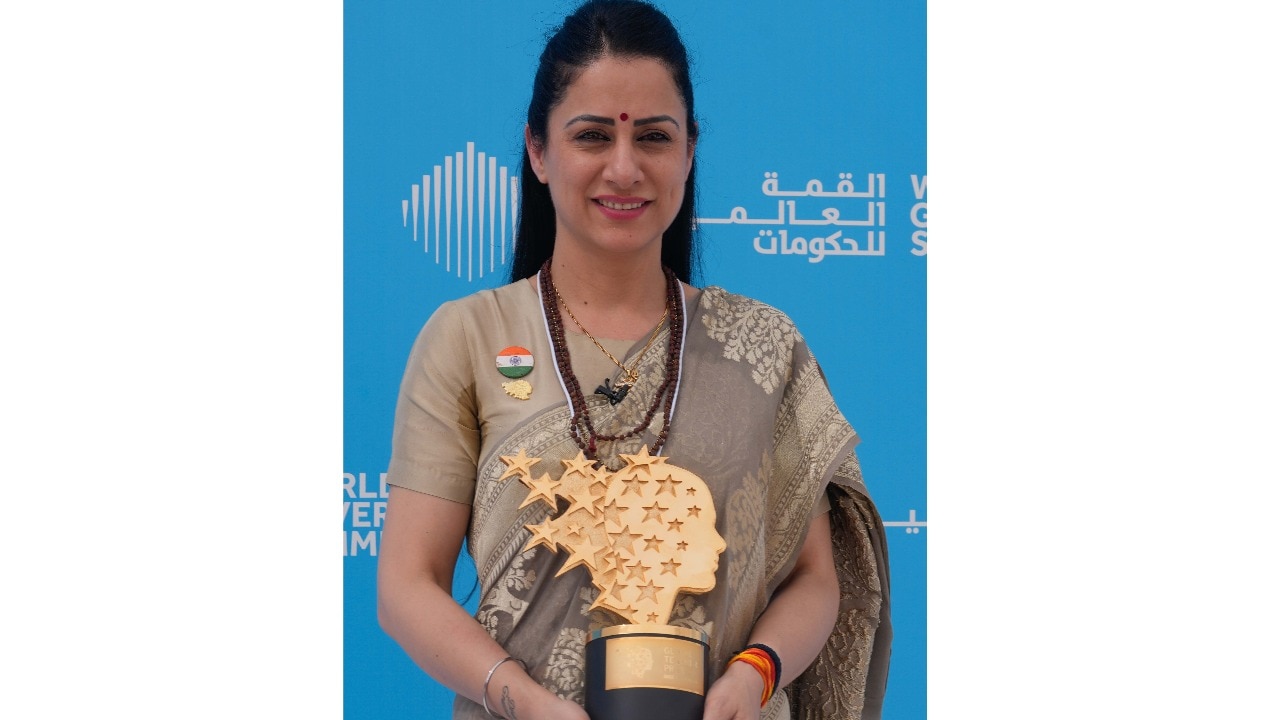
Rouble Nagi, Indian educator who transformed slums wins $1 million Global Teacher Prize
India Today
Rouble Nagi, an Indian teacher and social activist, has been honoured with the 1 million dollar Global Teacher Prize 2026 for her revolutionary work in education. She has transformed slums across India into vibrant learning spaces through innovative centres and educational murals.
Indian educator and activist Rouble Nagi has won the prestigious 1 million dollar GEMS Education Global Teacher Prize 2026, an initiative of the Varkey Foundation organised in collaboration with UNESCO.
The award was presented at the World Governments Summit in Dubai, which brings together leaders and policymakers from across the globe.
Over the past two decades, Nagi has established more than 800 learning centres across over 100 underserved communities in India through her Rouble Nagi Art Foundation (RNAF).
These centres provide children who have never attended school with structured learning, while also supporting those already in the formal education system with remedial education and creative enrichment.
Central to her work are the “Living Walls of Learning”, interactive murals painted on abandoned walls that teach literacy, numeracy, science, hygiene, history, environmental awareness, and social responsibility.
Far from being mere decorations, these murals turn neighbourhoods into active learning spaces, engaging children, parents, and the wider community.


ICAI CA Final January 2026 results have been declared today, March 1. Candidates who appeared for Group 1 and Group 2 exams can now check their scorecards, merit list and All India Rank holders on the official website, icai.nic.in. Direct result link is now active.

The OnePlus 15T is set to make its debut in China next week. The compact smartphone boasts a 6.32-inch AMOLED display and will be available in three colour options at launch.

The CBSE Class 12 Economics exam 2026 was moderate and balanced, say teachers. The paper followed the CBSE pattern and NCERT syllabus, with a mix of theory, numericals, and case-based questions. While many questions were manageable, application-based and case study questions required careful reading and strong conceptual clarity.

Audi has launched the Audi SQ8 in India at Rs 1.77 crore, slotting between the Audi Q8 and Audi RS Q8 Performance.

Short kurtas paired with loose pants and dupattas were a big trend in the 2000s Bollywood, and now, they seem to be catching on in the West too.

The OnePlus 15T is set to make its debut in China next week. The compact smartphone boasts a 6.32-inch AMOLED display and will be available in three colour options at launch.

Beats has launched the Powerbeats Pro 2 Nike special edition. The earbuds come with ANC, heart rate tracking, and long battery life. Here is more about the device.

A mysterious AI model was recently spotted on AI gateway platform OpenRouter. As per reports, this model, named Hunter Alpha, may be from DeepSeek. It is speculated that the Chinese firm may be testing the model via this anonymous release.

The Galaxy Z TriFold, Samsung's triple-folding smartphone, is reportedly getting the axe barely three months after launch. The TriFold's seemingly high production cost is being cited as the reason.

The CBSE Class 12 Economics exam 2026 was moderate and balanced, say teachers. The paper followed the CBSE pattern and NCERT syllabus, with a mix of theory, numericals, and case-based questions. While many questions were manageable, application-based and case study questions required careful reading and strong conceptual clarity.

WhatsApp is reportedly working on a built-in noise cancellation feature. This feature is designed to improve call quality on the platform. Here is what we know about the feature.

After cutting thousands of jobs, Amazon bets big on AI to power its next phase of growth. CEO Andy Jassy believes AWS could grow into a $600 billion business in the coming years. Here is everything you need to know.

One Nation One Subscription (ONOS) is beginning to reshape access to academic research in India. In its first year, the scheme enabled more than 11 crore article downloads across government institutions, with IIT Madras and IISc Bengaluru among the leading users.