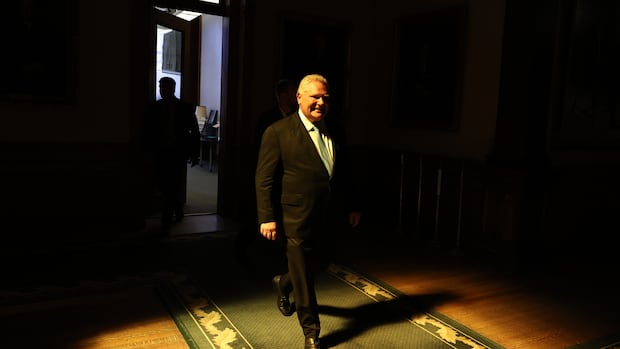
Return to office for Ontario civil servants 'unnecessarily confusing,' unions say
CBC
The return to office last week by thousands of Ontario public servants has been ”disrespectful,” “piecemeal” and filled with “unnecessary confusion,” say the workers' unions, who point out some ministries and agencies still don't have enough space to meet Premier Doug Ford’s order.
Last week, thousands of workers were to report to the office for four days of work instead of three, as a result of an order from the Progressive Conservative government this summer. The move has rankled workers who have had hybrid arrangements for more than three years and say it will cost taxpayers more because of the need to buy or lease new office space.
The head of the AMAPCEO, which represents some 17,000 professional, administrative and supervisory employees in the Ontario Public Service, says the process has been “very disruptive.” The government does not have enough space for the workers it ordered back, said Dave Bulmer in an interview with CBC News.
“There's had to have been a lot of ad hoc arrangements being made by local managers and directors, because they just don't have the space to accommodate people,” he said. “So, things are not going exactly to plan.”
In August, Treasury Board President Caroline Mulroney announced that the 60,000 employees of the Ontario Public Service, provincial agencies, boards and commissions had to "increase their attendance to four days per week" starting Oct. 20 and transition to full-time hours in-office effective Jan. 5, 2026.
It's a change from a policy that has been in place since April 2022, when provincial government employees were mandated to be in their offices at least three days per week.
Bulmer says the government and its arms-length agencies are busy buying buildings and signing leases to ensure they can accommodate the workers. But it couldn’t be executed on the timeline the Ford government set down, he said.
“These are places that are not just missing a few seats or desks, but are missing entire floors worth of space,” he said, pointing specifically to the Workplace Safety Insurance Board (WSIB) and Ontario Health.
Bulmer estimates that approximately 10,000 of AMAPCEO’s members returned to four days in the office last week. Approximately 6,000 of the union's members have pre-existing contractual hybrid work arrangements which the government will still have to honour despite the change, he said.
And thousands of those who have returned to the office are currently applying for some form of flexible work, he said.
“I think it's been very piecemeal,” Bulmer said of the return to office. “We have people … not even knowing what floor they're going to or where they're supposed to sit. It's just unnecessary confusion from our perspective.”
Both the WSIB and Ontario Health told CBC News that they are currently working to meet the province’s directive and increase available space for their workers.
The Ontario Public Service Employees Union (OPSEU), which represents roughly half of the Ontario Public Service workforce, said in a statement that the return to office order was a “direct show of disrespect” to workers.
Last week was full of confusion for union members, said Amanda Usher, chair of the OPSEU OPS unified central employee relations committee and unified bargaining team.


The family of an Edmonton woman who died in Honolulu last year is pushing for Hawaiian authorities to re-open the case.

It was around this time in 2020 that everything changed.

With its emergency shelter beds frequently running at 50 per cent over capacity and demand so great that it's forced to refer some women escaping domestic violence elsewhere, Gillian's Place in St. Catharines will soon be able to offer a broader range of services to more victims of gender-based violence.

The ceiling of the CAW Student Centre at the University of Windsor is decorated by flags of numerous nations — among them, Iran.

Turmoil in Iran, a major disruption in world oil markets, and stratospheric gasoline prices in Canada and beyond. What's racking motorists and governments in 2026 also faced them in 1979, sparked by the Iranian Revolution.

Five decades later, and Thunder Bay's Music World Academy remains a family-run business.

Dalton Dubois of Guelph, Ont., made history at the recent Paris Fashion Week when she became the first transgender model to walk the runway for Chanel Exclusive.

Work is scheduled to begin over the summer at the site of the former Clinton Creek asbestos mine, about 65 kilometres northwest of Dawson City, Yukon.

They may be bitter rivals in the House of Commons, but outside the chamber, recent events may have led to Conservative Leader Pierre Poilievre and Prime Minister Mark Carney forging a bond.

Local fans and industry insiders say the province’s move to ban the reselling of event tickets for more than their original value is a step in the right direction, but some say there are still larger issues that need to be addressed.

This First Person column is the experience of Mehdi M. Kashani, who lives in Toronto. For more information about CBC's First Person stories, please see the FAQ.

A very quiet queue has formed in Europe where some of Canada's long-standing, closest allies are seeking shelter under France's small but robust nuclear umbrella.

Friday morning's dusting of snow was no match for the large crowd visiting the Suleman Dawood Masjid in St. John’s for Eid-al-Fitr. A busy service marked the end of Ramadan, the Islamic holy month.