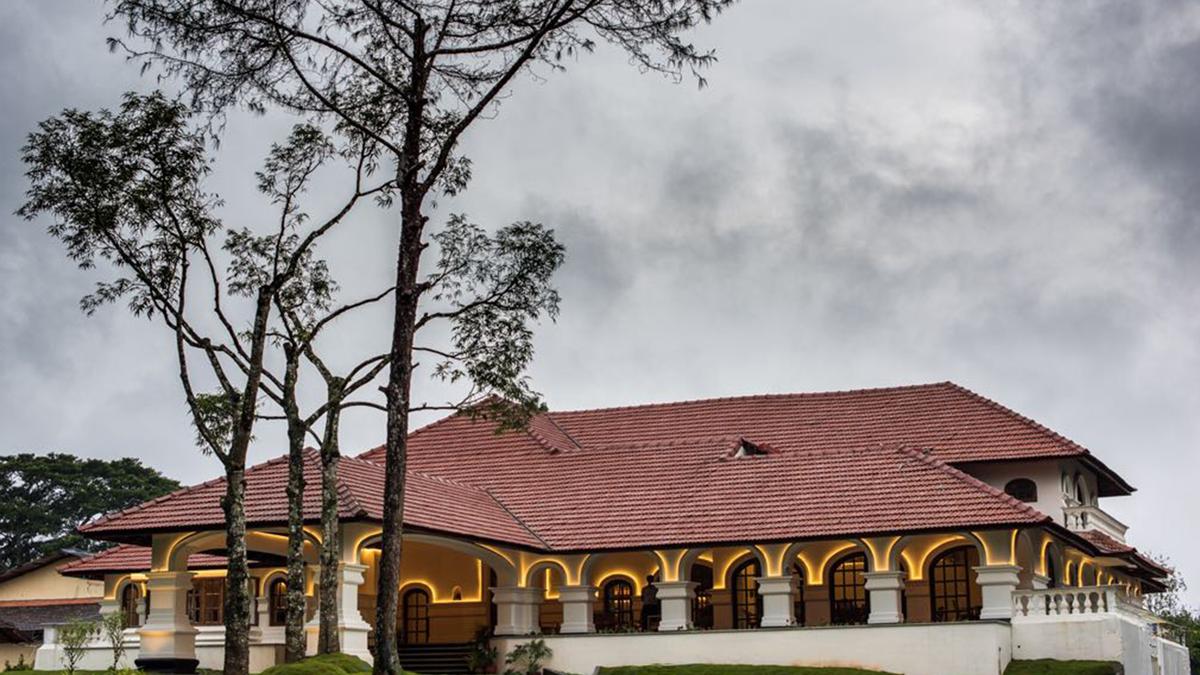
Restoration of Bamboo Club in Kodagu
The Hindu
Restoration of a 141-year-old colonial club in Kodagu by architect George Ramapuram, preserving original structure with modern interventions.
It is a nearly 140-year-old structure, built during the colonial era as a club for the Englishmen who had made the picturesque Kodagu their home. Nestling amidst the thick greens of the sprawling coffee estates, the Bamboo Club, built in 1886, had greatly weathered with time, displaying multiple erroneous interventions to meet altered functionalities as well as address structural repairs.
What architect George Ramapuram of Earthitects noticed while taking up the restoration of this heritage structure was random additions. Starting from an asbestos roof on the façade to make-shift toilets and rooms at the rear of the building, the interventions were totally out of sync with the original plan and language of the building. “The interiors were dimly lit because of limited access to direct sunlight. A false ceiling had been added to the ballroom to stem rainwater leakage, and this further added to the dinginess besides cutting down on the volume of the interiors,” points George.
Given the weathering structural form, George decided to start the restoration by first addressing the multiple arches that lined its expansive corridors. While retaining these multiple arches, George decided to deftly tweak their shape a bit to visually expand the individual arches. This was complemented by greater detailing brought to the columns to enhance the colonial visual appeal. “The originality of the individual arches was not tampered with; in fact, it was painstakingly retained to ensure they existed as a cohesive unit post the intervention to expand the sprawling verandas,” he states.
His next line of intervention addressed the Mangalore tiled roof, which had an intrusion of asbestos over the years to cover the additional rooms brought in to meet various functional requirements. “The original structure came with a tiled roof, and the asbestos was brought in much later. This becomes clear on inspecting the shift in the gradient of the roof, which marks the beginning of the asbestos,” explains George. The asbestos roof was dismantled as part of the intervention, at the front as well as the rear of the building, with the Mangalore tiles extended to cover the open corridors.
Kodagu is famous for its copious rain, with many areas reporting flooding during the peak monsoons. Sensitive to this, George created a large overhang of Mangalore tiles in the front of the building to shelter the entrance and the interiors from heavy seasonal rains. “The overhang of the tiles was extended to a height of about 2m to cover the eave board, a basic requirement to shield the interiors from the heavy rains,” he explains.
Incidentally, George did not stop there but created a porch at the entrance to facilitate vehicle drop-off during these heavy rains. A driveway was thus created over the expansive steps leading to the entrance gate of the club. Given the ragged state of these steps, George brought in a design intervention over the same, where their structural form was redone to lend aesthetics. George went further to green the landscape around the steps, besides retaining the existing trees around it. Black Kota stone was used to lay the treads in stark contrast to the lush greens surrounding it, thus offering the club a grand entry.
The next level of intervention was the interiors that required major transformation, given their dowdy state with scant infiltration of natural light. “The interior spaces came with their defined functionalities, each evolving over time based on emerging requirements. However, the spaces came with very limited natural light, affecting the functionality as well as the energy of the individual zones,” elaborates George.


The government plans to amend the FCRA, introducing new regulations for NGO asset management and accountability for key functionaries.

The draft policy for “Responsible Digital Use Among Students”, released on Monday by the Department of Health and Family Welfare, has recommended that parents set structured routines with clear screen-time rules and prioritise privacy, safety, and open conversation with children on digital well-being.

Police Observer Sushant Kumar Saxena conducts surprise inspection at Shencottai police station, reviewing warrants and security arrangements ahead of elections.

Andhra Pradesh government to launch key projects in April, focusing on industrial growth and infrastructure development, says Nara Lokesh.

Lok Sabha refers the Corporate Laws (Amendment) Bill to a JPC amid opposition concerns over CSR provisions dilution.

SHG members in Kanniyakumari use snakes and ladders to raise election awareness and boost voter turnout.

Government accelerates consultations for early implementation of the Women’s Reservation Act to ensure women’s representation in 2029 elections.

CM A. Revanth Reddy distributes ₹1 crore insurance cheques to families of deceased Electricity department employees, enhancing financial security for workers.

The Bengaluru Traffic Police (BTP) registered 634 cases of drunk driving during a week-long special enforcement drive conducted across the city between March 16 and March 22.

GHMC intensifies action against property tax defaulters, seizing properties and offering a One Time Settlement scheme for payments.

CCB arrests three drug peddlers in Mangaluru, seizing ₹2.5 lakh worth of MDMA and other valuables.

TVK's 28 candidates in Puducherry include former BJP MLAs, a sitting Independent, and a retired police IG.

BRS submits notice on private member bill to Speaker