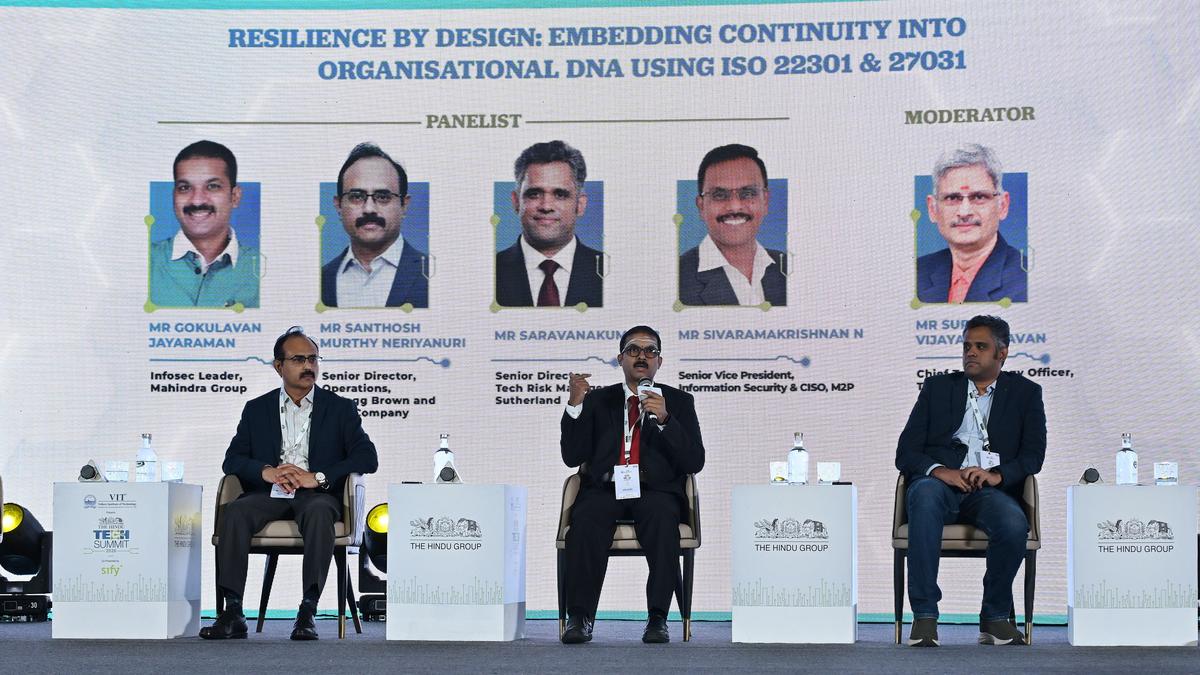
Resilience must be built into everyday operations of companies, say experts
The Hindu
Experts at The Hindu Tech Summit 2026 emphasize integrating resilience into daily operations, moving beyond compliance-driven approaches.
Experts from the technology, engineering, and financial services sectors said organisational resilience can no longer be treated as a compliance-driven exercise, but must be designed into everyday processes and decision-making. They were taking part in a panel discussion on “Resilience by Design: Embedding Continuity into Organisational DNA using ISO 22301 and ISO 27031” at The Hindu Tech Summit 2026 on Thursday (February 12, 2026). The summit, hosted by The Hindu, is presented by Vellore Institute of Technology and co-presented by Sify Technologies.
The speakers noted that while global standards such as ISO 22301 and ISO 27031 provide structure, resilience could fail when it is approached as a standalone IT or risk function. Instead, leadership ownership, business-aligned recovery priorities, and continuous testing were identified as key to ensuring that continuity plans work under real-world disruption.
Speaking on how perceptions around continuity have evolved, Gokulavan Jayaraman, Infosec Leader at Mahindra Group, said organisations were moving away from a checklist-driven mindset. “It is no longer a checkbox or documentation-only exercise. Organisations have understood this and are starting with the process and procedure because resilience has to be built into how applications and processes actually run,” he said. He added that modern systems must be designed assuming failure, with testing embedded across application, infrastructure, and business layers.
From an engineering and project-delivery perspective, Santhosh Murthy Neriyanuri, Senior Director – Operations at Kellogg Brown and Root Company, outlined a structured approach to business impact analysis. He said that all critical activities that depend on IT systems are first identified, followed by detailed data collection through interviews with project managers and stakeholders to understand what truly affects business outcomes. The impacts are then classified as financial, reputational, or operational and assessed accordingly.
Based on this four-step analysis, applications are identified and categorised into three tiers. Mission-critical systems form the first tier, the second tier comprises applications that are important but can tolerate longer downtime, and the third tier includes non-critical systems, said Mr. Neriyanuri.
Highlighting the importance of tailoring continuity objectives to business realities, Sivaramakrishnan N., Chief Information Security Officer at M2P Fintech, spoke about defining Minimum Business Continuity Objective levels during disruptions. One approach, he said, is to focus on ‘just enough’ services to keep the business running, rather than trying to restore everything at once. He said organisations could operationalise this by defining a limited set of “golden signals” for observability — such as latency, traffic, error rates, and saturation — to quickly assess system health without relying on detailed reports or executive dashboards.


District Collector releases coffee table book on Coimbatore

Madras High Court stays civil suit by PMK founder Ramadoss against son Anbumani until April 2026, amid party leadership disputes.

As they chug in from Arakkonam and Tirutanni and head towards Chennai Central, fast local trains do not have a platform on the fast line to halt at Ambattur railway station. As a result, commuters taking these trains to reach Ambattur have to do an extra train trip. Ambattur Rail Commuters Welfare Association wants Southern Railway to carry out yard remodelling and provide this much-needed platform

A.P. government assures LPG availability and urges consumers to avoid panic booking, with 17,962 MT stock and uninterrupted supply measures in place.

Deputy CM Udhayanidhi Stalin distributes ₹122.08 crore in welfare aid to 24,518 beneficiaries, highlighting Tamil Nadu's development progress.

Dakshina Kannada Member of Parliament Captain Brijesh Chowta on Thursday urged the Union Ministry of Environment, Forest and Climate Change to formulate a comprehensive district-level coastal protection plan for the district in coordination with the Ministry of Earth Sciences

Telangana High Court to deliver verdict on April 8 regarding Ghose Commission's report on Kaleshwaram Lift Irrigation Scheme irregularities.

Kerala High Court summons home secretary over delays in Rs 47 crore compensation for sexual assault survivors.

Indian Embassy in Iran assists stranded fishermen amid West Asia conflict, as court hears plea for evacuation and support.

The Gowd Saraswat Brahman Seva Sangh in association with Sri Narayani Sangeeth Kala Kendra will organise Vasantha Sangeetotsava, an assembly of exceptional young artists here on Sunday.

Join the 16th M.K. Nambyar Memorial Moot Court Competition in Belagavi, featuring 100+ participants debating government health interventions.

LPG shortage jeopardizes meals for over 8,000 students in Visakhapatnam's government-run hostels amid ongoing conflicts.

Forest Minister bans tree felling amid rising firewood demand, urging officials to enforce inspections and prevent illegal logging.