Residents’ association moves Madras High Court against traffic problem in MRC Nagar
The Hindu
MRC Nagar residents file PIL in Madras High Court over severe traffic congestion and parking issues affecting daily life and safety.
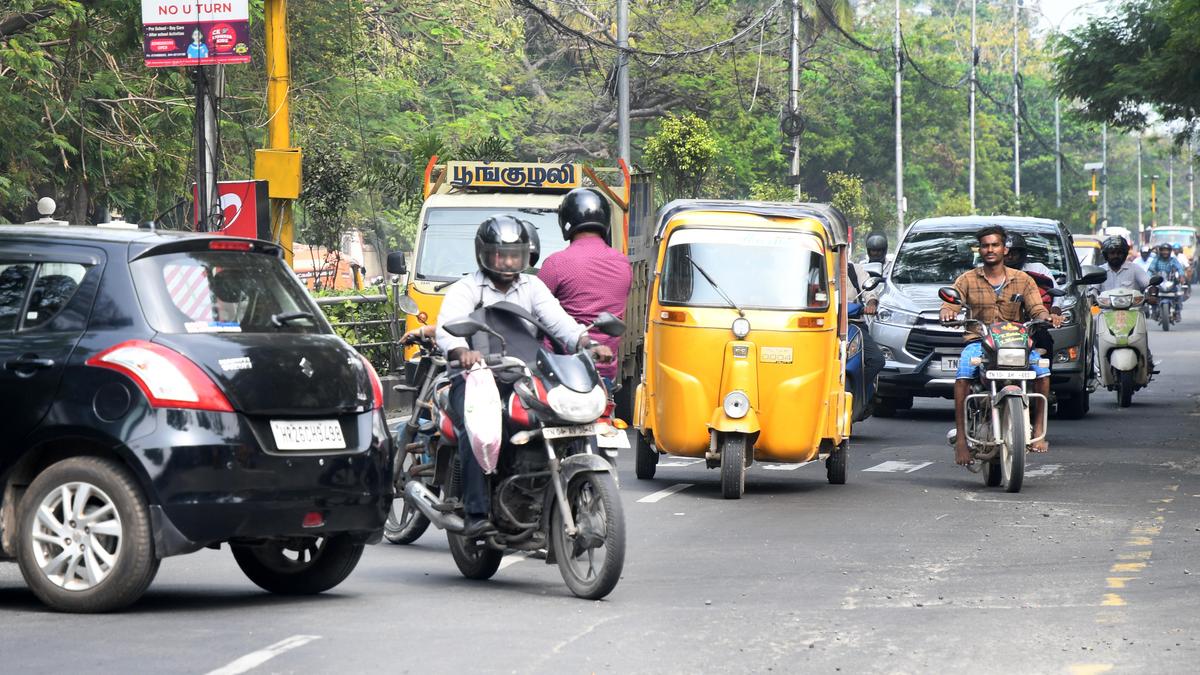
The Madras High Court on Wednesday (April 1, 2026) ordered notices to the Greater Chennai Corporation (GCC) and the Chennai Commissioner of Police on a public interest litigation (PIL) petition filed by the MRC Nagar Residents’ Association complaining about heavy road traffic in their locality due to multiple commercial establishments.
The First Division Bench of Chief Justice Sushrut Arvind Dharmadhikari and Justice G. Arul Murugan passed the orders after hearing senior counsel P.R. Raman who said that the parking of private vans, which transport schoolchildren, on the roads throughout the day was also one of the reasons for the traffic congestion.
In his affidavit, the association secretary S.K. Nawaz, 59, said, the residents of MRC Nagar Main Road, South Beach Avenue, Janaki Avenue, Sathyadev Avenue, Vasantha Avenue, Kasthuri Avenue, and Thandavarayan Street have been facing persistent and unabated public nuisance, traffic congestion, obstruction of public roads, encroachments on pavements, and severe sanitation issues for several years.
He said that the issues gravely affected the day-to-day life, safety, and free movement of the residents who included senior citizens, children, women, and persons with disabilities. Stating that a multi-speciality hospital, too, was located on Thandavarayan Street, he said that it becomes very diflicult even for an ambulance to enter the street during emergencies.
“The nuisance and obstruction are primarily caused by the unchecked and unregulated activities of Chettinad Vidyashram School, Sun TV Network Limited, and several illegal and unauthorised commercial eateries and street vendors operating in and around the Sri Ayyappan Temple at Thandavarayan Street,” the affidavit read.
It also stated that the commercial establishments had substantially increased their operational activity and footfall over the years, attracting large numbers of employees, visitors, vendors, service vehicles, and supporting personnel throughout the day, thereby destroying the residential character of the locality.


Impeachment motion against CEC: Exclusion of even a single eligible voter due to the way the SIR has been conducted would legitimise the criticism of this arbitrary and aggressive exercise

BJP candidate B. Gopalakrishnan faces backlash in Guruvayur for controversial flex highlighting past MLAs and “Hindu MLA” remarks.

Chicken shops across Hyderabad are closed from April 1, 2016, indefinitely as traders strike over unsustainable margins and demand government intervention.

MRC Nagar residents file PIL in Madras High Court over severe traffic congestion and parking issues affecting daily life and safety.

Kerala CM Pinarayi Vijayan criticizes G. Sudhakaran's UDF-backed candidacy, highlighting Congress-BJP political convergence in upcoming assembly polls.

Producer Supriya Yarlagadda on ‘Dacoit’, putting Adivi Sesh and Mrunal Thakur on equal footing, and a three-decade journey in Telugu cinema

Madras High Court requests CBI's response to A. Raja's plea for documents in a disproportionate assets case.

Discover how TP53 mutations in adult leukaemia impact treatment outcomes and potential strategies for improved patient care.

Kerala HC accepts a petition alleging corrupt practices by Union Minister Suresh Gopi in the 2024 election campaign.

Delhi‑based Keelaka Dance Company fuses Bharatanatyam with contemporary dance, theatre, and live Tamil jazz in its prodcution -- Rebel Ranis

Ashwini Bhide appointed as BMC commissioner, becoming the first woman to lead Mumbai's civic body amidst urban challenges.

PM Modi visits a tea garden in Assam, engaging with women workers during his campaign rallies for BJP candidates.

Thol. Thirumavalavan discusses Tamil Nadu politics, BJP's strategies, and VCK's role in the upcoming assembly elections.