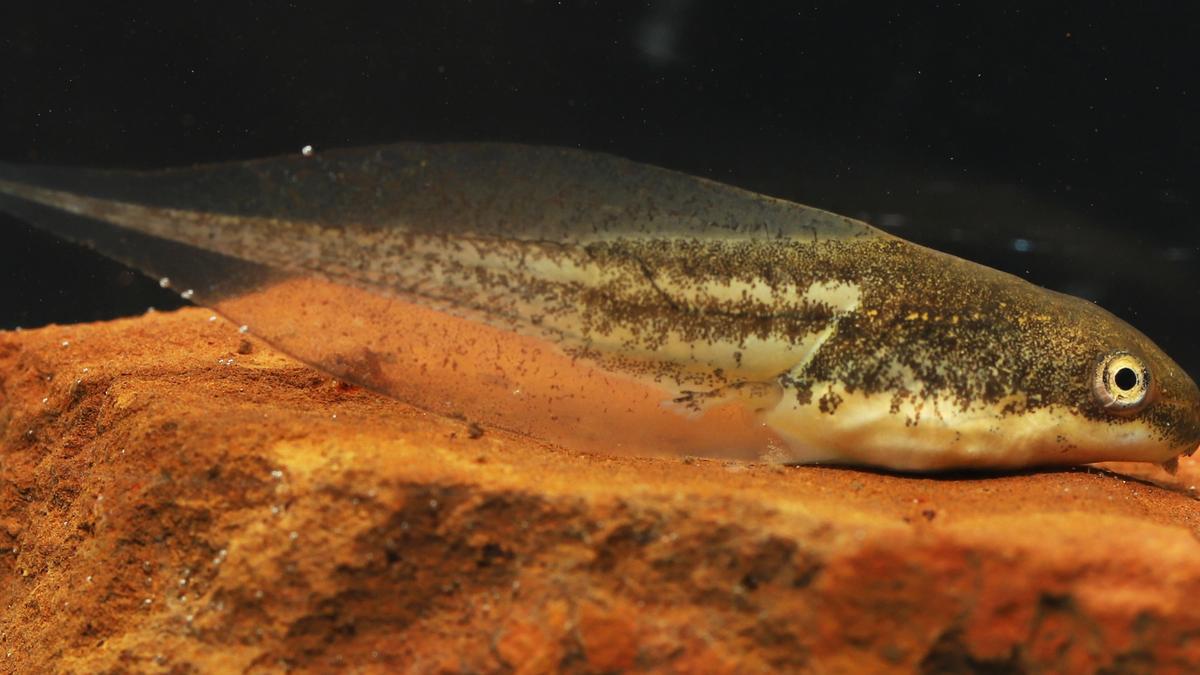
Rain pattern and rock pool size matter for tadpole growth in Konkan’s lateritic plateau
The Hindu
Research on tadpole ecology in Maharashtra's Konkan region rock pools reveals critical factors influencing frog breeding and conservation strategies.
Formed over millions of years ago, Maharashtra’s Konkan region’s lateritic plateaus, called ‘sadas’ in Marathi, are home to a diverse range of flora and fauna. These plateaus support unique freshwater rock pools that are formed due to erosion and weathering over a period of time and are critical frog breeding habitats.
A paper titled: ‘Effects of abiotic and biotic factors on tadpole occurrence and abundance in seasonal rock pools of rock outcrops, northern Western Ghats‘ published on a Netherlands-based journal, Aquatic Ecology on April 4, 2025, by research fellows and scientist from Nature Conservation Foundation, Vijayan Jithin and Rohit Naniwadekar, explains how the size of freshwater rock pools on the rocky outcrops, monsoon progression and presence of predators, influence the tadpoles growing in them.
Rock pools are depressions on rocky surfaces with pan - or bucket-shaped pools that are fed by monsoon rains. They harbor various endemic organisms uniquely adapted to the highly variable environment in the open rocky ecosystems. Since these depressions on the rock surface can temporarily store water during the monsoon time, they act as breeding grounds and tadpole habitats for frogs living around the area. Frogs generally need water bodies for breeding, depositing their eggs, and tadpole development.
These rock pools are also favourable to other organisms such as microscopic phytoplanktons, zooplanktons, larger algae, aquatic plants, insects, and vertebrates. Many of these are also endemic species, often occurring only in a few pools.
The lateritic rock pools can be found only along the Western coasts, starting from north Kerala till Maharashtra’s Ratnagiri district. The extensive Deccan volcanism has resulted in the greatest expanse of low-elevation lateritic plateaus of the Western Ghats, harbouring many rock pools in these open habitats.
The researchers carried out the fieldwork in Devihasol village of Rajapur taluka in Ratnagiri district from July to September 2022. The paper says that tadpoles’ survival depends on various biotic and abiotic factors in the aquatic habitat, including predation, competition, aquatic permanence, temperature, and anthropogenic disturbances, among others.
Mr. Jithin explained that for breeding, the frogs need water to last till the eggs hatch and tadpoles develop into frogs, which can last a few weeks. This is enabled by the rock pools that act as safe shelters of tadpoles due to water availability, presence of aquatic plants that provide them cover, availability of food items such as algae, and the absence of large predators like fishes makes them a perfect breeding habitat for frogs.”


India pledges 60% non-fossil fuel power by 2035, targeting 47% emissions reduction per GDP unit and enhanced carbon sinks.

Supreme Court rules land acquisition compensation and interest must uphold constitutional guarantees, unaffected by financial burdens.

Election officials accept 23 nominations for Bagalkot bypolls, rejecting three, with polling scheduled for April 9.

Students and women’s self-help groups in Madurai engage in vibrant voter awareness campaigns promoting 100% voting participation.

Congress signals a "friendly fight" with allies in select Puducherry Assembly seats ahead of the April 9 elections.

Airstrike in western Anbar kills 7 Iraqi soldiers, injures 13, prompting condemnation for violating international laws on medical facilities.

Plaque unveiled in Bengaluru honors 11 victims of RCB stampede, emphasizing safety responsibility for future events.

India and the U.S. reaffirm commitment to enhance strategic defense cooperation at the 18th Defence Policy Group meeting in New Delhi.

Chhattisgarh's Deputy CM reports only 30-40 Maoists remain in Bastar, highlighting recent surrenders and future development plans.

Explore the historical and industrial significance of Ariyalur constituency, highlighting its challenges, agriculture, and political landscape.

Dindigul and Madurai Collectors conduct joint inspection

In this episode, Kalki Subramaniam speaks to us about why the Transgender Persons Amendment Bill has sparked protests, and how these amendments threaten to push a marginalised community back into the shadows.

India's EU FTA is poised to attract more German companies, boosting bilateral trade and investment opportunities.