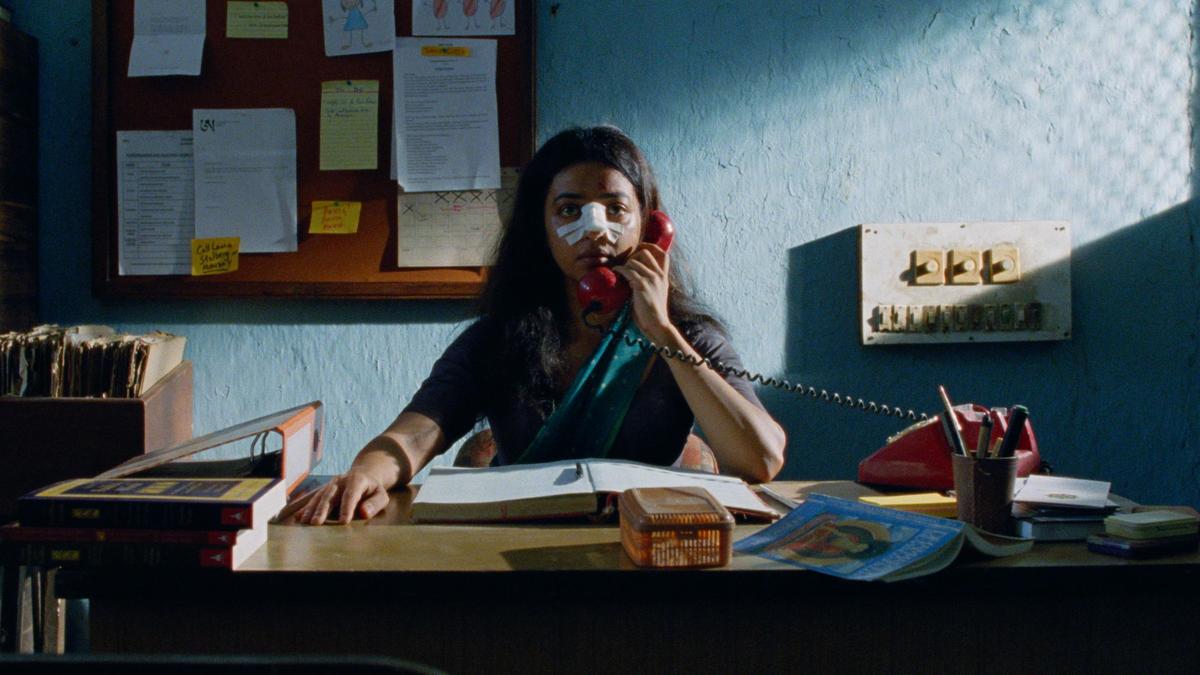
Radhika Apte interview | On ‘Sister Midnight’ and living away from Bollywood
The Hindu
The actor, who currently lives in London, chats about her instinctual, ‘animal-like’ performance in ‘Sister Midnight’, and why life away from the Hindi film industry has been a ‘blessing’
Radhika Apte has a flu. Over a Zoom call from London, the actor fights back a bout of coughing as she discusses Sister Midnight, her acclaimed, punk-powered black comedy that showed at last year’s Cannes and is opening in Indian theatres on May 30. By all accounts, Apte is a passionate talker. But her voice breaks down several times, and I wonder if she’s powering through out of politeness and professionalism. Perhaps not. There is a genuine delight in her words, a wonderment at looking back at a job well done.
Apte had stamped her comedic authority on Monica, O My Darling and Lust Stories. But Sister Midnight appears to nudge her into wilder terrain. The film centres on a newly married woman, Uma, and her nocturnal unravelling through the streets of Mumbai. London-based director Karan Kandhari has described the character as a ‘jar of unstable plutonium’, and anointed Apte ‘Buster Keaton reborn’.
We spoke to Apte about constructing and deconstructing Uma, her life away from Bollywood, and the status of her forthcoming directorial debut Kotya. Excerpts...
Radhika Apte: My usual go-to process is to intellectualise the whole thing. I have a biography and a history of the character: what happened to them, why are they a certain way, how do they react, why do they make the choices that they do? With Uma, Karan wanted me to delete all that out. To scrap any deep analysis or motivation and let my body take over. For instance, in a scene, Uma is walking and then she stops and takes a left turn. Normally, I would find a reason behind this action. But here, it had to come from pure impulse. I had to surprise myself. This took a few days to figure out. I changed the rhythm entirely, and my performance became more animal-like.
It helped a lot. Sister Midnight is not a ha-ha comedy. It’s a dark comedy and a lot of really strange things happen in the film. And a lot of it is silent. I had to convey everything through my face and body, as there are animals involved in the later half of the story. I have studied dance and theatre, and this film, too, is deliberately choreographed in a rhythmic, over-the-top way. It’s quite rare to get these opportunities. Right now, every platform or producer wants you to explain everything and spoon-feed the audience.
My favourite scene is the one I cannot divulge here, sadly. It’s a massive twist that comes after the midpoint. It’s the scene that transforms everything. It’s very funny and very bizarre. During the shoot, I thought it would be difficult to perform but it turned out to be quite simple. I also enjoyed all the night-time walking through South Bombay. We shot on film and the lighting and cinematography (by Norwegian DP Sverre Sørdal) is quite unique and interesting.
Not about the city or culture but about language. Karan had written the script in English. The dialogue had a predetermined rhythm to it. And in the translation, it was getting lost. Our absolutely wonderful casting director, Dilip Shankar, helped him translate the dialogue but some of it was also happening on set. And some of the dialogue didn’t make sense. Karan was chopping words and changing them to fit the rhythm. I was like, this doesn’t make sense grammatically, and he was like, I don’t care because I needed it to sound a certain way. So we had to sit together and make it work. It wasn’t friction but conversation.


Meet Nivrritii Mahesh, a Bharatanatyam dancer who dances with Cochlear implants

In a surprising turn of events, Urvashi theatre, one of Bengaluru’s iconic single screens, has re-opened, with the much-talked-about Dhurandhar: The Revenge running to a full house in the theatre. After the expiry of the 45-year lease, it seemed like curtains would come down on the king-size theatre but for now, it’s good news for fans.

The thrilling ‘Peaky Blinders’ finale is a farewell tour tailored for Tommy Shelby, while passing the baton to a new generation

BTS's comeback concert in Seoul drew over 100,000 fans, featuring their new album "ARIRANG" and a global livestream.

Khalid Rahman is reuniting with Malayalam superstar Mammootty after Unda (2019). The Thallumaala director has teamed up with the veteran for Mattancherry Mafia.

Bollywood actor Akshay Kumar paid tribute to the martial arts grandmaster and Hollywood’s action star, Chuck Norris, who passed away on Thursday, March 19, 2026.

Renowned Odissi dancer Madhumita Raut, aged 59, dies of cardiac arrest, leaving behind a legacy of artistic achievements.

Chuck Norris, iconic martial arts master and actor, dies at 86, leaving behind a legendary legacy and internet memes.

South African naturalist Steve Boyes speaks on ghost elephants, ancestral tracking, and Werner Herzog’s documentary exploring Angola’s elusive highland giants

Actor-director Amol Palekar will receive META's Lifetime Achievement award for 2026 on March 25 in New Delhi.

India's artists unite against rising censorship, advocating for creative freedom and support for marginalized voices in the arts.

Written and directed by Kunal, the film also stars Sparsh Shrivastava and Vanshika Dhir

This year, Bharatnatyam artistes will present the Tyagaraja Aradhane as a dance performance