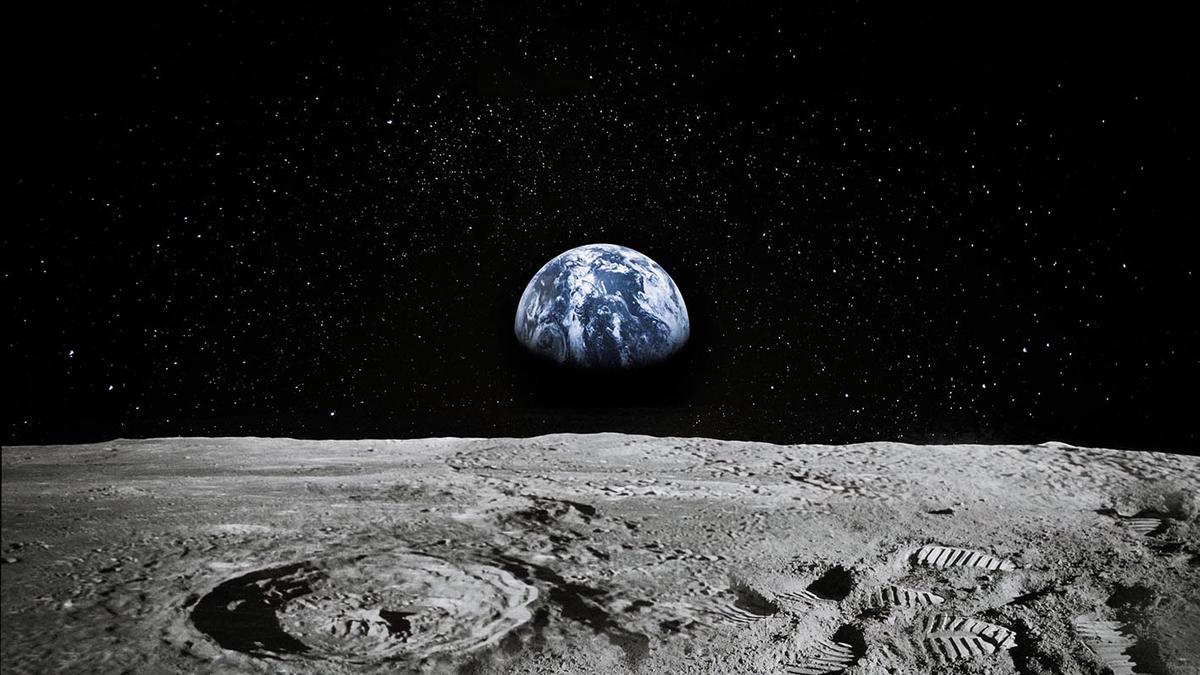
Racing for Moon real estate
The Hindu
The U.N.’s Outer Space Treaty bars private ownership in space, but that isn’t stopping India’s middle-class from buying a slice of the satellite. What’s driving this? And who will have the last laugh?
Last month, Meena Bishnoi bought an acre on the Moon. It wasn’t the thrill of buying land in space that drove her though; the nursing officer at AIIMS Jodhpur had something more significant in mind.
In early August, the 30-year-old was discussing Chandrayaan-3’s prospective landing with a friend in Ireland, when the friend suggested gifting her some land on the Moon. The two had been interested in space since their childhood, but being girls in Rajasthan meant they couldn’t pursue their interest. Bishnoi didn’t want the same happening to her pre-school daughters, Meghna and Laxita.
“I’ve always been very sensitive about the issue of the girl child,” says Bishnoi, who was married off when she was in Class XII. It was only thanks to a progressive grandfather-in-law, an advocate, that she was allowed to go back to school. “I see my two daughters as my chaand ke tukde. So, I wanted to give them a piece of the Moon — to show them what they mean to me, and that they can reach the Moon if they wanted to.”
On August 19, the two friends bought an acre in the ‘Lake of Happiness’, which is located centrally on the visible side of the Moon, from the Lunar Society of India (lunarregistry.com).
As the race to space bristles with new entrants, talk of human life beyond Earth, once unfathomable, is not uncommon. With companies such as Elon Musk’s SpaceX, Richard Branson’s Virgin Galactic and Jeff Bezos’ Blue Origin pioneering space tourism, and most recently, India’s Chandrayaan-3 lander touching down on the far side of the Moon, the lunar surface seems closer than it has ever been. And as with any new place in human history, the scramble to ‘colonise’ it has begun.
A cursory Google search is sufficient to see the motley group of organisations and websites selling land on the Moon. With names such as Lunar Embassy, Cosmic Register and Moon Estates, most of them are based abroad and offer buyers an acre for as little as $34.99 (approx. ₹2,890). The purchase often comes with a certificate of the land claim, a satellite image of the land, and mineral rights for a depth of five kilometres below the surface. It seems an affordable, if rather unbelievable, bargain. And it hasn’t cropped up under a ‘10 best cons of the century’ headline, yet.
But it begs the question, can one really buy lunar property? The rules surrounding ownership of the Moon and other bodies in outer space were laid down more than 50 years ago, with the U.N.’s Outer Space Treaty of 1967. It clearly states that outer space is “the province of all of mankind” and no country can appropriate it for its own purposes. Signed by 109 nations to date, including the U.S. and India, the treaty is often considered the Magna Carta of space legislation, and effectively bars private ownership in space. That hasn’t stopped people from trying though.


Explore 2026's wallpaper trends in India, highlighting botanicals and handmade designs that enhance modern homes with nature-inspired aesthetics.

Mercedes-Benz CLA 250+ with EQ Technology review: design, performance, range and features explained. Discover how the new electric CLA combines advanced AI, long range, fast charging and futuristic styling for the next generation of luxury EVs.

AI tool for sparrow conservation

BTS’s comeback with ‘Arirang’ marks a major global music event. When does the album release, and where can you watch their concert live stream? We have all the details

The 2026 U.S. cholesterol guidelines urge starting screening and treatment at 30 to prevent cardiovascular disease effectively.

Olam Festival 2026 in Thiruvananthapuram returns March 27-29 with 120+ vendors, music, art, and cultural zones.

A few storytellers in Thiruvananthapuram share their journeys, challenges, and evolving methods on World Storytelling Day, inspiring young minds.

76-year-old Kurian Jacob from Kerala triumphs with seven medals, including five golds, at the Open Masters Games in Abu Dhabi.

Explore the nature of the human mind as an emergent property of brain activity and complex neural interactions.

CERN's Large Hadron Collider discovers the Xi-cc-plus particle, enhancing understanding of quantum mechanics and baryon behavior.

Vibha Batra’s latest book, Spotless (Hachette India) is a novel in verse for young adults

In its first edition, the Madras Art Salon spotlights the works of journalist and artist Narayan Lakshman at The Botanical Club, a social space in the British Deputy High Commission, Chennai

Cholesterol enhances melanoma cell invasion by making nuclei squishier, revealing a potential treatment target in cancer progression.