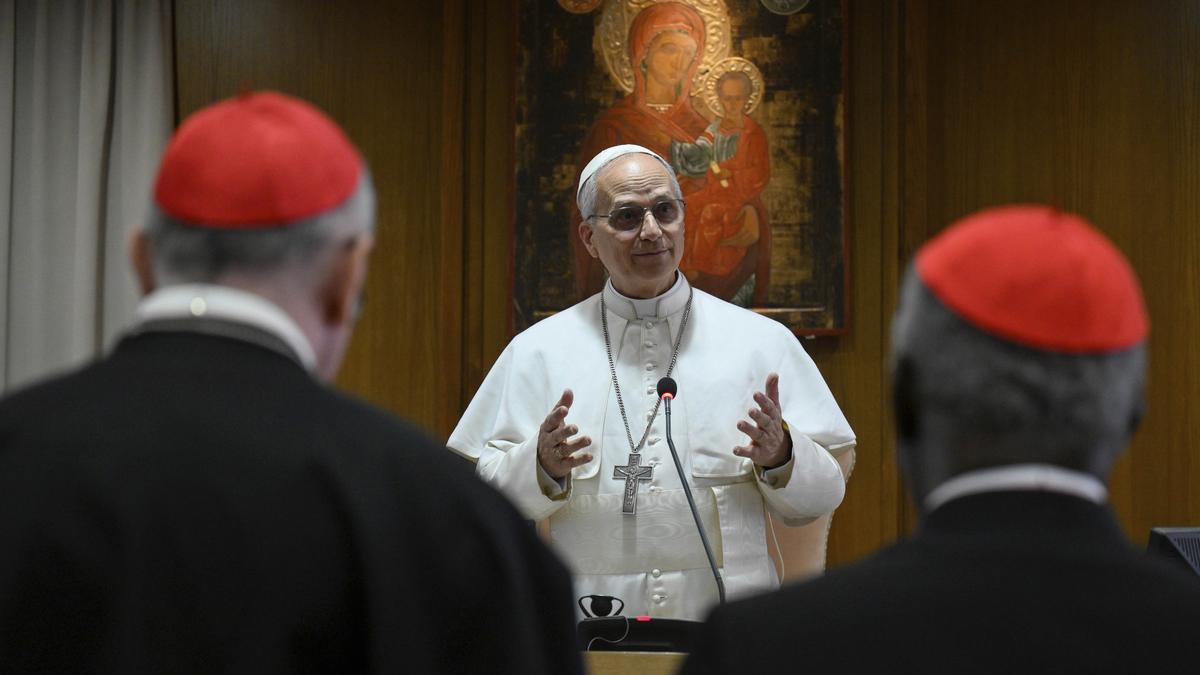
Pope Leo XIV lays out his vision and identifies AI as a main challenge for humanity
The Hindu
Pope Leo XIV vows to modernise the Catholic Church, address AI challenges, and continue Pope Francis' core priorities.
Pope Leo XIV laid out the vision of his papacy Saturday (May 10, 2025), identifying artificial intelligence as one of the most critical matters facing humanity and vowing to continue in some of the core priorities of Pope Francis.
In his first formal audience, Pope Leo repeatedly cited Francis and the Argentine pope’s own 2013 mission statement, making clear a commitment to making the Catholic Church more inclusive and attentive to the faithful and a church that looks out for the “least and rejected.”
Pope Leo, the first American pope, told the cardinals who elected him that he was fully committed to the reforms of the Second Vatican Council, the 1960s meetings that modernized the church. He identified AI as one of the main issues facing humanity, saying it poses challenges to defending human dignity, justice and labor.
In another hint of his priorities, the Vatican revealed that Pope Leo, a member of the Augustinian religious order, would retain the motto and coat of arms that he had as bishop of Chiclayo, Peru. The motto, “In Illo uno unum,” was pronounced by St. Augustine in a sermon to explain that “although we Christians are many, in the one Christ we are one.”
Pope Leo referred to AI in explaining the choice of his name: His namesake, Pope Leo XIII, was pope from 1878 to 1903 and laid the foundation for modern Catholic social thought. He did so most famously with his 1891 encyclical Rerum Novarum, which addressed workers’ rights and capitalism at the dawn of the industrial age. The late pope criticized both laissez-faire capitalism and state-centric socialism, giving shape to a distinctly Catholic vein of economic teaching.
In his remarks Saturday (May 10, 2025), Pope Leo said he identified with his predecessor, who addressed the great social question of the day posed by the industrial revolution in the encyclical.
“In our own day, the church offers everyone the treasury of its social teaching in response to another industrial revolution and to developments in the field of artificial intelligence that pose new challenges for the defense of human dignity, justice and labor,” he said.


Israel plans to occupy southern Lebanon amid escalating violence, targeting Hezbollah and causing widespread destruction and civilian casualties.

Trump reveals Secretary Hegseth was pivotal in discussing military action against Iran amid escalating tensions in the Middle East.

Iran arrests 466 individuals for online activities threatening national security amid ongoing tensions with Israel and the U.S.

China protests to Japan over a break-in at its Tokyo embassy, demanding a thorough investigation and accountability.

After securing a historic mandate in Nepal’s polls, Balendra Shah and the RSP face the task of navigating the West Asia conflict and managing ties with India, China and the U.S.

A magnitude 7.6 earthquake struck near Tonga, prompting evacuations but no tsunami warnings or immediate damage reports.

Iran launches missile attacks on Israel, rejecting Trump's negotiation claims as 'fake news,' escalating regional tensions and market volatility.

A large explosion at Valero refinery in Port Arthur, Texas, prompts shelter-in-place order for nearby residents, no injuries reported.

Kim Jong Un vows to solidify North Korea's nuclear status and labels South Korea as its "most hostile" adversary.

U.S.-Israel war on Iran LIVE: Follow The Hindu for updates on the West Asia conflict on March 24, 2026

Trump claims “very good” talks with Iran, despite Tehran’s denial, as U.S. negotiators plan potential meetings in Pakistan.

Netanyahu discusses U.S.-Israeli military gains with Trump, emphasizing commitment to protect Israel's interests amid ongoing conflicts.

Pakistan reaffirms commitment to combat terrorism as Afghan ceasefire approaches end amid rising tensions and recent casualties.